Focused Energy – Microwave Surgery

Focused Energy – Microwave Assisted Surgery

Ron Hines DVM PhD

  Portal to all of Dr. Hines’ animal health care articles

Ron Hines' Vetspace logo   Portal to donation page for devices that don’t display it

I wrote this article many years ago. Focused microwave energy never lived up to the potential that I once thought it might have, although it led to microwave ablation and ultrasound ablation of tumors which is now in common use. Today, I believe that Monoclonal antibody medications and CAR-T therapies that seek out and destroy cancer cells as well as Gene editing techniques such as CRISPR 9 offer greater precision and greater hope for us and our pets than what I describe here:  

Many years ago, I owned a veterinary hospital in a small village in the Galilee named Kiryat Tivon. 

From time to time, my neighbor, Alex Potok, would keep his radio blaring day and night. When Alex heard the DJ utter a specific string of words between tunes, he would unceremoniously walk the short distance to our water tower (the one on the upper left) and flip a the switch that set off our town’s air raid sirens. When he heard another coded phrase on the radio, he would turn it off. Every so often he forgot to fill the tank. Then the whole of the town had no water. That was the state of technology in October of 1973. The incoming missiles were gifts from Damascus, courtesy of their president, Hafez al-Assad.

During one such fusillade, a young woman roused me out of bed late one evening carrying her bloodied dog. The collie, Aphrodite, had the misfortune of being too close to the spot where one of the Katyusha rockets exploded. I sewed the dog back together. she, healed well and remained the talk and pride of our Town.  That is because katyusha rocket shrapnel is razor sharp and sterilized-hot. So, it produces wounds that heal well when they do not kill you outright. 

Fast-forward forty years to August 21, 2013. President Obama has threatened to destroy the chemical warfare missiles of Hafez’s son, Bashar al-Assad. Rather than retaliate against the USA, he threatens to lob missiles into the Galilee and points south.  

In the midst of that crisis, I received an email here in Texas from the owner of Pizza, a cat living in Rosh Ha’ayin, a village not that far from my old home. Pizza was in the midst of a uremic crisis. But why was the cat’s owner more concerned about the cat’s current predicament than her own safety? Because during the intervening 40 years, technological advances were protecting both of them. Pizza and her owner were safe under the activated Iron Dome.

Who is at fault and Who struck John aside; there is no greater motivation for innovation than the threat of one’s personal annihilation. In the near future, a technology, conceived to shield one population from the incoming missiles of another might affect you and your pet’s health as well. I call it focused energy. This adaptation defense industry’s technology to focus energy beams precisely might allow for ultra-precise incision-free surgery that has so many conceivable uses.

Dogs and cats might be spayed without an incision. Arthritic conditions could be treated and all manner of manipulations could be performed with little or no collateral damage to the patient. Perhaps ways will be found to interrupt the ovulation (heat) process and breeding potential of male dogs in ways that preserve the positive hormonal balance of your pet intact. The potential seems almost limitless.

Click on the video below if you would like to know more.

Dear reader, Besides your donations, visitors to the products that Google and others display on my website help me defray the cost of keeping my articles on the Web – and keeping you informed. As you know, sites like mine that intentionally use no AI texts or conclusions and are not written to Sell You Things are getting very hard to find, Best wishes, Ron Hines (2nd Chance)

All Of Dr. Hines’ Guides On Wildlife Rehabilitation

All Of Dr. Hines’ Guides On Wildlife Rehabilitation

  Portal to all of Dr. Hines’ animal health care articles Ron Hines' Vetspace logo   Portal to donation page for devices that don’t display it  

Dear Reader,

These articles are dynamic. I write, add and correct them between caring for injured animals, fielding the Texas Parks & Wildlife answer-line and dealing with online inquiries from dog and cat owners. There is usually more than one road leading to the same destination – a successful release back into the wild. If you have questions, if you want to make suggestions, if you would like to correct errors (we all make some) or if you just report what works for you or chat, email me. 

   Should I Become A Licensed Wildlife Rehabilitator? Is It The Right Thing For Me? 

  A Guide To Basic Hygiene And Sanitation

   A Guide To Basic And Specialized Supplies

   A Guide To Cages And Pens

  A Guide To Nutrition

   Should I Also Give Vitamins And If So, Which Ones?   

   Some Signs Of A Wildlife Vitamin Deficiency

   A Guide To Parasite Control

   A Guide To Mites And Lice And How To Eliminate Them

   A Guide To Medications

    Dealing With Dehydration & Heatstroke  

    Repairing Cracked Turtles & Tortoises 

   Feeding Orphaned Wild Doves & Pigeons?

  Raising Nightjars Nighthawks And Whip-poor-wills

    A Guide To Raising Killdeer And Plovers

   How Fast Should Baby Birds Grow?

   How To Fix Spraddle Leg

  What Are Feather Stress Bars?

   Bird Wrist And Coracoid Injuries And How I Treat Them

    Leg And Wing Fractures In Wild Birds And How I Repair Them

   Broken Legs In Song Birds And How I Repair Them  

  Repairing Bird Wing Injuries With Tape Support Or Cotton Twine And Glue

   What To Do For Birds That Can’t Or Won’t Eat  

   TomCat™ And Other Rodent Glue Traps And Wildlife – What To Do When The Two Of Them Meet

   Gout In Birds

   Robins Grow Up

    Salmonella In Birds

    What Odors Can Birds Smell? What Flavors Can Birds Taste? 

     Rodent & Rabbit Tooth Problems

  What Happens When Birds Molt?

   Collisions, Vision Problems And Eyeworms

   What Vaccinations Do Wild Animals Require? 

    The Wildlife Disease Experts 

   I Found A Baby Bird – What Should I Do?  Rescuing Them, Raising Them, Their Food & Care       

   Caring For Orphaned Cottontail Rabbits 

   Caring For Orphan Fox Squirrels

  Caring For Orphan Flying Squirrels

   Caring For Orphaned Baby Opossums

    Should I Have My Pet Opossum Spayed Or Neutered?

    Murine Typhus And Opossum Fleas 

   Caring For Orphaned Raccoons   

   What Is Baylisascaris, And Why Do I Need To Know?

   Cardiomyopathy In Opossums Dear reader, Besides your donations, visitors to the products that Google and others display on my website help me defray the cost of keeping my articles on the Web – and you informed. As you know, sites like mine that intentionally use no AI and are not written to Sell You Things are getting very hard to find, Best wishes, Ron Hines (2nd Chance)

Solensia® A New Approach To Arthritis Pain In Cats

Solensia® A New Approach To Arthritis Pain In Cats

Ron Hines DVM PhD

  Portal to all of Dr. Hines’ animal health care articles

Ron Hines' Vetspace logo   Portal to donation page for devices that don’t display it

   Solensia® Cat Owner Feedback Page

 The Special Needs Of Older Cats

   What To Do When Your Cat Is In Pain

When Zoetis was still the animal medications’ division of Pfizer Drug Company, they purchased three patents for monoclonal antibodies that targeted a particular messenger protein involved in nerve growth and nerve signal transmission, nerve growth factor (NGF). One of them, tanezumab had been bioengineered to be used as a treatment to relieve arthritis pain in humans. Another, bedinvetmab (Librela®) was bioengineered to be accepted by dogs and a third one, frunevetmab  (Solensia®) had been bioengineered to be acceptable for cats.

You see – all mAb medications, when they are scrutinized by your or your pet’s immune system, must be recognized as not being something foreign to the body. If the immune system’s decision is that they are foreign, it will attempt to destroy them as quickly as possible. You can think of it as being required to be fluently in the language of the country you are visiting in order not to be immediately deported. All the current monoclonal anybody drugs of today, for humans or animals begin their genesis in a mouse. Then every protein related specifically to mice is removed and replaced by proteins only found in the species for which the drug is intended to be used. The product is then called a “chimeric” antibody.

What Happened To The One Pfizer Designed To Treat Arthritic Pain In Humans?

Pfizer and their shareholders had great hopes that tanezumab (as a human arthritis pain reliever) would be a blockbuster money earner for the Company. First off, as best we know, mAb s are not addictive – which is the major drawback of narcotics. Second, mAb s would be extremely hard (or impossible) to overdose on in the way narcotic painkillers are.

However, a worrisome problem occurred in the later stages of human clinical trials. (read here)  Significantly more people who received the periodic drug injection needed knee or hip replacements than those that did not receive the drug. So, the FDA refused to grant Pfizer approval to sell the drug. The EMA did likewise.

The incidence of those unwanted events increased as the dose got higher and in the human patients who received the drug for more than 90 days. Those side effects were worse in the people who continued to take NSAIDs during the clinical trial. Local itching at the injection site, dermatitis, and hair loss, though not nearly as worrisome, were also commonly reported side effects.

Although those government agencies refused to approve the sale of the “humanized” product, both the FDA and the EMA approved Zoetis’ request to market their “felinized” product, Solensia®. Their “caninized” product, Librela® (bedinvetmab) was also approved by the EMA for sale in the European Union – but as of writing this article in March of 2022, I do not believe that Librela®  has been approved yet in North America.

Are The Cat Products Safe For Long-Term Use In My Cat?

The short answer to that is no one knows.

I am not aware of any studies that followed cats receiving Solensia® for more than a few months. If Zoetis ran any studies, they were not published.

 Solensia® reduces the amount of nerve growth factor (NGF)  in your cat’s body. Nerve growth factor in mature cats is involved in pain transmission and nerve health. During a cat’s growth from conception to maturity, NGF helps guide nerves from the brain to their appropriate final locations and assists in removing unnecessary cells as they occur (apoptosis). Figuring that out earned one lady a Nobel Prize. (read here)

 Do Cat’s Need Better Pain Control Options?

Yes

Dogs handle oral non-steroidal anti-inflammatory drugs (NSAID) like carprofen  (Rimadyl®), firocoxib  (Previcox®) and meloxicam  (Metacam®)  relatively well. When side effects do occur in dogs, they are usually due to gastrointestinal bleeding. But the toxic effects of NSAIDs in cats often relate to kidney damage. (read here) Cats can only be given certain NSAIDs (e.g., meloxicam) – and, when attempted, in very low doses or for very short periods. How even those very low doses, when given long-term affect your cat’s kidneys is unknown. Cats in short term acute pain appear to respond well to fentanyl patches. But the DEA discourages their use in veterinary medicine.

Corticosteroid drugs like prednisolone also decrease the pain and inflammation of arthritis. But they too have significant side effects when given long-term to cats as well as to people. (read here)  The most common one in cats is the generation of diabetes. (read here) The effectiveness of tramadol and gabapentin in cats, dogs and humans in combating arthritis pain is debatable.

Where Can I Find Unbiased Information Regarding Solensia®?

Try the Cat Owner Solensia Feedback Page

I will begin with a warning that people whose animals experience unexpected side effects from a medication tend to report them to me more frequently than those that were satisfied with their experience using a drug. That is the case with human drugs as well. You can see that in my webpage that concerns another Zoetis mAb product, Cytopoint. However, the Solensia® Cat Owner Feedback Page should be a good place to start.

Other unbiased online sources will be harder for you to find. Perhaps social media – although I myself have no trust in posts and blogs. That is because the majority of the information you find online and in other media will be generated by the pharmaceutical companies themselves and their downstream sellers intent on selling their products to you. You might even find them at the bottom of this webpage. Your clicking on those ads and your donations are what keep my website online. 

Promotional material will always emphasize the positive and de-emphasize the negative. The only pet medications that have zero potential to cause side effects are the ones that don’t have the potential to have positive health benefits either.

Zoetis is quite generous in funding veterinary college research studies that find their products beneficial. Long ago, veterinary colleges themselves funded their medication research. However, the product manufacturers themselves fund most new medication studies these days. There is no doubt that purse string control influences study outcomes. (read here,   here  &  here)

What About The Cat Owner Surveys That Zoetis Conducted?

Zoetis reported that 77% of cat owners saw a reduction in signs of pain when their cats were treated monthly with Solensia® (in a 3-month-long study). And that 12.9% of the cats that received Solensia® were more active during the first three weeks after their first injection. That difference between the medicated and non-medicated group declined over time. The evaluation was said to have been based on   “subjective” (owner’s opinion?) as well as “objective” data (activity monitors?).

Owner opinion has been found to be an unreliable way to measure a drug’s effectiveness (In the same experiment, 67% of cat owners whose cats received the placebo injection thought their cat had improved too). It’s just human nature to try to maintain a positive attitude and hope for the best. (read here  &  here) Activity monitors like the one the cat at the top of this page is wearing around its neck are really the only valid way to judge the effectiveness of any pain-control medication given to cats. (read here)

Doubly so because your cat can’t talk. The EMA website reports a study of Solensia® in 182 client-owned cats who received the drug and 93 cats that received a placebo injection instead. After several months of injections, 66.7% of the cat owners whose cats received Solensia® thought their cat was more active and sociable than before. However, 52.06% of the owners of cats that received the placebo injection also reported that their cat was more active and sociable than before. By the third shot, there was no statistical difference in the opinions of the owners of cats that received Solensia® and those that received the placebo. Another problem is that veterinarians have no scientific way to measure arthritic pain level in your cat. Just like you, your cat can become reluctant to move for a plethora (=a very large number) of reasons that have nothing to do with its joints.

Joint x-rays are unreliable indicators of pain. Studies have indicated that only ~50% of people over the age of 65 that have x-ray evidence of arthritic knee joint changes experience any pain. And those that have joint pain do not necessarily have x-ray evidence of arthritis.  As for hip pain, only 9.1 – 15.6% of people that experienced hip pain had any x-ray evidence of hip arthritis. And of those that did have evidence of hip arthritis, only 20% reported frequent hip pain.

I believe that it will only be after Solensia® has been in widespread use in cats for a year or two that pet owners and veterinarians alike will be able to decide how effective and safe this medication actually is.  I do hope with all my heart that it will be both effective and safe for the cats that really need it. The acute pain that accompanies an injury, a torn ligament, muscle strains, car accident or surgery is real. But pain in those cases has positives as well as negative effects. Pain decreases motion, and that reluctance to move and inactivity gives your cat’s body a chance to heal.    

 More About The Product

Please read the entire Solensia® label online because there are more warnings I did not mention and because the label directions may have changed by the time you read this article.

 Solensia® comes in 1 ml vials. Each contains 7 mg of frunevetmab solution. It is to be given by subcutaneous injection. Monoclonal antibody drug molecules like Solensia® are too large to be absorbed through the intestine intact.

Not mentioned by the Company, but on my mind is that injections given to cats are best given in the lower leg or tail because cats have been known to develop injection site tumors. (read here). Reading from the EMA website, the suggested dose is 1 – 2.8 mg/kg of body weight, given once a month. So at the time I am writing this article, cats 7 kg (15.4 lbs) or less would get one vial and cats 7 – 14 kg (< 30.8 lbs) would get two vials – once a month. It took 6.2 days for the level of the drug in their blood to peak after the cat’s first injection.  That might mean that you need to be patient before making a judgement. But with repeated monthly injections, the cat’s frunevetmab blood levels became constant. The Company suggests that Solensia® not be given to cats that are still growing (less than 12 months old) or that weigh less than 2.5 kg (5.5 lbs). I mentioned earlier that nerve growth hormone (NGF) which Solensia® targets, was necessary for proper nerve development. 

Old cats often have kidney health issues. (read here) The EMA recommends that your veterinarian consider that and dispense the drug on a risk-to-benefit basis. We do not know how or if lowering your cat’s NGF level affects its kidneys. But there is an interplay. (read here)

There are other questions to be answered regarding the long-term benefit of Solensia® in reliving chronic arthritis pain in cats. When laboratory rats were given injections of mouse nerve growth factor in an attempt to produce antibodies against NGF similar to what Solensia® does, the rats did produce anti-NGF antibodies. However, that had deleterious effects throughout their nervous system.  (read here) That study was performed long ago. Perhaps it was accurate; perhaps it wasn’t. Perhaps Zoetis keeps its recommended monthly dose low enough to avoid the problem.

Another unknown is if cats receiving an mAb such as Solensia® eventually, after multiple monthly injections, recognize that it is foreign to their body and destroy it. If so, will the drug lose its effectiveness over time? There are instances of that occurring, it is called loss of response or LOR. (read about that here)

Dear reader, Besides your donations, visitors to the products that Google and others display on my website help me defray the cost of keeping my articles on the Web – and you informed. As you know, sites like mine that intentionally use no AI, no SEO, and are not written to Sell You Things are getting harder and harder to find, Best wishes, Ron Hines

The Red-Crowned Parrots Of Brownsville Fight For Their Citizenship

Help The Red-Crowned Parrots Of Brownsville Texas Fight For Their Citizenship

Ron Hines DVM PhD

My house sits on an old bend of the Rio Grande River – one the River abandoned years ago, having found a more direct path to the sea. We call these river bend remnants resacas.

I bought the property from the Nature Conservancy. The Conservancy had judged this parcel too small for their broader mission. Every morning, the red-crowned parrots nesting in a palm tree across the resaca cheer me with their calls, their comings and their goings. They have done so since I was a boy. I spend my days now caring for the injured wildlife that Texas Parks & Wildlife and the US Fish & Wildlife Service send me. I am the only veterinarian licensed by the USFWS & TPW to do so in my six county area.

Occasionally, local wild red-crowned parrots and green conures are brought to me by the game wardens.   It is a Hispanoamérican tradition from the distant past to attempt to catch and confine most any colorful bird to a cage. In the process some get injured. When they are well again, I turn them loose.

However, the game wardens, the US Fish & Wildlife Service and I are at a disadvantage because our local parrots are officially considered feral, that is, escaped pets – not native wildlife. That is a fallacy, convenient to some, a burden to others. I wrote this article to give the red-crowned parrots of the Texas Rio Grande Valley a chance to tell their side of the story. And while I am at it, I am going to tell you a bit about the trafficking that has driven many wild parrots close to extinction and about politics and special interests with their thumbs on the scale when decisions to protect them need to be made.  It’s a story that will affect the lives of the parrots nesting in the palm tree across my resaca  

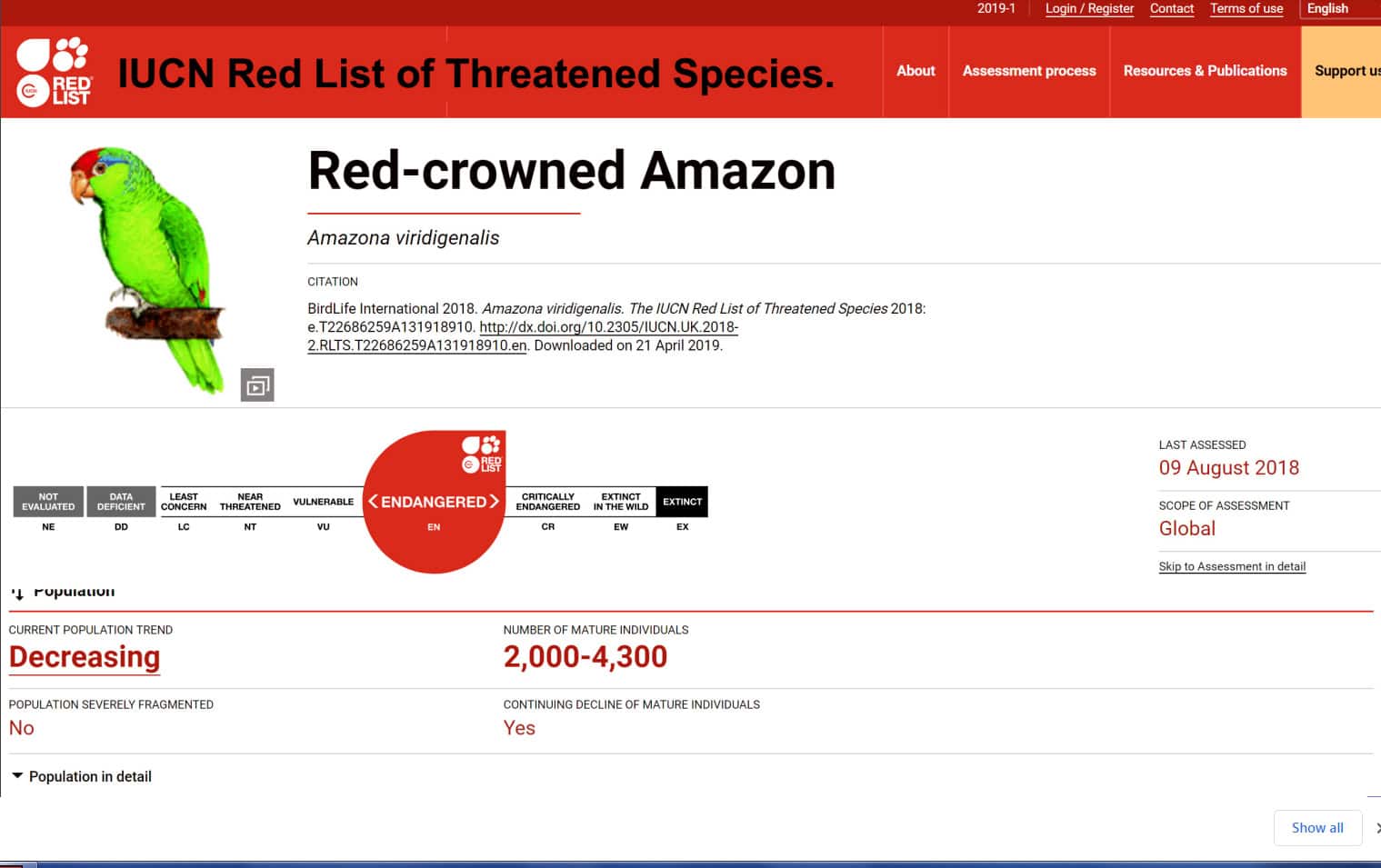
Rio Grande Valley park rangers estimate that there were 700-750 red-crowned parrots living between Brownsville and McAllen Texas in 2019. In 2026, there are undoubtedly many more. But even here in the United States, they and their smaller coenure relatives are subject to baby and adult robbery by tree trimmers (jardineros). To them, there bright green plumage signifies easy money.  Red-crowned parrots can only be counted accurately in the fall and winter months when they form large flocks. The tendency of most observers is to underestimate the number of parrots in a large flocks and, due to the nomadic tendency of red-crowned amazon parrots, whole flocks can be missed.

The Long History Of Red-crowned Parrots In The Rio Grande Valley Of Texas:

When I was a boy in the 1950s, red-crowned parrots were common in Brownsville, Texas (my observations and those of my boyhood friends, Don Eddie Moore and Clark Owen). The grandmother of another close friend of mine, “Miss Bliss”, also told me in the 1950s that the same kind of parrots where here, wild when she was a small child. Mrs. Bertha Lieck/Bliss, her real name,  was born in 1901 . In the 1950s, these parrots tended to hang out in three locations in Brownsville – all of them with tall pecan trees. One hangout was near the corner of Morningside Road and Southmost Road. Another was near the old Guadalupe Church on 13th Street and the last was near my  house at the corner of Honeydale  and Boca Chica Roads. Miraculously, the Honeydale Road location is still a preferred location to observe these wild red-crowned parrots in 2019. Large numbers of parrots were also present in Brownsville in 1885 – so many so that the news of them reached newspapers far and wide.        

There is good reason why reports of these parrots in the RGV had been sporadic. Unlike most parrots, red-crowned parrots are highly nomadic because they are genetically programmed to live along the few rivers that pass through traditionally arid regions. It is a necessary genetic trait they developed overt eons to prosper in a region where rains are unreliable and where occasional hard winter freezes occur. Both make food sources periodically scarce for them and induce them to migrate. Similar trates occure in the thick billed parrots of Mexico’s pine treee regions. Audubon saw them in El Passo in 1827.  Logging disrupted their roads north. The last ones were seen in the USA during the Gold Rush.

Rio Grande Valley Red-crowned parrots are capable of exceedingly long flights and migrations to find sufficient food. When they do, they have never shown respect for national boundaries. Since the 1960s, food sources and safety have been greater in the United States portion of their range. A professor at the University of Arkansas’s tree ring laboratory, Dr. David Stahle, was kind enough to prepared a drought index for me for the years 1751 to 2012 centered on the Mexican portion of the range of the red-crowned parrot . You can view it here: It is during those minus 3 and minus 4 drought events that the red-crowned parrots look for greener pastures. You can see that the 1960s began a number of severe (-3 to –4) droughts. That, plus simultaneous deforestation occurring in the Mexican state of Tamaulipas, likely accounted for the increase in parrot numbers in Brownsville at the time. You will also notice that a severe drought accompanied the 1885 incident when large numbers of parrots were reported in the Rio Grande Valley. The geographic ranges of all wildlife are dynamic. Wildlife ranges expand, contract and shift as climatic conditions and other factors dictate; not as bureaucrats dictate. Governments tend to think in terms of political borders, short periods of time (mere nanoseconds on the geological time scale), and rigid one-size-fits-all rules. Just because red-crowned parrots are at times sporadic in the Rio Grande Valley does not make this area any less a part of their native range.

In 2008 the Environmental Law Clinic of the University of Denver, representing Friends of Animals, sued the USFWS seeking to protect a number of endangered parrots. Among them were the red-crowned parrot of the Rio Grande Valley and Mexico. As a result of that lawsuit, the USFWS undertook a detailed study of the red-crowned parrots and determined that the species was indeed threatened with extinction. At the same time the USFWS made the determination that the Rio Grande Valley is the northernmost part of the parrot’s natural range and that they would be protected here as well under the Endangered Species Act. 

However, in 2019 the USFWS reneged on that promise and produced a new map that conveniently and arbitrarily carves out the tiny portion of the parrot’s United States range in the Rio Grande Valley. Here they label all parrots as escaped pets (“feral”). There is no evidence to support that decision and the theory does not hold water. In the 1950s and 1960s, the time RGV red-crowned parrot numbers began rising, parrots smuggled into South Texas were almost exclusively double yellow-head parrots (DYH). DYH parrots were more desirable pets than red-crowned parrots because of their superior talking ability. Throughout the 1960s, DYH parrots were still relatively common and easy to trap in Mexico. There was no market in Brownsville or across the river in Matamoros for red-crowned parrots. Everyone here knew that the red-crowns’ talking abilities was inferior to that of the double yellow head parrots and that red-crowned parrots had a tendency to scream. I spent much of my time in Matamoros, Mexico and Ciudad Victoria in those days. In the bird shops of Mercado Juarez, and elsewhere, I never saw red-crowned parrots offered.

Why Did The USFWS Arbitrarily Change Their Position?

The reason the USFWS now refuses to admit that red-crowned parrots are native to Texas has nothing to do with scientific research, the welfare of the species, history or common sense. What it has a lot to do with is funding priorities, sweetheart deals with research scientists, and advancement of careers. There is also an element of Mexican nationalism and bowing to the desires of pet parrot breeders – a consortium which fears that recognition of the red-crowned parrots as bona fide US residents will lead to restrictions on their ownership and monetarisation. 

If you read the Endangered  Species Act, you will find that it is prohibited to “take” (defined by the ESA as harm, harass, kill, injure, etc.) any listed bird within the United States. Experiments, such of those of the Schuboat Group at Texas A&M University on our red-crowned parrots would be subject to heightened scrutiny if the birds had legal status in the United States. They actively lobby to prevent the USFWS from extending protection to parrots in the United States because it restricts commerce in these birds. As I write, in 2019, the Schuboat Group has personnel in the Rio Grande Valley trapping and placing radio collars on these parrots. They trap the parrots as they return to their nest cavities to feed their young and trap them at feeding stations. All that might have to halt if the parrots gained protective status under the Endangered Species Act. That upsets me greatly. I abhore this sort of cruelty to animals. 

Trapping is very traumatic to these intelligent birds. Parrots do not return to feed where their kin have been trapped. Parents abandon nests where they were traumatized. The Schuboat Group also has designs on the Rio Grande Valley’s parrots for restocking attempts in Mexico. Experts in bird flight know that if the parrots of the RGV wanted to fly back to Mexico they could do so at any time. We don’t need traumatic studies to track their movements. Many believe that all races of  parrots in the Caribbean islands are descended from the  white-fronted  parrots of Yucatan which also nest in Tamaulipas in the same trees used by red-crowned parrots. They had no problem flying across the 135 miles that separate the Yucatan from Cuba. 

Using the RGV parrots in poorly thought out attempts to reestablish them in Mexico are unlikely to be any more successful that a similar 2012 attempt with thick-billed parrots in Arizona.

and for the same reasons. The reason there are fewer red-crowned parrots remaining in Mexico today is habitat loss, poaching and drought. It will be an enjoyable diversion for the A&M folks involved in such a project; but no number of the Valley’s parrots released into a decimated Mexican environment are going to bring them back. Incidentally, thick-billed parrots were deemed native to Arizona by the USFWS based on evidence considerably more flimsy than the evidence USFWS is using today to deny the red-crowned parrots of the RGV native status.

The FWS/TPW most recent study was done hush hush. They were secretive because they knew that the “conclusions” they planned to reach before the “study” was even begun would not sit well with most residents of the RGV. Therefore, experts, such as Dr. Stan Casto and the Audubon Society were not consulted or tipped off that they intended to downgrade these parrot’s legitimacy in the RGV. They did not tip off or ask for input from the members of the GBIF  or the IUCN who had developed rage maps for the birds themselves. Dr. Casto and emeinent Texas ornithologis whose research the entire USFWS and TPW group were or should have been aware of was left unmentioned in their study declaring the red crowned amazon parrot an exotic pest. I am the only USFWS-licensed wild bird rehabilitator in the Rio Grande Valley. Neither myself nor my handlers, Katie Wade-Mathews and Eldon Brown in the USFWS Albuquerque office were tipped off either. The 2016 historic Mexican range maps of Dr. Monterrubio-Rico that shows the birds historic range reaching Matamoros on the US border was never mentioned. I find this quite bizarre in what purports to be an open-minded scientific review. The actual reason was that the USFWS at that time was under heavy political, farm and ranch and commercial pressure not to declare any more species of wildlife to be indigenous to the United States. (

There is another very important reason. The current Administration in Washington is systematically weakening USFWS protection of wild birds throughout America, not just here in the RGV.  The Audubon Society is of the opinion that longstanding USFWS policies that protect vulnerable birds are currently being “gutted”.    With their federal protection gone, it could have been anticipated that groups with different motivations, would see the red-crowned parrots of the RGV as fair game.    the USFWS also downgraded the parrot’s threatened stathttps://vetspace.2ndchance.info/redhead-imageMotivation.jpgus in Mexico this year, stating that the parrot’s population there is beginning to rebound. I know of no evidence of that and they give none. What there is evidence of is more reported sighting, but that is just due to more eyes in the field counting the same birds.

The USFWS’ Failure To Recognize The Effects Of Climate Change On Range And Species Survival

Using the RGV parrot population in an attempt to restock the bird’s more southern range with Texas-born red-crown parrots, as a storehouse and “future insurance policy” for Mexico as some of these people propose relies on a steady climate that emulated the climate of northeastern Mexico over the last 150 years. The USFWS and the Schuboat Group seems unaware that the climate of Northern Mexico is changing and will continue to change. They fail to understand that the species hope for survival depends more on the protection of the Rio Grande Valley flocks than it does on the birds remaining in Mexico.  The state of Tamaulipas  is becoming dryer and hotter – both of which decrease soil moisture and wild sources of food for the parrots. At best, these birds will be forced to feed on agricultural grains and fruits putting them in conflict with the human inhabitants of the region. What is currently occurring in Bolivia could well be a prelude to what would occur in Mexico if such a poorly thought out transfer was attempted. No climatologists are listed as having been consulted when preparing the 2019 USFWS study. These parrots evolved over millennia to adapt their range to the severe droughts that have always plagued northeastern Mexico. That appears to have never been considered by the USFWS. (ask me for redhead-Stahle2016 & redhead-Marvel2019)

Reduced Room In The Mexican Portion Of These Parrot’s Range Remains Unappreciated By The USFWS

In making their decisions, the USFWS failed to appreciate that the sustainability of red-crowned amazon parrot populations in the Mexican portion of their range has been greatly reduced by human population growth, deforestation, modern agricultural practices and nest robbing. There is no room for sizable numbers of these parrots in the majority of their Mexican range any more. In the late 1960s, an acquaintance of mine, Pete M., built a pole hut near the mountains along the banks of the Sabinas River not far from the town of Llera. The Sabinas River at that time was near the heart of the red-crowned parrot’s Mexican range. They bred and roosted in the tops of the tall Montezuma cypress that lined both banks of the river – much as they lined the lower Rio Grande River in the 1700s. The parrots commuted to the  mountains every morning to feed. During breeding season, cavities in the crotches of the cypress served as their nests. In the village of El Ciela, there lived a man locally nicknamed Polo Cotorro. He was “short, muscular, poor as dirt”, and a frequent visitor to the village cantina. During parrot breeding season, he would arrive with his 8-year old son, a sack and some rope. First he tied a rock to the end of a light rope. He threw that over the lowest cypress branches and let it drop back to the ground. Then he tied a larger rope to the end and pulled that up and over the branch. Once secured, he climbed, hand-over-hand, up the rope “like a monkey”. When he got as high as the parrot’s nest, he pitched the chicks down to his son on the ground. Pete M. returned again between 1980 and 1983. By then, hardly any parrots remained. The locals attributed that to Polo Cotorro. Mexico is full of Polo Cotorro ‘s, impoverished peasants making ends meet when they can day by day. A grueling task. Those involved in the illegal trapping of parrots in Mexico will not give up their livelihood without strong resistance. They have been know to mob Profepa officials (Mexican wildlife police) when they dared to enter the Sonora Bird Market in Mexico City. 

Organized crime in Mexico has also found the parrot trade lucrative. Not only does Mexico City serve as a hub for its illegally captured Mexican parrots, it serves as hub for parrots illegally captured throughout the world.    So the future of Red-crowned parrots in Mexico is currently quite bleak. By the early 1980s, Tamaulipas and the surrounding Mexican states could not keep up with Mexican and US demands for yellow-head parrot chicks. About that time red-crowned parrot chicks started showing up in the border cities of Matamoros, Nuevo Laredo and Ciudad Acuña and at my animal hospital in San Antonio, Texas with their red head feathers bleached yellow. Word was that there was a fabrica in Ciudad Mante  that specialized in the procedure. Some came to my office blinded by the harsh chemicals used in the process; others with skin burns that persisted the rest of the unfortunate animal’s life. Today the Rio Sabinas is just another tourist destination for the folks of Ciudad Victoria, the capital of the state of Tamaulipas. Here are some photos of the river as it looks in 2019: The calls of the parrots are long gone– not in the memories of a single child playing in the river today. The Tamaulipan rivers of my youth, the San Rafael, Purificación and Corona, are silent as well. Only stands of the cypress remain. The populations of the cities of Tamaulipas state have ballooned over the years. The parrot’s native food supply is greatly reduced, nesting sites have been destroyed, but the desire for parrots as household pets remains. The Sabinas River, like all the rivers critical to the parrots survival, is now the source of water for the orchards that have replaced native growth. View those orchards as the exist along the Sabinas today:      I believe that it is quite unrealistic for the USFWS to believe that the parrots of the RGV range have a future in such an inhospitable environment. What do you think the Mexican orchard owners are going to do if flocks of hungry parrots descend on their orchards?  They will do the same thing that citrus grove owners still do when woodpeckers ruin their fruit in the Rio Grande Valley. The going bounty for shooting parrots in the mango orchards south of Ciudad Victoria in the 1960s was twenty-five cents/bird (per Ed Hockaday2019). Let Mexico return things to as they once were and sufficient parrots from the American side of the Rio Grande River will fly back on their own. If that is impossible, find joy in the fact that they still prosper and are safe in the Rio Grande Valley of Texas. Large tree-cavity nesters are particularly vulnerable to extinction. The imperial woodpecker, is already extinct or on its way to extinction in its Mexican range. 

It is not only habitat destruction in Mexico that accounts for the decision of these parrots to move to the northern extremity of their range in the Rio Grande Valley of Texas. Cultural and political issues farther south account for that too.  Capturing parrots is deeply rooted in the Hispanoamérican culture of Mexico – going back at least to the time of the Aztec empire. The same issues face the parrots that dwell farther south in Central and South America. I have been immersed in Mexican culture most of my life. Two of my children were born in Matamoros. There is nothing that represents a blessed small town Mexican home more than a small statue of the Virgin of Guadalupe and a parrot in a small cage hanging from a beam on the front porch. My wife fondly recalls the cotorro whose cage hung from her grandma’s porch on Jackson St. in central Brownsville. That is unlikely to change because some “bolillo” from Monterrey, representative from Texas A&M’s Schuboat Lab or UTRGV ornithological professor tells them that doing so threatens the survival of these parrots. Many people in the USA are not aware that only 4 – 14% of the parrots captured in Mexico end up smuggled into the United States; the rest feed this Mexican desire for pet parrots. To be fair, there are groups in Mexico, teamed with Defenders Of Wildlife, who are attempting to change those attitudes in future generations.

There is also the factor of  nationalism. Why should Mexico share with the United States a species so long associated only with Mexico?  Besides, if red-crowned parrots of the Rio Grande Valley were acknowledged as rightfully belonging here, much of the TPW and USFWS funds now allocated to “restoration” and “study projects” in Mexico would dry up. There are substantial lobbying effort by groups on both sides of the Border who would be negatively effected if the USFWS officially acknowledged that the red-crowned parrot’s range extended into the United States.

So these parrots are entangled in a deep bureaucratic morass. The USFWS blames the parrot’s predicament on the Migratory Bird treaty Act (MBTA). However I believe that they are just using provisions 65848 pt-III as a convenient excuse when it comes to denying the RGV parrots their deserved protection. 

There was a time in the late 1970s when the US Department of Agriculture was seriously considering exterminating the red-crowned parrots of the Rio Grande Valley as foreign invasive pests – a threat to agriculture. That mindset among bureaucrats persists. Only official acknowledgment by the USFWS that the red-crowned parrots are a native species of the RGV would protect them from various government entities.

 No Validity To The USFWS’ Escaped Pet/Feral Birds Theory

That theory does not hold water. At the same time that red-crowned parrot numbers began to increase in the RGV, green conure numbers began to increase too. Conures were never a high volume smuggled bird. The heads of a few were dyed yellow and sold to unsuspecting tourists; but the fact that their numbers increased at the same time as red-crowned parrots increased is evidence that it was habitat destruction and climatic changes in Mexico that encouraged the parrots to move to the far northern portions of their range in the US. Many more of the red-crowned parrots and green conures ended up in San Antonio. Undoubtedly, many more escaped there than in the RGV.  Yet wild flocks of red-crowned parrots and green parakeets never established flocks north of the RGV. What did establish flocks in San Antonio were monk parakeets and nanday conures originating in Argentina and Bolivia. So it was not cold weather that prevented escaped red-crowned parrots and green parakeets from establishing flocks farther north.

The USFWS’ unwillingness to accept red-crowned parrots as native residents, rests entirely on urban legends propagated by the AFA, about large numbers of red-crowned parrots escaping from boxes being ferried across the Rio Grande River. Red-crowned amazon parrots were considered a poor choice as pets on both sides of the River because of their tendency to scream annoyingly – particularly in the mornings and evenings and when bored. They were also mediocre talkers. Yet the number of red-crowned parrots in the RGV began to rise twenty years before there were sufficiently fewer smuggled double-yellow headed parrots chicks to meet the US demand for pet parrots. Young boys waded the Rio Grande at the old PUB water purification facility in Riverside and sold the baby yellow-headed parrots throughout walking distance in the residential neighborhoods of Brownsville.   They were teenage street children who took the Transportes del Norte bus line up from Tampico, Veracruz and, occasionally, points farther south. They slept in an open courtyard off of Herrera St. in Matamoros, not far from the veterinary office of a friend of mine, Dr. Gonzalez Barron. I knew a number of the teenagers by name. They liked to show me the parrots they had brought. Never was a red-crowned parrot among them, only DYPs and an occasional Chiapas nape.

I grew up in Brownsville, Texas. I knew the major individuals involved in the legal, quasi-legal and illegal parrot trade on both sides of the River as far south as Ciudad Victoria. During the time that USDA-licensed parrot quarantine sheds were operating in Brownsville, I surgically sexed and tattooed most of the mature parrots that passed through them. At the time, only three people knew how to perform the procedure: Ken Fletcher at the San Antonio zoo, Michael Coffee, a San Benito OBGYN and myself. Many smuggled parrots purchased in Ciudad Acuña, Reynosa and Matamoros eventually passed through my San Antonio facility, Castle West Animal Hospital. So I knew most of the AFA members that lived there well. In the 1980s, they established a meeting point at a McDonalds on the south side of San Antonio where they exchanged cash for the mature, trapped, red-crowned and red-lored parrots then being smuggled into Brownsville by a family of shrimp boat owners, the Roussetts. That particular Roussett family lived not far from my parent’s house.  My acquaintances, Joe Ramos, undercover USFWS RGV agent and Alex Hazacheck of their San Antonio USFWS office knew about the smuggling operation as well. None of these players, including the Roussetts ever told me about crates of parrots being released because of the approach of Border Patrol agents along the River. These mature wild parrots (“broncos”) were offloaded at the Brownsville Shrimp Basin, not floated across the River. The McDonald’s transfer point only dried up when Agent Ramos helped brake up the ring. (ref) I have no doubt that released red-crown parrots did occasionally join the local RGV parrot flocks and survived; but that is not how our RGV flocks came to be. As many trapped mature A. autumnalis parrots were smuggled through Brownsville as red-crowned parrots. If escapees accounted for our current red-crown parrot flocks we would have flocks of red-lored amazons flying in the RGV as well.

It wasn’t until the hard freezes of the 1980s that killed many of our local palm trees that the Rio Grande Valley parrots found adequate numbers of nesting cavities to reproduce efficiently. Parrots are incapable of making their own tree cavity nests from scratch. But with some parrot modifications, the woodpeckers of the Valley excavate the holes for them.

Lapses In Residency Reports Do Not Abrogate the USFWS’ Duty to Protect Native Red-crowned Parrots In The Rio Grande Valley Of Texas

It is true that during the last 160 years, red-crowned parrots and green conures have been reported only sporadically by the residents of tropical Texas. The lower RGV is a very small island of subtropical climate and riparian vegetation – much closer in ecological makeup to the majority of the Mexican state of Tamaulipas than to the majority of the State of Texas. In early recorded history, the border area had a very sparse, mostly illiterate population. The few with an education were merchants, not folks likely to report bird sighting to Northern ornithologists. That, plus its tiny area (the lower Rio Grande Valley represents less than 1% of the total area of Texas, and is less than 7% the size of the State of Tamaulipas) make it highly unlikely that the presence of red-crowned parrots would be historically documented with any accuracy.

As conditions for the parrots began to deteriorate in Mexico in the 1950s we know that these bird’s geographical range shifted farther to the north. In the 1960s these red-crowned parrots were so common around Washington Park in Brownsville that my wife’s teacher, Ms. Ruth Cavazos, at Annie Putegnat Elementary had to close the windows of her non-air conditioned classroom to be heard over the loud parrot racket (as told to me by another classmate, Anna Owen) . Are we to believe that the 1950s and 1960s events in Mexico were the first time the northern extremes of the parrot’s range were found most desirable by them? The history of parrots goes back millions of years. We humans tend to think in centuries. The USFWS fails to understand that 160 years are mere seconds in the history of the species. The climate of the lower Rio Grande River has changed many times and all successful animal life here adapted to those changes by changing their range, their diet or both. Even during the short course of the last 268 years, severe droughts and freezes have periodically decreased the red-crowned parrots regional food supplies forcing them to change their range. I believe that lack of sufficient food compounded by deforestation in southern Tamaulipas simply encouraged them to move to the far northern limits of their range here in the Rio Grande Valley. Those deteriorating conditions in Mexico caused them to expanded westward into the State of Nuevo Leon as well. 

Nesting success is another factor accounting for their population increase in the RGV. A parrot nesting in a palm or ash tree at a Rio Grande Valley golf course is considerably more likely to successfully rear its chicks than one subject to nest robbing in Mexico. Tropical PDSI tables are not always accurate to exact years for a number of factors including hard freezes that can be misinterpreted as low rainfall years.

Critical to red-crowned parrots have always been the Montezuma cypress  that line tropical rivers as far north as the Arroyo Colorado that passes through Harlingen, Texas. This species of tree appears to mark the limits of the red-crowned parrots northern natural range. Historical records confirm that in the 1700s the trees, shrubs and plants growing along the Rio Grande River and the Arroyo included stands of Montezuma cypress as well as the other trees that furnished this species of parrot its primary food supply. Montezuma cypress and the rest began to disappear soon after Europeans arrived in the Rio Grande Valley. By 1912, most of the cypress had been cut down. Cypress wood resists rot. They were the only trees in the Rio Grande Valley suitable for ship planking for the nascent ship and fishing boat industry that developed at Point Isabel in the 1800. These trees were also considered ideal posts for the peer and beam construction that began in earnest with the establishment of Brownsville. Their lumber was also a source of railroad ties for the tracks that began to lace the RGV in 1870.    By 1910, only isolated cypress trees remained along the lower Rio Grande.  The rest of the old growth trees of all species along the River were cut down – first to fire bricks to build the city of Brownsville  and from 1906 onward to fuel the pump boilers that lifted Rio Grande river water to irrigate non-riparian fields.) Although tropical along the river, the flora quickly changed to arid land species a mile or two back from the banks. Before the pumps, farmers just plowed the river flood plane and relied on seasonal floods for soil moisture.  It was not until Washingtonia palms and “Arizona”Ash  were planted in abundance in the early 1900s that nesting cavities again became available in the Brownsville portion of the parrot’s range. The first to return in numbers were probably the native green parakeets, mentioned as living in the Brownsville area in 1893. 

A misconception of what constitutes the limits and fluctuations of natural range is what has led the USFWS to describe the red-crowned parrots of the RGV as “vagrants”, “wanderers”, “accidental” or “casual visitors”, “hypothetical” resident, “strays”, “escapees” and, most recently, “feral” That so many terms have been used, shows the consternation of USFWS bureaucrats in explaining their continuing presence north of the Rio Grande River over so many years. The glaring and quite obvious reason is politically unacceptable to them.

These bureaucrats also fail to understand that the range of parrots in the deeper tropics is not challenged by periodic limitations in their food supplies. Over the eons, red-fronted parrots developed in a unique area that includes the Rio Grande Valley. Here, and south of us to the Sierra Madre mountains, rains are unreliable and winter temperature extremes vary greatly over evolutionary time scales. To deal with those unique challenges, red-crowned parrots developed a strong genetic nomadic nature, to migrate when their current environmental conditions deteriorate. I believe that they are most likely to shift their range during their winter non-breeding flocking months when they find their current situations hostile. Droughts (sequias) as well as severe frosts are facts of life throughout the red-fronted parrot’s range – including the Rio Grande Valley. The nomadic tendencies of red-crowned amazon parrots is their adaptation to those challenges.

Loss of nesting sites and nest robbing may play a part in population dynamics and movement of these parrots as well. In parrots, successful rearing of young is followed by gonadal involution, molt, flocking and major behavioral changes related to drops in their testosterone, estrogen and GnRH levels. When only sub-optimal nesting sites remain and nests are robbed, the bird’s normal yearly hormonal and psychological cycles are more likely to fail. That is why red-crowned parrots confined to indoor lighting drop their feathers now and then (intermittently), while red-crowned parrots in the wild experience a complete post-breeding season molts. How and if that factors into the current population movements of red-crowned parrots into the Rio Grande Valley remains unknown.

Four Maps & A USFWS Preoccupation With National Boundaries:

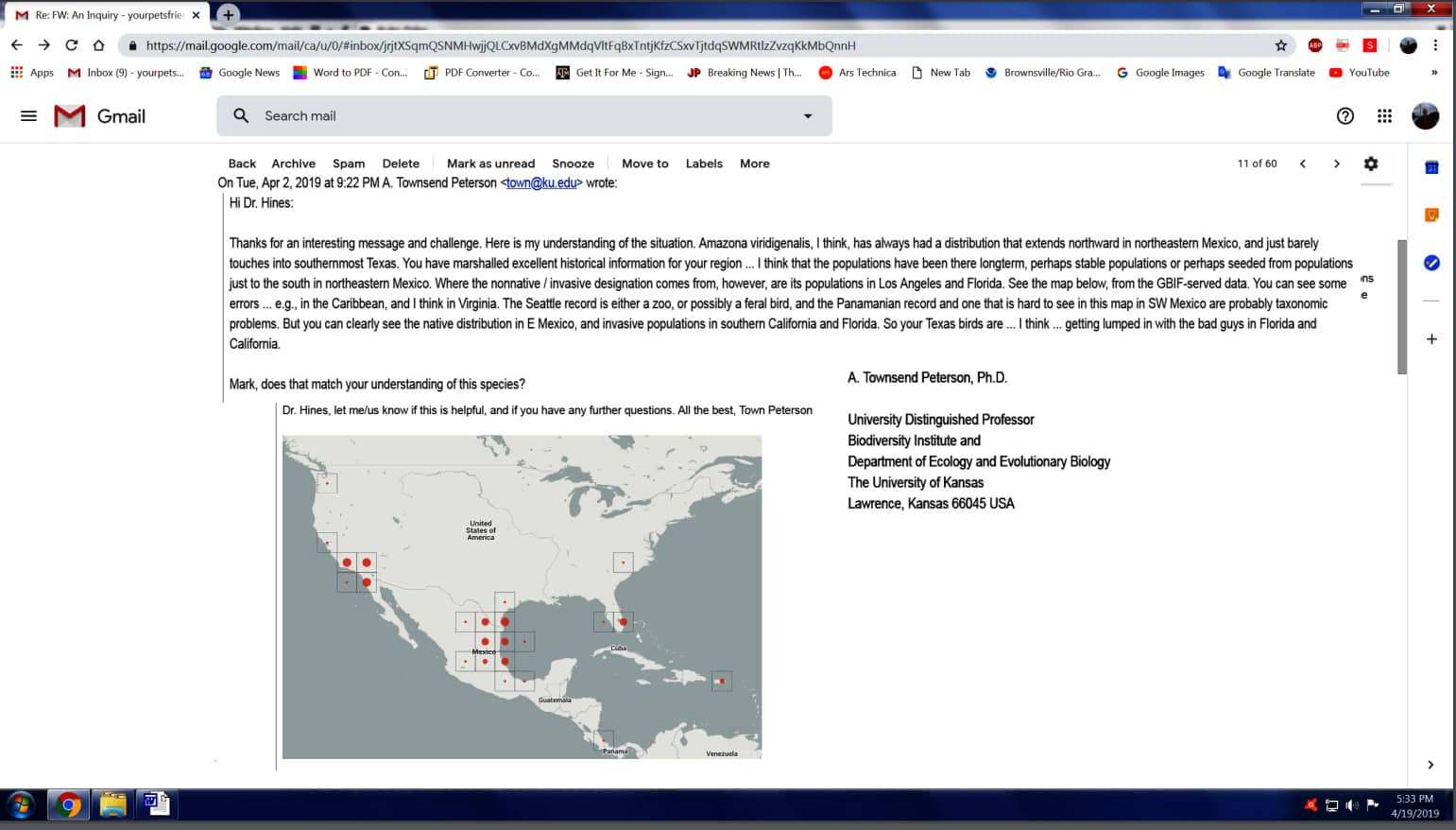
The greatest danger to the survival of the red-crown parrots of the Rio Grande Valley and Mexico is the refusal of the US Fish & Wildlife Service to recognize them as a native North American species. The first map on the left is the red-crowned parrot’s range as published by the Global Biodiversity Information Facility (GBIF). GBIF maps are not influenced by politics, national borders, special interests or nationalism. They simply present wildlife ranges based on the evidence. If you observe the 2019 GBIF map of the red-crowned parrot’s natural range, you will observe that it includes the Rio Grande Valley of Texas.

The second map was produced by the Mexican ornithologist, Tiberio Monterrubio-Rico in 2016. The historical range assigned to the red-crowned parrot (Amazona viridigenalis) reaches the US Mexican border on the Rio Grande River. Are we to believe that these parrots respect national borders and never crossed the Rio Grande River? Are they prohibited from flying back and forth from the Mexican to the US side? If you believe the third USFWS 2019 map you would have to believe that that was true.

The third map is the new 2019 range map produced by the US Fish & Wildlife Service’s Albuquerque office. Texas is part of the Albuquerque sector. The Albuquerque office carefully moved the parrot’s range in Mexico a little bit south so that they had room to draw a circle around the Rio Grande Valley flocks and label all parrots here escaped feral pets. Besides being down right silly, this new map abrogates the USFWS agreement of  2011 that acknowledges that the Rio Grande Valley is simply the northernmost portion of the parrot’s native range. In doing so, they also abrogate their duty to protect these birds in their United States portion of their range.  [pertinent paragraph in red] Parrots have no respect for national boundaries, international agreements. or make-believe maps. It is Nature that determines their range. These sort of bureaucratic shenanigans erode public trust in the USFWS, a Federal institution that has, to date, benefited from wide public trust.

The fourth map is my conception of what a legitimate map of the red-crowned parrots native range should look like in 2019.

The USFWS appears highly dysfunctional when it comes to classifying the red-crowned parrots of the Rio Grande Valley as native to the RGV or feral escaped pets. They can not seem to make up their mind. On April 26, 2019 they and the National Park Service signed off on the Federal Energy Regulatory Commission’s LGN environmental impact study listing the red-crowned parrots of the Rio Grande Valley as a United States, federally listed native species candidates. (ref) That April decision was from the same Corpus Christi USFWS field office team that listed the birds as feral and non-protected in the United States in February of the same year. On 6/4/2019 the Corpus Christi Ecological Services Field Office of the US Fish & Wildlife Service, reversed that position and acknowledged that red-crowned parrot are a native North American species endemic in part to the Rio Grande Valley of Texas. However they announced that because the parrots living in Texas are not mentioned in the Migratory Bird Treaty Act of 1918, they are not entitled to federal protection. 

However the USFWS website describing these parrots still refuses to acknowledge their presence in the RGV, describing their native range as entirely in Mexico. The current USFWS excuse for not protecting red-crowned parrots in the RGV is that they are not mentioned in the  Migratory Bird Treaty Act of 1918. However red-crowned parrots are non-migratory. The USFWS said so themselves in  2011  and again in  2014 .

So including the USFWS 2011 study, that now gives us one USFWS decisions that the parrots are native to the Rio Grande Valley and eligible for federal protection, one that they are not native to Texas, one that they are native to Texas but are not federally protected, one that says they are only native to Mexico. One that says they are migratory and two that say they are non-migratory.

The Legacy Of Richard Schuboat, The Parrot Aficionado Clubs And Their Influence On The Downfall Of The Wild Parrots Of North And South America- Lust Versus Love

I only take you to these two subjects because both have legacies and exert strong lobbying efforts to this very day that are quite likely to influence the decisions of the US Fish & Wildlife Service regarding the red-crowned parrots of the Rio Grande Valley and their safety from harassment. Neither want the parrots listed as native to the Valley.

Some people, like you and I, admire wild birds in their natural settings. Others have a hunger to possess them. Such a man was Richard Schuboat.  Like the “collecting Naturalists” of old, Mr. Schuboat was a well-to-do man. He owned 15 McDonalds Hamburger franchises.  At one time, he owned a pet shop. But unlike the collecting naturalists of old, he was not content with the bird’s hide or eggs. He wanted his great collection of parrots to be alive and he had a reputation for getting what he wanted – “one way or another”.  A cursory search yielded thirty-four court cases he and his family were involved in. A number of their associates had less than sterling reputations as well. Besides his parrot compound in Loxahatchee which was patrolled by armed security patrols, and bodyguards, Schuboat and his friend, Dr. Bernie, who owned a Miami parrot import shed, eventually purchased the roadside amusement park, Parrot Jungle (aka Jungle Island), where parrots were sold in the gift shop – no questions asked. 

I have been told by people in the know that the majority of the parrots in commerce at the time has been smuggled into the United States APHIS-licensed parrot sheds using false CITES origination documents. The stress of capture and the crowding and mistreatment they experienced in the Miami sheds caused enormous mortality; but the trafficking was still lucrative for all concerned. Importation also broke the birds’ resistance to a virus disease that caused the unfortunate creatures (generally cockatoos) that Schuboat possessed to loose their feathers and portions of their beaks and claws. Schuboat ’s imported macaws were also dying of macaw wasting syndrome. Vexed that none of the Miami veterinarians or those at the vet school in Gainesville could cure his parrots (gossip at the time was that Gainesville turned him down flat when he offered to fund a parrot disease laboratory there) he chanced upon an acquaintance of mine, Dr. David Graham, at the time an avian pathologist at Cornell University. That was the beginning of the Schuboat Exotic Bird Health Group

   at Texas A&M University founded By Mr. Schuboat  in 1987. These are the same folks currently pursuing the red-crowned amazon parrots across the Rio Grande Valley. The 2016 article in Forbes Magazine suggests that the Schuboat Group has designs on parrots of the Rio Grande Valley. If the wild red-crowned parrots of the RGV were to receive protected status in the United States, they could no longer be captured for used as experimental animals or for dubious restocking projects in Mexico. One unfortunate RGV red-crowned parrot I was nursing back to health a few months ago for a dislocated wrist is now attempting to fly around the Valley with a transmitter and battery backpack strapped to the unfortunate creature’s back – applied by the Texas A&M Schuboat Group through trickery and collusion. The Texas A&M Schuboat group is not the first group of caranchos to abuse parrots in the Rio Grande Valley. Another similar one, Joe Lieberman, preceded them. (ref)

People who lust for parrots and/or breed them for profit have a national organization. It is called the American Federation of Aviculture (AFA). They hold periodic conventions. Their 1988 convention was in Tampa, Florida. You can read their 1988 convention brochure here if you ask me for it Dr. Graham attended, representing the Schuboat Exotic Bird Health Group at A&M. The names are a who’s who of the people of the day involved in importing parrots and/or attempting to breed them for money. I knew most of them. Buzz Paree owned the Gators of Miami parrot import sheds. He told me his Dad tried to make a go of it importing caimans, he sold as baby aligators hence the name). Buzz contributed door prize parrots. A congenial man, Buzz was later nabbed in a USFWS sting operation. Rosemary Low represented Loro Parque – not renown for their compassion for animals either. I do not know if Tony Sylva was in attendance although he represented the AFA ’s Midwestern region at the time. The law finally caught up with Tony as well. As for the rest, they could, like Captain Renault in Casablanca, be paraphrased as “shocked, shocked to find that smuggling and cruelty is going on in here”. After operation psittacine the AFA still sent a letter to USFWS in an attempt to rout the smuggled birds to them. The article in Forbes suggests that these people fear added regulations if the wild red-crowned parrots of the Rio Grande Valley were to receive protected status. 

 How Can I Do My Part To Protect These Last Of The North American Parrots?

Forward this article to as many people as you can. Sunshine on a problem is often its best cure. I do not believe the parrots of the Rio Grande Valley will be truly safe until the US Fish & Wildlife Service & or TPW is taken to court again and forced to protect them as they do all other native American wildlife. If you know of public interest law groups or altruistic attorneys that would like to take the lead in doing so, let me know. 

When bureaucrats of all shapes and sizes are faced with having to make a decision that favors one interest group over another, they generally dance around the issue and appoint another “study committee or group” that takes  years to report back. During that time, they hope that the public (you) will loose interest, move on, or that there will be new developments that make it unnecessary for them to make a decision one way or the other. It is time to end the plight of the parrots of the RGV once and for all. Another tactic bureaucrats commonly used is to blame the problem on someone else “we are very sympathetic to your point of view but our hands are tied“. The June, 2019 stance of the USFWS Corpus Christi office to this article is “don’t worry about the parrots loosing their federal protection in the United States, the State of Texas will protect these parrots” I do not believe that the US Congress ever gave the USFWS the right to abdicate their responsibilities to individual states when faced with difficult decisions – nor do I know of any other species of bird where that ever occurred. How can any creature be both native and feral? The ornithologists of TPW realized these parrots were native (indigenous) to the RGV quite some time ago. They just don’t want the heat and blow back of a crisp decision to be on them. You and others like you are the only people who can save and protect these birds.

Bird watchers do our parrots no service when they point out breeding parrot pairs and roosting flocks to academics intent on experimenting on them. Whether they are out for beer money or PhDs, we don’t need more Polo Cotorros and Snake Kings (rptref) harassing the parrots of the Rio Grande Valley. The parrots might just pack their bags and move to where they feel less threatened – they have done that before. Well-meaning Schuboat Tejano Parrot nest spotters might be unwittingly feeding the appetites of the Schuboat Staff for pet RGV parrots. One of their staff appeared on a social media site with an obviously hand raised young red-crowned Amazon parrot I mailed her a copy of this article. She never responded, but within days, the photograph of her and the young parrot disappeared from the internet.

Let the USFWS know that refusing to grant endangered species protection to RGV and Mexican red-crown parrots is scientifically and intellectually unjustifiable. These birds are the greatest treasure of the Rio Grande Valley, perhaps the last hope for an entire species. With Carolina parakeets already driven to extinction, the Valley flocks are the last surviving native American parrots. We should be intensely proud of them and defend them against all comers. They should not have to rely on local ordinances and the State for their protection.

Urge your City Council and Counties to continue to pass local laws making it a crime to harass local wild parrots until the USFWS can finally get it right. Be sure your ordinance prohibits capture of healthy parrots for any purpose including “scientific study” application of tracking devices, cameras in nest cavities, harassment with drones, etc. – all of which are cruel and stressful activities that cause persistent behavioral alterations. The yearly Japanese whale harvest is supposedly conducted for “scientific study”

Visual observation from a distance provides sufficient parrot census data. Stool and shed feathers collected under roosts give enough general health and wellness information. One can tell from a single shed wing feather if a parrot suffers from malnutrition or chronic disease. I collect a DNA sample from every parrot or conure that it brought to me. They are eventually destined for a comparative study by the American Museum of Natural History, NY, to DNA samples collected in the late 1800s and early 1900s.

Explain to your neighbors not to be quick to take down dead palm trees. Leave their trunks standing when they die so woodpeckers can turn them into parrot nesting sites. Trimming a palm’s canopy for eye-appeal weakens the health of palms and makes them more susceptible to fatal fusarium wilt and other palm diseases.

In the wild, Red-crowned amazon parrots in the rio grande valley feed on the seeds and fruits of Texas ebony, anaqua ,brazil, pecan and coma. At bird feeders, a mix of fresh fruit and fresh corn, sweet potato and sunflower seeds and peanuts all sold for human consumption is fine. They like the crunchiness of carrots. But too many carrots can turn their feathers yellow. Corn sold for animal consumption can contain toxins. They love thawed blueberries. But planting the trees whose fruit and seeds red-crowned parrots naturally feed on is a much better option. 

Artificial nest boxes need to be grandfather clock silhouette in shape with an internal ladder to the bottom. The bottom needs a 6 inch layer of uncompacted mulch. If not adequately mulched, hens often accidentally breaks their eggs. If the box is not deep enough, the hens often throw the mulch out of nest entrance hole which also results in broken eggs. A strip of spinosad-impregnated (Naturalyte™) string or sponge near the box entrance discourages colonization by bees. This is one of my conure nest boxes in Florida strapped to a palm tree: Parrots prefer wood to PVC pipe and I never used pressure treated lumber. With a single “tummy bag” section of  9 gauge tension wire (HmDepot/Lowes), one slides from ground to ladder height and the rest of the way up a moderately tall Washingtonia palm using a section of timber bamboo to push up from the bottom and no ladder. Over time, parrots destroy the entrance to natural and artificial nest cavities/boxes. The only way to slow that is a sheet metal bezel surrounding the entrance. Roof flashing works fine as long as no sharp edges protrude. Making the entrance hole somewhat smaller than the bird can pass through and smaller than the bezel stimulates a parrot’s curiosity and brings a lot of parrot pairs into reproductive mode. If the top piece extends an inch or so to the rear, water draining off the top will not enter the entrance hole. I have tried pulley systems like I have on my martin houses but never found a design that worked. Besides, that encourages parrot nappers. Here in the Valley, tree ducks can be a problem. But they tend to make their nest box selections later in the year than the parrots. Expect parrots out scouting when their winter roosting flocks begin to break up.

There are 33 pdf reference articles associated with this article. You might be able to read them through the internet Wayback machine. If not I can supply them to you if you ask me to. 

 Dear reader, Besides your donations, Visiting the products that Google chooses to display on this webpage helps me pay the cost of keeping this article on the Web. As you know, sites like mine that are not designed to make money are getting harder and harder to find. Best wishes, Ron Hines

Librela® A New Approach To Arthritis Pain In Your Dog 


Librela®, A New Approach To Arthritis Pain In Your Dog

Ron Hines DVM PhD

7/29/2026: this email was in my inbox today RSH: 

Dear Veterinarian, We are writing to share a new JAVMA review on bedinvetmab, marketed as Librela, published June 26, 2026. The review examines emerging reports of rapidly progressive osteoarthritis and other severe joint changes in dogs receiving bedinvetmab. Reported outcomes include rapid joint degeneration, progressive osseous collapse, pathological fractures, instability, and marked effusion. The authors describe these changes as potentially irreversible and catastrophic, while acknowledging that their true frequency remains uncertain. A key concern is that pain relief may not reliably reflect joint integrity. Because bedinvetmab blocks NGF-mediated pain signaling, a dog may appear more comfortable while structural deterioration continues to progress unnoticed. The review also questions whether preapproval safety testing was capable of detecting a delayed structural complication, noting that the pivotal laboratory study lasted 26 weeks, involved 32 healthy young-mature Beagles, and included radiographic descriptions for only five dogs. The authors recommend careful baseline and follow-up examinations, longitudinal imaging when clinically indicated, assessment of both the treated and untreated joints, prompt investigation of new lameness, swelling, instability, or apparent loss of efficacy, and transparent risk communication with documented informed consent. We encourage every veterinarian who prescribes or administers Librela to read this publication in full (link below) and to consider whether additional caution, monitoring, and client counseling are warranted in their own patients.Thank you for your continued commitment to evidence-based care and patient safety.

With respect, L.M.W. Esq. ,Co-Executive Director and General Counsel

Paws Over Profits, Inc. (promoting transparency in veterinary pharmaceuticals)

  Portal to all of Dr. Hines’ animal health care articles

Ron Hines' Vetspace logo  Donation page if your device does not display it

 Drugs Marketed To Do Good Sometimes Do Bad

 Librela® Dog Owner Feedback Page

 Dealing With Joint And Back Pain In Your Older Dog

 Galliprant®

 Cat Owner Feedback On Solensia® 

 In Australia Librela is or was Beransa®

In a small USA trial, 47.4% of dog owners whose pets took Librela® (bedinvetmab) injections monthly for arthritis thought it might have been helpful to their pet in reducing its arthritis pain. But 36.6% of the dog owners whose dogs received placebo injections thought their dog improved too. (read here) So through 2023, I believe that Zoetis did not find the drug spectacular enough to be profitable in the United States (at least I couldn’t bring it up for purchase through my Zoetis account). Prior to marketing, companies like Zoetis usually make sure that their produce, in this case bedinvetmab, has a Wikipedia page. Through 3/13/23 there was none. To the best of my knowledge, in 2023 it was available in the UK and mainland Europe. I may be incorrect in some of my assumptions because I have no access to Zoetis’s internal decision making process.  

But by August of 2025, Zoetis saw sufficient profitability in this medication to mount a massive advertising campaign. Drugs that actually work in us and our pets – always have the potential for unwanted side effects. The only ones that don’t are the placebos. Perhaps your dog will have no serious side effects – I hope so. But if it does, its up to you – not your veterinarian – to decide if a somewhat shorter but happier life outweighs those side effects.  

This article about Librela repeats much of what you will find in another article of mine that concerns a very similar Zoetis anti-nerve growth factor (NGF) for arthritis pain management in arthritic cats, Solensia®. Solensia has been on the US market much longer. You can read some cat owner’s experience with that Solensia here. Because cats, are genetically, psycologically and metabolically quite different from dogs, you cannot assume that the benefits or hazards of the two drugs will be the same in both species. But both drugs are basically the same anti-nerve growth factor medication. It is just that the cat product, Solensia®, had to be bioengineered (“felinized”) to work in cats and Zoetis’ canine product, Librela®, has been bioengineered (“caninized”) to work in dogs. All MAB drugs like these are species-specific. 

  More About Librela

As I mentioned, Librela®  is a new treatment option for your dog when it inevitably develops age-associated joint pain. Nothing lasts for ever and canine joints are no exception. With time, your dog’s cushoning and protective joint cartilage , composed of chondrocytes and the cartilage they produce stiffens in texture and loses its cushoning ability. The thickness and water content of the cartilage decrease and its joint lubricating ability decreases as well. Those changes eventually result in inflammation of the underlying bones that compose the joint. (read here) Bone erodes at pressure points, joints remodle in ways that encourage inflamation and pain. Dogs develop these problems at different ages and to different extents. An accident or repeated trauma to specific joints might make arthritic pain appear in those joints at a quite early age. Working dogs are apt to develop arthritis in the joints their work stresses the most. Breed conformation is very important as well. Dogs with body conformation quite different from primordial breeds may be cute to look at. But their breed cuteness comes at quite high a cost when it comes to health and longevity. Being larger-than-life for a breed is apt to bring blue ribbons and best of show. But that all comes with a price as well. (read here) Being overweight hastens the stress on a dog’s joints as well. Your dog will do most anything for you because it loves you.  But please do not ask it to do physical things that will hasten arthritis pain.

No medication that is effective in lessening the pain of arthritis is free of potential side effects. The most common effective ones veterinarians dispensed to dogs are Rimadyl®, Previcox® and Galaprant®. Some vets dispense gabapentin (Neurontin®), a drug originally dispensed as a treatment for human epilepsy. Gabapentin’s effects on blocking arthritis pain in dogs are debatable.  

However, in March of 2020, the FDA did agree to consider Pfizer’s request to conditionally approve tanezumab, the “humanized” form of the same anti-nerve-growth factor (NGF) that is in Librela® as a non-narcotic option for the treatment of knee and hip arthritis pain in people. However, in 2021 both the FDA and the EMA turned Pfizer down. The FDA vote was vote of 19 to 1 against approval – based on the findings that patients that took that drug needed knee or hip replacements sooner than patients that didn’t take it. It is not clear if their rapid joint deterioration was due to a decrease in pain that allowed them to use their joints too vigorously, or if the drug itself caused the problem in some other way. 

The bar for new animal drug approvals is set lower than it is for drugs that are intended for use in people. Never publically expressed – but perhaps on the FDA’s mind is “let’s give the dog and cat versions a go first and see how that turns out”.

  Do Veterinarians Need Better Chronic Pain Control Medications For My Dog Than They Have Now?

Yes, it would be wonderful if veterinarians and dog owners had more options for your dog. Things like therapeutic lazers have not been proven to be any more effective against arthritis pain than heating pads or hot water bottles.  CBD/Hemp oils, peddled by various veterinary supply houses have no proven pain relieving properties in pets or people. (read here & here) 

We veterinarians have the same tools today that your physician has to treat arthritic and other chronic pain should they occur:

We can give your dog NSAIDs like carprofen (Rimadyl®), firocoxib  (Previcox®), grapiprant (Galliprant®) or meloxicam (Metacam®) to decrease your pet’s joint inflammation and pain. Most dogs handle those drugs reasonably well. But more frequently that we would wish for, side effects occur that include gastrointestinal irritation, vomiting, a drop in appetite and diarrhea. Physicians prescribe some of these same NSAID drugs to their patients. Never give one prescribed for a human family member or sold over-the-counter to a dog. 

Veterinarians can give your dog corticosteroid injections or corticosteroid pills such as prednisone . They are all potent blockers of chronic joint inflammation and the pain that it produces. However, corticosteroids also have serious side effects when given frequently that include weight gain, fluid retention, excessive thirst and urination, panting, increased susceptibility to infections – even Addison’s disease upon withdrawal, etc. They are best reserved for diseases for which no other treatment options exist. 

Some veterinarians dispense narcotics like tramadol for pain, or even fentanyl (Duragesic®) patches when nothing else is effective anymore. How effect tramadol might be in countering arthritis pain remains unknown. You would have to be the judge of that. Fentanyl is a powerful pain-relieving narcotic. Because of diversion fears, the DEA prefers that veterinarian’s confine its use to post-surgical pain or to a pet whose potential time on the earth is brief – such as terminal cancer patients. 

There are veterinarians who suggest acupuncture, homeopathic remedies and “alternative medicine” for the control of pain in your dog. (read here) But there is no high quality scientific evidence that any of those things actually work – in pets or humans. (read here  & here) Other vets, as I mentioned, suggest therapeutic laser therapy as an alternative to traditional physiotherapy. And still others suggest mood-altering drugs like amitriptyline or imipramine based on their use in treating human fibromyalgia. None of these are likely to do your dog any harm when given under veterinary supervision. But I personally have no faith in any of them. Giving your dog extra time, love and affection and altering its lifestyle to deal with its disabilities is likely to do it considerably more good than mood modifying drugs designed to treat depression.

 How Might Librela® Fit Into My Dog’s Treatment Options?

The international Development Group’s 2023 international guidelines for the treatment of arthritis in dogs suggests Librela injections be given every 4 weeks. They mention that it hasn’t been on the market long enough yet to judge its long-term effects or drawbacks. They suggest ~2 months trial to judge its effectiveness in relieving arthritis pain and, if it is effective and side effects, if any, are minimal, the treatment can continue. Three of the 9 veterinarians specialists on the panel preferred relying on NSAID medication in mild to moderate arthritis pain situations (stage1). Six out of the 9 found it acceptable to use NSAID or another medications that had been studied longer or Librela® in stage 1 cases. (read here) Some of these specialists groups receive pharmaceutical company largesse in direct or roundabout ways. There is a link here and at the top of this webpage of dog owner’s actual experiences using Librela®.

  What Is Nerve Growth Factor (NGF) And What Part Does It Play In My Dog’s Arthritis Pain?

Nerve growth factor is a small, protein-like molecule that individual nerve cells (neurons) rely on to communicate with each other. Among NGF’s many chores, it is esential for the development and later health of nerves that sense pain. During growth and development, NGF helps determine which neurons survive and prosper (read here) and has more recently been found to have a host of different functions within the mature body ranging from insulin secretion from the pancreas (read here)  to allergic inflammation. (read here) Librela® was designed to cause your dog to have less NGF in its blood. That could mean less arthritis pain, but veterinarians know very little about what else might occur.

The nerve highway through which signals travel in you and your dog’s body is a two-way street. Some nerve signals travel from your dog’s brain to the far ends of its twig-like branches throughout it’s body to tell cells there what to do (motor neurons). Others travel in the opposite direction, from those fine end branches to its brain to communicate cold, warmth, taste, feel, smell, etc. Those are called sensory neurons. The finger-like ends of some sensory neurons appear to only sense pain. (read here) Drugs like Librela are all monoclonal antibodies (mAb’s) – protein “smart bombs” carrying “payload” antibodies that seek out and disable (in theory) only one compound within the body. Some are designed to destroy cancer cells, others, like Cytopoint®, to destroy compounds involved in your dog’s itching, others to fight asthma and a variety of other diseases in people. (read here)

  What Do Studies Tell Us About The Effectiveness And Safety Profile Of Medications Similar To Librela®?

The basic science behind Librela® appears valid, and it would be wonderful if Librela® turns out to be an unqualified successes. But it is impossible to predict that based on the Zoetis-sponsored studies that have been released to the public so far. Lavish drug company publication-funding made it harder and harder for people like me to determine the true worth of medications and procedures across the entire spectrum of veterinary medicine. There is no doubt in my mind that purse string control influences study outcomes. (read here,   here  &  here)

  What About The Dog Owner Surveys That Where Conducted?

Purse string control often influences study outcomes. (read here,   here  &  here) Pet Owner opinion has been found to be an unreliable way to measure a drug’s effectiveness.  In one of Zoetis’ studies of Solensia®, the sister “felinized” equivalent of the “caninized” Librela®, 67% of cat owners whose cats received the placebo injection thought that their cat had improved after its injection too! That wasn’t much fewer than the number that thought their cat’s pain had lessened after the real injections. Activity monitors, like the one in this photo, are the only valid way to judge the effectiveness of any pain-control medication you give to your dog or your cat. (read here) 

All older dogs will have mild to moderate evidence of joint wear and tear. We all do too. But just like in us, your dog can be reluctant to move and slow down for a plethora (a very large number) of reasons that do not have to do with its joints. Joint x-rays are also unreliable indicators of pain. Human studies have shown that only ~50% of people over the age of 65 that have x-ray evidence of arthritic knee joint changes experience any knee pain. And those that have joint pain do not necessarily have x-ray evidence of arthritis. As for hip pain, only 9.1 – 15.6% of people that experienced hip pain had any x-ray evidence of hip arthritis. And of those that did have evidence of hip arthritis, only 20% reported frequent hip pain. You yourself are the best judge as to whether Librela benefits you dog. If it does or if it doesn’t please let me know. 

Dear reader, Besides your donations, visitors to the products that Google and others display on my website help me defray the cost of keeping my articles on the Web – and you informed. As you know, sites like mine that intentionally use no AI, no SEO, and are not written to Sell You Things are getting harder and harder to find, Best wishes, Ron Hines

Dog Owner Feedback From Apoquel Users

Dog Owner Feedback From Apoquel® Users

Ron Hines DVM PhD

Cytopoint® Dog Owner Feedback

Back To Apoquel® Article 

The FDA

*************************

Please let me know how well Apoquel® worked for your dog

As you read the emails below, please remember that cause and effect are sometimes an illusion. When things occur, one shortly after the other, we call them cause and effect when we believe the first event caused the second event to happen. If we feel that the two incidents were not related, we call the second event a mere coincidence. Cause and effect and mere coincidence can be very difficult for us humans to sort out. It is only when they occur repeatedly in pets receiving a medication that we can be reasonably certain that we are not dealing with a mere coincidence. Also, just because something occurred in one dog does not mean it will occur in your dog. RSH

Many owners of allergic dogs who once gave their pets Apoquel® have now decided to give their dogs Cytopoint®  instead. That is either because Apoquel® lost its effectiveness or, more likely, because they or their veterinarian thought that Cytopoint® was less likely to cause negative side effects. To read the stories of dogs that receive Cytopoint®,  go here. When Apoquel is given, it is not unusual for the amount of itching your dog experiences to increase when your veterinarian attempts to lower its twice-a-day dose to once a day (rebound pruritus). Adding prednisolone during its first few days of Apoquel might avoid that. (read here) 

Apoquel® Dog Owner’s Comments:

Owner email in black, follow-up emails in purple, my comments in green

*************************

 Jan 12, 2026

My dog, Sam is now 7 years old. He is a neutered rescue from Kuwait. We, adopted him even though his . His SDMA level was elevated. When he was thought to be ~2 years old. Continuing monitoring of his kidney tests are recommended by our regular vet and also by the vet dermatologist due to his Apoquel® usage for our peace of mind. Sam is on Simparica Trio® for flea and tick prevention and has not had fleas since I’ve had him).  We tried Zyrtec®, which didn’t help.  Then Cytopoint®, which didn’t help.  We put him on Apoquel® (actually started on a very low, even sub-therapeutic level dose) and his itching/licking resolved..  Used it to get through allergy season then took him off. Allergies came back the next year, even worse, so we tried Apoquel® again and it didn’t help this time. Upped the dose, still no help. Tried a few other things the didn’t help (steroids, topicals, etc) so our regular vet recommended a dermatologist. It took six months to get an appointment, so I decided to try and elimination diet in the meantime, using novel proteins and using rigorous protocols (even switched to a non-chewable flea and tick preventative and heartworm).  None of this helped. Sam’s symptoms were so severe that he would lick all the fur off his back toes, paws, up the legs, and his front legs, until he would bleed in spots. Our vet dermatologist determined it was due to the allergic skin disease, it wasn’t that the Apoquel® stopped working like we thought, but that he was developing secondary yeast infections (took skin scrapings) on top of the allergies.  So put him back on Apoquel® and a course of anti-fungals which was when he finally had full relief.  He stays on Apoquel® about 8 months of every year, I take him off during winter months when he’s never exhibited symptoms.  He did need to go up the the middle of the therapeutic range after a couple of seasons when his symptoms flared and there was no secondary yeast infection present.  He also has a topical cream to help during mini-flares.  Because we had identified which seasons he had allergies and it has been relatively well controlled, I opted not to do the full specific allergy testing, though I might this year just to see. I wasn’t crazy about using Apoquel® long-term, but it really has been the only thing (in conjunction with other therapies when needed for yeast) that saved him.  He was truly miserable for close to a year before all other approaches failed and we got on a good regime with the veterinary dermatologist.  

Your article about SDMA  was absolutely invaluable and saved me a ton of stress. My vet’s take on SDMA, while not as thorough as your explanation, was that he’d seen plenty of patients with elevated numbers that never went on to develop kidney disease, so we could monitor and wait to pull the trigger on a special kidney diet until something in addition to the SMDA seemed to indicate a kidney issue. And magically his SDMA number dropped into the normal range.  I’ve been trying to remember to add water to his food dish at dinner time, since he cleans out the entire bowl water and all, in an effort to increase his hydration.  Maybe it was that or had nothing to do with it, who knows. But my boy is in good health 🙂 Thanks for what you do,

Brenda M.

*************************

February 14, 2024

Hi Dr. Hines, I have two French Bulldogs. One Bullet, is 11, and the other, Wilbur, is 12 years old. They’ve both always suffered from allergies but presented differently. The 12 year old had super bad itching, constant licking his paws until raw and runny eyes, right out the gate. He lived in his cone when we weren’t around. Allergy testing revealed that he was allergic to everything under the sun, including human dander (though pollen and cats were higher on the list!). From a young age, he was intermittently given prednisone to calm some of the symptoms… until we realized the concern of Cushing’s disease and sought an alternative.
Our 11 year old would lick his paws, but not to the same extent. He would develop atopic dermatitis and eventually yeast infections on or near his tail nub when allergens became unbearable. Needless to say around 2 and 3 years of age, Apoquel entered as the knight in shining armor. They have taken this medication like clockwork, daily, 8mg each, up until two weeks ago. For at least 4 years, Apoquel gave significant relief. When seasonal allergens became really bad, there was paw licking, but not to the extent of open sores. Some time after that, Apoquel’s efficacy began to wane. Especially for the now 12 year old. We would have to supplement with additional medication such as diphenhydramine or chlorpheniramine  which maybe took the edge off. I still didn’t doubt the medication [Apoquel] until we ran into problems. These are dogs from different breeders. They eat the same grain-free diet. They took the same allergy medications.

The 11 year old for the past 5 years has developed annual bronchitis. The first time around, it became pneumonia and we wound up having him in an oxygen bubble at the emergency vet. Consecutive years, we’ve been on alert and caught it sooner when still in the bronchitis phase. Hindsight – he’s always dealt with ascites and pleurisy…. And I’ve read about this being linked with Apoquel. About 4 years ago, the 12 year old had bloody stool and ended up needing a colorectal polyp removed. We thought nothing of it. The last 3-ish years, it has been a may-lay [mix] of intermittent diarrhea for both dogs. So began the episodes of feeding chicken and rice and then trying a different food. Of course including Pro–Pectalin and FortiFlora in the regimen [treatment]. Side note – their behavior had changed. Not as playful, moody and withdrawn. I figured it was old age. About 6 months ago, they both started eating their stool. Fast forward to about 3 months ago, with one dog and then the other developing colitis. Uncontrollable diarrhea in the house. We thought it was the end. The vet suspected malabsorption. We ended up doing a GI panel on one of them to learn of a couple deficiencies…. but while we were waiting on the results, the 11 year old passed 10 polyps over the course of two bowel movements. That’s when I started looking further at why both dogs were suffering in the same way…. what was the bottom line…. I had figured it was diet related until we ran out of options. Apoquel. I immediately stopped the drug. Found a supplement to deal with the allergies. So far, their appetite is back. Their stool is normal. And their mood and behavior is vastly improved. Long term – to be determined if the damage is done or if they truly bounce back. But I firmly believe my findings to be true. I’m disappointed it took myself this long to get here [since] I naturally question the safety and efficacy of pharmaceuticals anyway [in general ?].

L. H. New York

French bulldogs have the shortest average lifespan of all dog breeds, according to a UK study. Jack Russell Terrier have the longest.

*************************

January 15, 2024

Our Goldendoodle Lui was 2.5 years old. [In April of 2022, he developed a cough or snort that came and went]. [The veterinarian we use] suggested that Lui had seasonal allergies and put him on apoquel. We accepted that [although] he never scratched or was itchy. [ ] On Tuesday, August 16, we took Lui to our local dog park [ ] and he played like he always did. That night he didn’t want to go out [to] tinkle. We called the vet the next morning and they suggested we observe him for the next 24-hours to see if he improved. He did not and could hardly move [by] Wednesday.  We took him to the animal hospital where they told us he had a massive infection- catastrophic pneumonia – and [placed] him on IV antibiotics [and] kept him overnight.  We got a call the next morning that they were doing CPR – that Lui’s heart had stopped.  Never in a million years could I imagine losing a 2.5-year-old dog like this. I work for the FDA and so got their help [in performing] a necropsy and [I] got in touch with Zoetis.  The necropsy confirmed catastrophic pneumonia [but] there was nothing that could [definitely] tie his death directly to the drug. My take is that Apoquel completely depleted Lui’s immune system -and that he had some underlying infection that just blew up when he couldn’t fight it.  Zoetis took an interest but ultimately only paid for what was left of Lui’s hospital bill after insurance. [Our] vet never called us after they learned about Lui’s death. We [are] new dog owners and put way too much faith in the vet we chose who it situated in a very affluent community where pet owners will pay just about anything for their pet’s care. I am ridden with guilt that we didn’t seek different care for Lui. Thank you for the work you do.

S. L., Bethesda, Maryland

1-15-24 At least in some dogs, Apoquel has the ability to suppress various elements of a dog’s immune system, other than those responsible for allergic itching. Veterinarians and physicians are no different than supermarket fruit in at least one respect. Unfortunately, sometimes you get a rotten one.

*************************

August 12, 2023

Our vet has had our 8 year old pug, Elliot, on Apoquel for a few years now to stop him licking his paws and waxy ear’s but the last six months he has started getting these black growth’s on his paws they really look unsightly getting quite big. Then we noticed he had one under his chin and one growing on his face now. The vet said he didn’t actually know what they were but took a few off and sent them away and they are not [malignant], thank god. He is still on Apoquel but constantly licking at these black lumps on his feet to the point where he makes himself sick The vet doesn’t seem to think it’s a side effect from years of being on Apoquel but after reading many reviews I’m not so sure. When I asked him about removing some more from his legs and paws he said he could but he wasn’t sure if they would just grow back. We have considered stopping the Apoquel simply because [it doesn’t] seem to be doing what they were intended for, he is licking these black lumps on his paws continuously now to the point where he makes himself sick so we have to continually watch him he can’t be left on his own. Elliot received two Cytopoint injections about a month apart too along side of the Apoquel. At the moment we are working on a Herbal remedy and looking to see if his diet needs attention. (See Elliot’s lumps here)

 S., Westmidlands near Birmingham, UK

Dear Mr. S.,

I have not heard back from the virologist I wrote to at the RVC. I still think you should seek a second opinion regarding options for Elliott that do not include immunosuppressive medications such as Apoquel or Cytopoint. Or, perhaps if none are suitable, attempt to lower the doses of those medications. But I am far away and unable to size up Elliot or the challenges you face over there. I will try to find another veterinarian at the RVC who might be willing to discuss Elliott’s situation and your options. It might come down to some physical method to keep him from bothering his toes. Often, there are a bit of psychological issues in addition to allergies that come into play. At first glance, these “lumps” appear to be papillomas. (read here) Once exposed to the virus, various factors, including  immunosuppressive medications and advancing age, can cause them to reappear. 

*************************

May 24, 2023

My husband and I had to put down our beloved 13 year old Cairn terrier Elvis, last Friday. We believe Apoquel was the reason that he started having multiple health issues. He began taking Apoquel March 2018 because of his constant itching and scratching. I tried medicated shampoos and home remedies and nothing was working. We were so relieved that our Elvis was finally free from all of the painful itching. In 2021 Elvis developed a tumor in his neck area. His vet did a biopsy and it came back benign. In May 2023 Elvis started showing blood in his urine every time we took him out to urinate. We made an appointment that very day to see his vet. The vet diagnosed him to have a UTI and gave him a 1 week foil pack of antibiotics. The next day we walked him and he was urinating and his other business like normal and eating and drinking his water like always. But on the 15th we noticed he would have some dribble of blood towards the end of urinating. Our vet called us 4:30pm and told us that Elvis had an enlarged right kidney, an abnormal left kidney and that his prostate is enlarged and she was almost sure it was cancer. A few hours later she called again and said that there was nothing they could do other than send a referral to Texas A&M to put a stent bypass in so he could urinate again.

G. B., East Texas

5-27-23 Hello Mrs. B., I was so sorry to read about Elvis. After reading your email, I want to tell you and your husband that you did the only kind thing that there was to do. I am so glad you did not take him to A&M. That would have caused extended grief to Elvis, and to both of you. Veterinarians are obligated by State Boards of Veterinary Medicine to mention all options – even the ones that offer no real hope and are inherently cruel. I took portions of your email and posted them on this webpage today. I am glad that you and Elvis had 13 precious years together. Best wishes, R. H.

*************************

May 17, 2023

My dog, Oscar, who is 8, has been on Apoquel x 5 years, with moderately good results related to his itching. A week ago he developed a deep infection in his left front paw, with multiple cysts between his toes, and multiple papilloma growths all over his paw pads, in between toes, and under his toenails. He will not bear weight on the paw. The paw is extremely swollen, and it is obviously painful. Initially the vet started him on basic antibiotics for skin issues. Currently Oscar is on azithromycin and Tagamet x 2 days without any improvement. I am holding pending update to vet in AM.
Mid-panic here. :/   A., and Oscar, Central Ohio

5-19-23 His care plan has changed due to Oscar being unable to tolerate oral meds (he has a ridiculously sensitive stomach). Today, an injectable antibiotic (Convenia) and a long acting steroid injection. So far he continues to have a very swollen painful paw with many papillomas, mostly between toes and under toenails. 

*************************

August 20, 2022

We rescued our German shepherd when she was about four years old. We had her for about three years. Nala always had a problem with allergies and scratching. She chewed on her feet constantly. We tried several medicines and gave her medicated baths. Nothing helped much.  She was a very healthy dog except for the itch. I heard about Apoquel and thought about talking to the vet, but I decided against it because I read many reviews including a few bad ones, and I decided to wait. I waited two years and decided it was time to try Apoquel. I followed the instructions for about three weeks, and her itching stopped. I was so happy. However after those three weeks, Nala could not get up and walk straight. She wobbled and fell over. She stopped eating and would drink little water. I stopped her Apoquel, took her to the vet, and they made an appointment with a neurologist. He did over $7000.00 worth of tests and determined Nala had meningoencephalitis. He said that he didn’t know why. He put her on a bunch of medicines, but Nala passed away one week later. No one can tell me what happened. Apoquel was the only thing different in her life.

D.S., Grant, Florida   Sent from Mail for Windows

What a heartbreaking experience. No one can prove that Apoquel was responsible. But I agree that the timing was suspicious. Unfortunately, we veterinarians are dealing with two unknowns: We don’t know what causes meningoencephalitis; and we don’t know what the full ramifications of disabling portions of the immune system might be. Physicians do know that their patients facing health issues that weaken the immune system, such as organ transplants, HIV or chemo have a higher likelihood of developing meningoencephalitis. RSH

*************************

February 26, 2022

My 2-year-old springer spaniel, Sadie, suffered from itchy paws and skin. She was constantly at the vets. But with a good routine, keeping her away from certain food and the odd medicated shampoo etc., it calmed down. We would often just opt for using a cone when she was itching badly and make sure her skin and paws were clean and dry until the itching subsided. She was prescribed Apoquel®. The dose was 1 tablet a day for 6 days. We soon noticed that her breathing was slightly faster but we had a follow up appointment for her skin the following morning. The vet said she had a fever. We took her home and checked her temperature hourly, used cold cloths, a fan and opened the windows to cool her down. But by 6 AM her temperature had climbed to 41.5 (106.7 F) so back to the vet. She was kept overnight for monitoring and an (IV) drip. They did (ultrasound) scans and x-rays and found that she had fluid in her abdomen and presumed she had septic peritonitis. They explained that she likely had swallowed a foreign object that had cut her intestines and caused a gap/split that was allowed fluid to leak into her abdomen and that they would perform emergency surgery to find the tear and fix it. The vets didn’t find any foreign body. They didn’t find a gap, split or tear in her intestines. They found that her intestines had become fused together (adhesions). They separated the adhesions and hoped that the issue was fixed. Unfortunately the fluid built up again and entered her lungs. She was put to sleep 3 days after her original vet trip. It wasn’t until I came across a similar occurrence on Apoquel regarding unknown cause of fluid build up in a dog that had been taking Apoquel for 450 days. Although I can’t say for certain that Apoquel was the cause, I won’t be using it ever again.

C.M.326@hotmail.co.uk

*************************

October 2, 2021

I have been giving my English Bulldog, Dallas, who is almost 8 yrs old Apoquel® 16 mg tabs once a day for approx. 2 years now. Suddenly, in May of 2021, he had was diagnosed with Dilated Cardiomyopathy. Strange thing was in March of 2021 he was in for a checkup with the same vet & everything was normal. He is an extremely playful dog who brings anyone his toy once they walk into my home. That’s how we realized immediately that something was wrong. He now has to take Pimobendan 15 mg & Sotalol 40 mg daily. So far he has been stable since the cardiomyopathy diagnosis. I don’t know if any other people’s animals have been affected with heart issues while taking Apoquel®. As I mentioned earlier, this condition came on so sudden in a dog that was constantly running up & down the house from the age of 1 year old till May 2021. And the only medication he was taking daily is Apoquel. Hopefully my response may be helpful if any other animals have similar symptoms while using this medication.
Thank you, E.S.124@aol.com

10-3-21 At the time of the cardiac visit the vet who we see was Shocked & especially since we were just in to see him 3 weeks prior. Nationwide pet insurance even searched every vet that my dog had seen in the last 5 years to see if anything was written with anything that would possibly have caused this. That I know was not for my dog’s benefit but only so they could deny the claim. That is how sudden this was. He is not my first English Bulldog & none ever had this problem. 

*************************

September 6, 2021

I started my 24 Kg English setter on Apoquel®. He has been taking it twice a day now for 6 days. He is now lethargic and has had possible petit mal seizures. He is 11 years old and had seizures once 5 years ago. Can I stop the Apoquel now?

A. A. Sent from  Mail  for Windows

9/13/21  I’m giving him a lower dose of Apoquel now and the seizures stopped. Ann

*************************

August 30, 2021

We started our two dogs, Ellie and Hydro, on Apoquel® Sunday morning. They were given a loading doses of twice a day. It’s now Monday evening and they both have such horrible diarrhea that I am going to stop the meds until we talk to the vet tomorrow. I may start again as they both have such horrible itching problems… or may have to try something else. There were no changes in their food or medications. They didn’t get into anything that I am aware of… there are usually indications with these two! Ellie is pure Australian Shepard, she is 4 years old and does have chicken allergies. She eat prescription food (rabbit). She has always had some issues with her belly being red, break outs around her mouth and some kind of dermatitis on the back of her legs. But nothing horrible. Hydro is an Australian Shepard mix, he is 3 years old, no known allergies. He started chewing his paws and scratching his muzzle to the point of drawing blood and deep tears in his muzzle. We had been using Benadryl for quite some time and intermittent rounds of prednisone for both. The prednisone works great while they are on it. Takes about 2 days after last dose before the signs/symptoms return. There was a lot of hair loss for both of them this time as well. Recurrent ear infections included. The vet indicated that diarrhea wasn’t a side effect (it’s in the med insert) and that we could come get some meds for their stomachs. I have decided to not do the loading doses and to try just one pill a day for a couple of days and see what happens. 

P.S.@yahoo.com Sent from my iPhone

*************************

July 2, 2021

Apoquel and lethargy

My service dog, Jack, was prescribed Apoquel® on May 24th, 2021.  He was very active (for an 8 year old Golden Retriever) until 4 days after starting the Apoquel®. I noticed he wasn’t quite as perky. This has progressed until now he is really lethargic.  He will get up to eat and drink, lay down by a vent for several hours, go out to relieve himself, come back in and lay down again by the vent. He doesn’t want to play anymore and does not bring us a shoe or blanket in the morning as usual. Today I even clipped his nails (which is not his favorite activity) and he didn’t flinch or bat an eye. I contacted my vet who lowered his dosage to 1 pill a day (from the initial 1.5 pills bid) two days ago. But Jack is still lethargic. I realize lethargy is a side effect, but when will this end?
R.P., Chesterfield, Missouri

*************************

July 2, 2021

Our yellow Labrador retriever, Finn, who we adopted at the age of 5, developed panhypoproteinemia (low blood protein) caused by inflammatory bowel disease. He has been a poop eater his entire life and had episodes of diarrhea and weight loss his entire life. Finn has responded well to a low fat diet, steroids and chlorambucil. He discontinued Apoquel® when he started chlorambucil at his internal medicine specialists’ recommendation. However, this summer his hot spots were out of control without it so she authorized us to use it but actually recommended Cytopoint®. When Finn added Apoquel® to budesonide and chlorambucil, his stools got firmer and less frequent. Finn was getting manic after taking Apoquel® so I discontinued it for 4 days and his stools got looser and more frequent. It could just have been coincidence. Finn did find and eat another dog’s poop while off the Apoquel® and that could have caused is softer stools. I would be very interested to know if anyone has written you to tell you that Apoquel® helped their IBD dog?

S. F., Washougal, Washington

*************************

May 20, 2021

Hello, Have found/heard of dogs gaining weight on Apoquel®?  Our male Polish Lowland Sheepdog was prescribed Apoquel® in March of 2020 after a trial on Cytopoint® failed.  At that time, he weighed 58 lbs which is within the standard for his breed.  Ten weeks later, he weighed 70 lbs.  We asked the vet about this and she didn’t seem concerned.  4 months later, he weighed 77 lbs. Last Saturday we had to take him to the ER VET because he ran for a ball and came back limping on his right rear leg.  They suspect a CCL tear. He’s going to see an ortho specialist in the morning.  At the ER Vet, he weighed 88.18 lbs pushing almost 35 pounds over his optimal weight!  I have called the makers of Apoquel and they denied EVER hearing about weight gain. We feed him 1 level cup of limited ingredient “clean” food in the morning and another at night.  He runs and runs during the day in our large fenced yard. Treats are very limited to 2 small treats per day.  Now I fear if he has a tear and need to have surgery, the weight gain will be worse.

D.S., Wrigley, Minnesota

Dear D.S. I do not recall anyone reporting this to me before. However, Apoquel® (oclacitinib) works because it blocks portions of the JAK signaling pathway. In mice, loss of JAK3 is associated with obesity. ( read here,  here , & here ) In humans given Apoquel’s “sister” drug Xeljanz® (tofacitinib) body fat mass significantly increased. (read here)I cannot say if Apoquel® had anything to do with your dog’s weight gain or torn cruciate ligament. But all dogs are unique and each is going to react differently to this drug than another.

*************************

April 16, 2021

I have been a Board certified MD for over 20 years.  Our beloved German shepherd, Juno, was a vibrant, intelligent and healthy 11-year-old dog.  She did however have numerous environmental allergies, which were to a large degree unavoidable.  Our veterinarian recommended Apoquel®. We tried it with good efficacy relating to her itching. Juno was on Apoquel® for roughly 4-5 years.  One evening while playing with her, I noticed that she had a 1-2 cm growth on her left lower gum line. The area was biopsied by our veterinarian and sent to the University’s pathologist.  Unfortunately, the growth was a very malignant melanoma tumor.  We chose surgery and chemo. After two surgeries and two rounds of chemotherapy, the tumor returned.  She was euthanized in my arms several weeks later. Apoquel® is a potent JAK inhibitor that significantly cripples a dog’s immune systems’ ability to fight infections and cancer. There is no doubt in my mind that her rapid tumor growth was facilitated by the drug crippling her body’s ability to mount a defense and slow the growth of the tumor. The oncologist instructed us to IMMEDIATELY stop the Apoquel® and never use it on any dog. There are many other treatment options for atopic dermatitis in dogs, and I strongly recommend to dog owners to exhaust all other safer treatments.  After over a year following the loss of our beloved companion, I still lament the decision to give her Apoquel®.  That is a pain I hope to keep from ever happening to other dog owners.
T. H, MD, US Gulf Coast, Sent from my iPhone

*************************

April 5, 2021

I wanted to add my experience treating my dog’s allergies with Apoquel®. Heidi is a 13-year-old husky mix. She began to show allergy symptoms when she was about 6 months old. It is seasonal, usually starting in July (I live in Michigan) and continues until the first hard frost usually in December. She was first treated with Temaril-P®, which made her very lethargic and she gained a lot of weight. Then we put her on Atopica®, which worked very well for about 6 months. Then it stopped working. Back to Temaril-P® until Apoquel® became available. Heidi has been taking Apoquel® for around 8 years now. Over these years I have continued to look for supplements to help reduce her reliance on Apoquel®. July through December I have her on half the recommended daily Apoquel® dose — that is half of one pill a day. I also do not put her on the double dose for two weeks when I start her back on Apoquel® in July. I start with one pill a day for about a week then reduce it to one-half pill. So far, she has not had any negative effect from the Apoquel®, other than that two years ago, for the first time, she had slightly elevated liver enzymes. Last year, they were normal again. So far, I think Apoquel® has been a good option for her and has helped her live a better quality of life, which has always been my first priority.   

R. S., Michigan

*************************

February 15, 2021

I have been looking for some natural treatments to replace Apoquel®. And I’ll be damned: A vet who quit the biz because he was tired of pushing Big Pharma’s pills launched a series of videos on natural treatments. So there I was last night feeling like a fool while peeling and crushing the ribs of a raw cabbage leaf to extract as much moisture as possible and then applying the leaf to my Min Pin, Louie’s, underarms — and it’s just past 7 pm here and Louie hasn’t started his merciless scratching yet, something he does every day by 5-6 pm. It is nothing short of a miracle. I will let you know if this really works. Stay tuned.
Best,
Joan,  Rehovot,  Israel 

*************************

November 24, 2020

My 12 year old cocker spaniel, Jake, had been on Apoquel® for about 2 years and its [effectiveness] had started to wear off. My vet added antibiotics which worked really well. But when he stopped taking them he was back to itching again. Then my vet suggested Cytopoint® which I tried and paid £166 for. It made absolutely no difference to him. He is now worse than ever. His skin is raw and his ear problems are flaring up. I asked the vet to put him back on Apoquel® but they are not keen on doing so until the Cytopoint® is out of his system. I now face 4 weeks of a suffering dog and sleepless nights. Not impressed at all. Bathing him with Malaseb™ twice a week has helped. 

PB44, Lanarkshire, Scotland 

*************************

September 19, 2020

My Labrador retriever is nearly ten months old and three weeks ago he was prescribed Apoquel®.  I had looked up the side effects but his itching was so bad I didn’t know what else to do. He’s only been on the drugs a week and a half, yes the itching stopped but he throws up three or four times a day.  We stopped the Apoquel 48 hours ago and he’s still throwing up. I don’t know what to do because after he throws up he’s completely fine. I’m terrified we haven’t seen the worst of it and don’t want to lose my puppy.  I’ll keep you updated.  Please pray for our Ryder
J.I….21@gmail.com, Sent from my iPhone

*************************

June 16, 2020

I thought our experience with Apoquel® might be useful. My 3-year-old dog, George, had dermatitis and was started on Apoquel in March of 2016. He took the initial 16 mg oral tablet/day for two weeks followed by 8 mg/day ongoing. In November of 2016 he developed a growth on his rectum that was initially treated as an infection. Over two weeks it did not respond to antibiotics and it had grown. Cytology ultimately revealed a B-cell lymphoma. He had been on Apoquel approximately 222 days – beginning at age 3. He began CHOP protocol chemotherapy within the week. His oncologist believed George’s best-case scenario was [to live another] 6 months. Unfortunately he had no therapeutic response to the chemo. We ultimately had to euthanize George several weeks later in his third year before he had even finished the first round of chemo. He had progressed from completely asymptomatic at the time of diagnosis to suffering in a matter of weeks. George had no [known] underlying health problems or genetic issues [nor] did any of his breeder’s line. His breeder has done all available genetic testing and has found no abnormalities. My current dog is George’s nephew. He too has some dermatitis issues and is managing well enough after having received two Cytopoint injections. In my experience the Cytopoint has not been as effective for him as the Apoquel was for his uncle (100% near-immediate effective at itch suppression) but the immunosuppression I am now aware of is not worth the risk.

J.N. Sent from my iPhone, Wyckoff, NJ

*************************

June 13, 2020

My dog Coco is an 8-year-old ~10lb Chihuahua/Terrier mix. She suffers from a terrible itching problem. We hesitated treating her with drugs since she periodically has to take meds due to her contracting Toxoplasmosis/ Meningitis.  When we heard about Apoquel® we took her to our vet and were advised that she should be on Apoquel®, but should also receive the Cytopoint® shot every four weeks.  The combination worked very well for the first month.  Immediately after getting the second shot (about two weeks ago) her personality changed dramatically. She used to spend her days with her brother looking out the front window and barking at anything that walked or flew by.  Now she hides in the tiniest and darkest places in our house and will not come out when called. If we turn a light on in the room where she is hiding she runs to a different darker room. We aren’t sure, but it seems she has become extremely light sensitive. Her appetite has increased dramatically, although, I have to find her to feed her.  We stopped the Apoquel® about ten days ago. We are hoping that after the Cytopoint® wears off she will return to her normal self.  If she still continues to hide after another two weeks we will take her in for blood tests.  I pray that I have not doomed my little girl by choosing to have her injected with the Cytopoint®. After reading other’s stories and knowing what I now know, I would caution anyone considering the drug to try anything and everything else first.

J.G. San Antonio, TX

*************************

May 6, 2020

Hello Dr. Hines.  We moved to Houston 2 years ago with our perfectly healthy labradoodle, Max. He never suffered from allergies in Chicago (or any health issue), but in Houston was another story.  He scratched constantly.  Our vet put him on Apoquel® about 15 months ago and his health immediately took a hit. It never occurred to us that it may have been caused by the drug.  He started having foot issues – infected nail beds that required first one toe amputation then two more. The infections were virulent so he was on very strong antibiotics, which did not cure the infections.  His biopsies came back showing possible cancer cells but the samples were so [difficult to for the lab to interpret]. The biopsies have now been sent to A&M Veterinary School because they can’t quite tell what is going on with him. Right now he’s had 3 toes amputated and his remaining nails are disintegrating and painful. He pants constantly and has lost any desire to exercise. He is clearly sick and it seems systemic but so far no certain cause. The vet’s best guess is that he has a rare form of cancer. The last vet visit it was suggested that there have been problems with Apoquel. REALLY???  We are heartbroken and will probably have to put Max down. Please inform others that this drug is po***n. Thanks,

C.McM. @icloud.com

Max was euthanized on 5/11/2020. His immune system could no longer fight the common bacteria that all dogs are exposed to. 

*************************

November 4, 2019

My 13 year old healthy Westie was itching out of control, took 4 pills of Apoquel® and had a seizure, I KNOW it was brought on by this drug, I stopped immediately even though I had just bought a month supply at $ 122 and could not get it back. Vets I took him to due to the seizure assured me it wasn’t the drug, I think otherwise. A friends friend lost her dog to a stroke, it was taking Apoquel®. I think this drug is very dangerous, they need to stop prescribing it !!
L. M. ,**********61ny@gmail.com
*************************

October 17, 2019

My Chinese crested dog, Pippin, was prescribed Apoquel for itch.  After a couple of days his skin was a mass or sores, he had mites and warts between his paws that prevented him walking comfortably.  We pushed on and after 7 months of intense treatment his skin has cleared up.  Simple over the counter antihistamines would have sufficed.  Now he has developed a lump on his side I have no doubt will turn out to be tumor.  The tests come back today. He is seven years old and has been to hell and back.  Now he faces cancer.  How do these drugs get on the market?

K.S. @iinet.net.au

*************************

August 29, 2019

Hi Dr. Hines,

My dog was given Apoquel® for 2 years + 10 months.  Immediately after starting Apoquel®, he began to become more clingy, nervous, lethargic, restless. I found him laying in strange places, under the bed or hiding behind the toilet. He occasionally had difficulty making his usual leap up on to the couch. A couple of times he missed the second stair between the family room and kitchen, plowing face/chest first into the riser. There were a couple of episodes of extreme shaking/ trembling and anxiety…also blatant loss of appetite. Lastly, his eyes appeared glazed and he seemed increasingly nervous/ anxious. He had to be euthanized after 2 yrs+10 months on Apoquel® after he developed 2 cancerous ulcers that burst on his intestine.As well as, vomiting, diarrhea, appetite loss, lethargy, hot spots, bladder infection, increased water intake, development of watery eyes/runny nose, one instance of skin change, and finally the development of fatal cancerous ulcers, I forgot to mention weight gain and will post on your link regarding Apoquel® + mood/behavior changes to describe anxiety/shaking/hiding and occasional disorientation.

E. M.  ********97@gmail.com

*************************

August 15, 2019

 [In] May [of] 2016, after appropriate tests, we put our 9-yr old male Shih Tzu/chihuahua mix [on Apoquel because he] had experienced some itching. [While on the drug] he [twice] developed hot spots on his paws. It took over 2 weeks to clear [them] up properly. [In] March, 2019 (he had been on Apoquel 2 years + 10 months) 2 cancerous ulcers (diffuse neoplasia) burst on his intestine. [ ] We had to euthanize him. [I believe as a dog-owner that] Careful candidate selection, accurate risk/benefit explanation, owner/vet education and monitoring, access to drug data and labeling updates are crucial here. I absolutely believe that adverse events are under-recognized and under-reported regarding Apoquel. Similar to steroids, Apoquel should only be prescribed as a “last resort” for dogs who have no other alternative.

E. S. , Sent from Mail for Windows 10

*************************

August 13, 2019

Hi Dr. Hines,

I came across your web page about Apoquel and thought maybe my story has some value to you since my dog, [Ziggy] has been on Apoquel for some time. [He] is a little over three years old and has been on Apoquel for a ~2.5 years. He has allergies to ragweed and mites. He gets really red and itches until he bleeds and scabs up. We manage the allergies by keeping the house as clean as possible, and the daily Apoquel. We notice it gets the worst in his armpits, around his mouth, and feet.  The Apoquel seems to do a good job controlling the allergies most of the time. However, there are sometimes of the year they will flare up for a few days and then get better. [he weights ~65-70 lbs and gets 16mg once a day in the morning] I haven’t tried a dose reduction recently, but when I have in the past the allergies seem to be worse. So for now we plan on keeping him on the meds indefinitely, and monitor his bloodwork. As far as side effects, there aren’t really any that I notice, overall he seems to be a healthy energetic 3.5 year old boxer/rott/pit/chow/hound mix. 

Cheers, I.I. , Philadelphia, PA area

*************************

August 6, 2019

Hello

My Pit/heeler dog started Apoquel approximately 2 years ago at age 11 or 12. She [has] had allergies all her life and it had gotten worse as she got older.  Initially her vet wanted to put her on Apoquel but decided not to because she had a few warts and some bumps and a non-[malignant] tumor on her cheek.  One day I brought her in because of a suspected ear infection (it was just wax build up). Her regular vet was on vacation. The new vet saw her chewed up paws and red skin and was eager to prescribe Apoquel. I was undecided but he asked me if my dog had ever had cancer and [I said] a no, so he told me there should be [no] problems. Apoquel worked, all symptoms disappeared. I thought at least she [won’t] have to [end her life] with itchy and infected skin. Well, at age 13 1/2 I noticed that she was uncomfortable and seemed to be really sensitive to [the] touch. I blamed it on her old age until she turned 14 and one day started peeing a lot of blood with big clots and got really weak all over. She was diagnosed with bladder cancer. We had to euthanize her last week. I’m sharing my story in case there are other people with a similar experience of long-term use of Apoquel. I’m not blaming Apoquel at this point, but after reading what it really does to a dog’s immune system I’m extremely skeptical. I wanted her to have happy golden years which did not happen. 

D. H. , California

*************************

October 21, 2016

My six yr old mix breed took Apoquel for six months this summer. I didn’t want to give it to him as the prednisone worked very well last yr and he didn’t have to take very much. We had to use the Apoquel because he was scratching a lot and was about to have ACL surgery and couldn’t take the pred. He now has a tumor (just removed and sent for histopathology) on his neck that looked cancerous under my Vets microscope when she aspirated it. We will know more next week when the pathology report comes back. It was attached to the muscle so she couldn’t get margins in that area. I am very upset. I am not convinced that the Apoquel caused this tumor but I am quite certain that it exacerbated it. My husband found it three months ago and thought it was nothing and said nothing to me. He said it was about the size that it was when we had it removed. I found it three days before she took it off so I don’t know how much it grew or if it was there before we started the Apoquel. It was under the skin [] and kind of flat and wide so it didn’t show to the naked eye, only when felt. Chauncey has had no other side effects from the Apoquel and it worked very well. I will never use it again.

10/24/16
We received VERY GOOD news this morning from our Vet. Chauncey’s mass was a benign basal cell tumor which was completely removed. We are thrilled!

A.S. , Marquette, Michigan

*************************

September 16, 2016

You asked for positive or negative feedback from users and I have some positive comments. We have an aged [] Cavalier King Charles Spaniel.[] Recently, after trying antihistamines, corticosteroids, Temaril-P, and various medicated shampoos, all to no avail, our vet has put him on Apoquel. He has been taking one to two 5 mg. pills most days for several months with no side effects whatsoever so far. Perhaps the most amazing thing is — that much of his itching/scratching seem[ed] to be neurological rather than allergy and yet Apoquel works, it works fast, and it keeps him comfortable. It has been a miracle drug for him and us.[] Whatever we can do for this little guy who has been through so much to make his life more comfortable is worth the risk of side-effects, of lowered immune system and so forth at this late stage in his life. He is a happy, loved dog, and every day is precious for him.  Sincerely,

Judge A.G. , Ft. Worth, Texas

*************************

September 3, 2016

My dog, Moby, is a 2 year old cross-breed rescue dog []. He showed inflammation and increased itchiness, especially in summer. Our local vet gave him steroids and that calmed it down, but I was concerned about long term usage. She switched to Apoquel and claimed it was a wonder drug vets couldn’t keep in stock as it was so successful. Moby began his course and it worked a treat. No redness. No itching. A happy dog. Then he started showing signs of discomfort walking. I checked his paws and they were riddled with warts. At least ten on each paw. They bled when he walked and he became unwilling to walk. His toes also flared up red. [] I turned to the vet to help and she didn’t agree that they were warts as “he was too old”. She gave me Imaverol® [enilconazole] to treat a “fungal infection” on his toes and “ringworm” that appeared on his leg. She also prescribed antibiotics and wants to treat him for parasites (scabies). He had no signs of fungus or parasites previously. I took him back to the vet and insisted she look at the warts. She did and agreed with a glance that they definitely WERE warts. He tries, every day, to walk but can only manage 200 meters or so. I carry him home. I stopped the Apoquel at the first signs of problems.The itch is the least of his problems now. My vet claims he is “unlucky” to have reacted so badly and that the fungal infections are coincidental. I don’t buy this.

D.S. , Dublin, Ireland

Six days after sending me the above email, the owner reported that since discontinuing the Apoquel, the warts were shrinking, the possible “ringworm” was gone and the dog was walking normally. Two weeks after that, he informed me that veterinarians at the vet school in Dublin had decided that the problem was demodectic mange which, they believed, was activated by the Apoquel. After two Bravecto (fluralaner) treatments, the mange problem was on the way to resolution and Moby’s feet had returned to normal.

*************************

May 31, 2016

We had an adopted beagle, Cooper,[about 6 years old]. We had him for 4 years. He had allergy problems for much of his life. We took him to 4 vets with four different treatments. The last sent him home with Apoquel. That was May 9, 2016. His raw skin calmed down [] and his itched [got better]. We thought we were on the road to [recovery]v. Then around May 27th 2016 he wasn’t as hungry as he normally was, he would drink water [] but his appetite diminished drastically. Late on Day 2 he was drinking water and then vomiting, his nose was running. He still seemed alert and content. We just thought it was [the weather] change we were experiencing. Later that night he got sluggish and tired and he went to bed. He had been outside earlier in the day doing his normal howling and Beagle barking in the yard. By day 3 he looked as if he had aged 10 years overnight. He was able to walk, but wobbled. He tried to drink a little water, but couldn’t really manage. He had bright green loose stool. My wife got him [to the vet] at 10 am on May 30th, By 12 pm [we agreed to have him] put down. His liver [had failed] and his spleen was enlarged and his bloodwork wasn’t good.
S.C. , Egg Harbor Township, NJ

I try to publish all emails that pet owners send to me regarding Apoquel without putting a spin on them. This last email was upsetting to me because of the owner’s obvious grief. So I exchanged a series of emails with him and explained that with the information at hand, there was really no way of knowing if Apoquel played a part in this dog’s crisis. The human ‘sister’ medication to Apoquel, Xeljanz, has an FDA warning that it can cause or exacerbate liver disease. But this dog had also been given cefpodoxime, a cephalosporin antibiotic. On extremely rare occasions, that group of antibiotics have also caused liver failure. However, Cooper had received another cephalosporin on a prior occasion without problems. We also cannot know what other undiagnosed health issues this dog might have faced.

*************************

May 31, 2016

I meant to update you at the end of last year. We used Apoquel again, starting when our dog’s itchiness started (end of July) and ending at the beginning of December (after hard frosts). We only did a 7-day loading dose instead of 14 days.[] Again the effect was quick and amazing with no side effects. His itchiness wasn’t eliminated completely, but he was overall pretty normal and happy. He still got weekly baths and we wiped him down after he went outside, but he didn’t chew/rub any skin raw or need his comfy cone. He stayed fluffy all season (his tummy was almost bare when we adopted him due to his scratching and rubbing). Our veterinarian is thrilled with how well he’s doing.

Sarah, ….Madison, WI

*************************

May 24, 2016

I just read your article online about Apoquel. My dog has been through everything including environmental changes, skin and blood tests, diet restriction and reintroduction. She has tried Atopica tabs, steroid creams, sprays and potions. After a particularly nasty flare up recently, the vet recommended Apoquel – 14 days at half tab twice daily and then 14 days half tab daily. It made her better! She finished the tabs about 2 days ago and the telltale itching is already [reduced to] a bearable level, sore toes and itchy eyes have [stopped]. [] I’d prefer my dog to live a shorter happier life than an uncomfortable longer one with suffering. I’ll be calling the vets tomorrow for some more tabs!

E.J.

*************************

May 16, 2016

I came across your page back in July, 2015 to review Apoquel]. My dog Boo had really bad allergies and would get yeast infections. So we placed her on [it]. She was on Apoquel for 5 months. Everyday she would take one. But her yeast infection would always come back. Towards the end of her 5th month, she started to get sick. She wouldn’t eat and she would throw up bile. I noticed when I took her off the meds she got better. We decided to see a allergy specialist [] because I couldn’t see her taken a pill every day and becoming sick. I also didn’t want to risk her getting a cyst even thought her vet said it’s rare. In the 6th month, the allergy Dr. placed her back on Apoquel for a couple of weeks. She started to get sick again, so we stopped the medicine and started giving her allergy shots. This time she didn’t get better when we removed the Apoquel. We did several test to figure out why she was sick. [] We visited 3 vets and finally the last one decided to do an endoscopy. She had a tumor in her belly and would have needed surgery to remove part of her stomach. We put her down [] because even with surgery she only had a couple of months to live. The surgeon said it was most likely because of the Apoquel since she was on that when she first started getting sick but he had no proof. [] She was a 5 year old dachshund-yorkie mix.

Amanda L.B. , Plano, TX

I reviewed Boo’ s records. As is often the case, it can be very difficult to know if a medication causes a disease, compounds a pre-existing disease or just happens to be given when an unrelated problem occurs. It is only over time that trends and links become apparent. Apoquel is oclacitinib. Xeljanz, a similar human medication, is tofacitinib. Through 2015, there is no evidence that Xeljanz increases the risk of cancer. ( read here )

*************************

May 10, 2016

I wanted to share our story with Apoquel use in our dog, a 6 year old, male, bull terrier mix. He has been on Apoquel for approximately 3 months due to chronic atopic dermatitis, yeast infections and secondary skin infections from scratching his skin open. We had tried many, many different options – multiple protein changes with his food, gluten free, potato free, etc…, different shampoos specifically for atopic dermatitis, yogurt, vinegar and peroxide mixes on the feet, fragrance and dye-free detergents, [cortico]steroids, antibiotics, Benadryl, Zyrtec, nothing worked. The [cortico]steroids helped, but each time he was on them, he had an injury to his CCL [knee cruciate ligament], and as soon as he stopped, the itching returned. And he scratched constantly, everywhere, and his skin pigment was darkening. So we tried Apoquel on recommendation from our vet. The itching stopped the first day on it. He took 2 pills a day for 14 days, then a 16 mg pill once a day. Fur grew back, his skin looked healthier, but I noticed he had a growth in the muscle of his front leg after 2 months on it. It hasn’t gotten any bigger and is about the size of a pea. And then a toe swelled on his front paw. I initially thought he injured it somehow. After a week and a half, the swelling went away and he seemed fine. Then just a few days ago, a toe on one of his hind legs swelled so large that the skin broke open and bled. The entire foot swelled. I immediately suspected the Apoquel and stopped giving it to him. I called the vet and scheduled an appt. She fully agreed that it was due to the Apoquel. His foot has multiple cysts. He is now on antibiotics [] He is finally starting to put weight on it after being off the Apoquel for almost 3 days. I would rather have him scratch and keep looking for something that will help him than have him ever on this drug again. He was in terrible pain and couldn’t even stand. What seemed like a miracle at first surely was not. I think this drug is good for very short term use, no longer than a month, but is definitely no cure for allergies. Our vet has shared this side effect with Zoetis and the FDA. 

H.S., Palmerton, PA

Sent from my iPad

*************************

April 18, 2016

I [] have a six year old terrier/lab mix — about 50 pounds. He [has] suffered from allergies since we adopted him at 8 months. We’ve done the usual [ things]: limited ingredient foods, bath once a week with medicated shampoo, he had allergy testing and shots a few years ago. We try to keep him out of dog parks with grass and away from what really bothers him. We dip his feet in water EVERY time we come in from outside. [] He has been on alternating rounds of antibiotics,steroids and benadryl. Then we tried Apoquel — we noticed a change in the first week. He no longer fussed over his feet []. His hair stopped falling out and his coat grew thicker. His usual issue [before Apoquel] was infection — lots of round, red, hivey looking spots, which would then turn flaky, and lead to hair loss. No more infections since he’s been on [Apoquel]. [] He has been on it about 3 months now. 2x/day at first, now 1x/day.
He had a small growth on his leg long before the apoquel — the vet said it was a wart and not a cause for concern. But since putting him on this medicine, it has grown pretty fast – from the size of a nail head to the size of a dime. We’ve had it tested, It’s benign, but the vet thought it was infected (the dog licks at it constantly). He’s on antibiotics to see if that helps, but we will probably have to have it removed. He also has a small growth on the outside of his upper lip that’s new. [It came up] within the last couple of weeks. I’m thinking it’s Apoquel related. Behavior-wise, we’ve noticed him be a little more ‘amped up’ … he’s barkier toward other dogs (which he wasn’t when he was on steroids). Maybe related, maybe not. Hard to know or prove. Overall, I believe the quality of his life is better due to the reduction in itchiness. But I am concerned about the growths on his leg and lip and how that will ultimately affect [him].

P.D. , San Francisco

*************************

March 24, 2016

I have a 5 year old American bull dog X. She weighs 38# []. She has been on Apoquel since June 2015 – 5.4 mg – 1 1/2 pills [] per day. Within the last 6 mths we have cut her back to 1 pill daily and we split it morning and night. [] Although we have cut her back [] she still itches, but I believe at a level that acceptable. Just within the last week I noticed some warts around her eyes. I seen where you had posted something about warts and infections being a problem. She also has severe problems with infections between your toes constant[ly] reoccurring not so much within the last three months but up until then quite frequently.
Also most recently she seems to be very fearful of things and more insecure, she’s been laying in places in the house that she never has before? I don’t know if any of these are due to this medication or not.

Sincerely, K.B.
Sent from my iPad

*************************

March 15, 2016

We have a 4 yr old shiba inu who has been on apoquel for 2 years. He constantly chewed on his feet and up his legs. Our vet recommended Apoquel, and it has completely stopped the chewing. His fur grew back, and he looks great. We have noticed no side effects at all. He is on 5.4 mg a day. We tried cutting the dosage in half, but within 48 hrs, he was back to the chewing. He is a very happy and active pup.
L.H.
Laguna Niguel, CA
Sent from my iPad

Thank you for that information. I will post it without your name on my website. As with all things, people tend to respond online when things do not go as they anticipated. So I am sure my comments page has more negative responses than positive ones. That is why I value your information on the success of Apoquel in your pet so much. RSH

*************************

February 23, 2016

My [12 year old male Shiba Inu, Fox] started off on a pretty high dose of 16 mg [Apoquel], and then we tapered down to 8 mg, and finally 4 mg as a maintenance dose. Occasionally, when his allergies start to act up a bit we might bump up his dose to 8 mg for a couple days, but then taper back to the 4 mg.[] Fox did develop a small tumor in the brisket area under his right front leg that had to be removed. [] I can’t help but wonder if maybe the Apoquel was the cause. Another thing that has happened much more frequently on Apoquel is ear infections. (one of the most common side effects of Pfizer’s “sister” human medication, Xeljanz is nasal and sinus infections) Fox has never had an ear infection in his entire life, but the past year we’ve had two pretty bad ear infections, all while on Apoquel. The last thing that I have noticed with Fox is that his personality has really perked up. He’s always been a bouncy happy guy, but this past year he’s just had a renewed spirit and has really returned to his younger days. I love him so much and I want to make sure that his final years are spent enjoying his couch potato status and not spent chewing the fur off of his paws. His fur is so full, soft, and fluffy, something that has been missing for years. Even though he’s an old man he looks and acts so much younger. For anyone who may be on the fence with this medication, please let them know to give it a try and do please share our success story with others.

C.C.

*************************

February 14, 2016

Dear Dr. Hines – In 2011 I lost my entire family [ ]- I only have my female Cocker and she takes 8 mg. Apoquel sometimes up to one every 12 hours (BID) – I really don’t want to lose her prematurely – she is the last vestige I have of any family. I read where you said that Apoquel shortens a dog’s life span. Are we talking months or years – She is 9 1/2 years old and 24 pounds – She has been on Apoquel for nearly 2 years and it has solved her constant scratching problem. I also read that the dosage for her weight should be 5-6 mg. Please let me know what you think with regard to life span and dosage.
Thank You, P.D. Wilmington, NC

Dear Dr. D.,
I can not tell you that taking Apoquel will shorten your dog’s life. What I was attempting to say was that the long-term side effects and consequences of tinkering with the immune system in that way are unknown. Apoquel turns down the volume of the immune system regarding many things. One of them is a positive thing, it turns down the volume or intensity of immune systems that have mistakenly identify harmless things in your dog’s environment as potential threats. However, the drug affects other positive aspects of the pet’s immune system as well. It comes down to this. You love your dog. Is it more important that its days be happy or that its life might be longer (perhaps but uncertainly so) if it was not taking this medication? Compare it to people who have had a kidney transplant. Other than the very rare “perfect” match, that person must take drugs that also turn down the volume and intensity of their immune system in order to prevent organ rejection. The drugs that person must take also turn down the intensity of the entire immune system. But people generally make the decision that that risk is worth taking because they want to live a more pleasant life – whatever length God grants them. Every year the enormous complexity of the immune system becomes more apparent to us. I pin my hopes on the Broad Institute and their pioneering work on gene editing. It is in its infancy, but I have faith that some day we will be able to edit out immune system errors with something similar. Broad has a particular interest in the genomes of dogs and cats and their health problems since they are so similar to ours.

*************************

January 27, 2016

Hi I am getting back with you, as promised. Took my 7 y/o female cockapoo off of Apoquel about 3 wks ago. She had been taking it daily for several months for chronic dermatitis, and ear infection. The medication did not help her skin allergies, but did well to keep her ears clear. Off of the meds for 3 wks, I have noticed signs of a brewing ear infection . ..redness, and slight inflammation. Since this problem is chronic, I have decided to treat her ears prophylactically with an otic solution. I don’t like what I have read about long term use side affects of apoquel, and, since is so new on the market with small population studies, I have decided that the benefit does not outweigh the cost of harmful affects on her overall health.

M.J.
Edgewood, KY

*************************

December 31, 2015

My 5 year old Havanese suffers from what began as a seasonal allergy in the fall and seems to now have become an all year problem. She weighs 14 pounds and was prescribed 5.4 mg pills. The first 2 weeks she got half a pill twice a day. But when I switched to the maintenance dosage, the itching returned. I find that giving her one whole 5.4 pill every day is effective, but I am worried about over dosing. She has now been taking it for more than a year. By the way, I notice that her tear stains returned when I decreased her Apoquel dosage. Thought you might like to know.
Sent from my iPad
Joan, NYC

With any medicine, the standard suggested dose is what the Company believes is an average effective dose. There will be dogs that require less than that, those that require more and some may require the medication more frequently than others. Zoetis, the FDA and the EMA suggest a long-term dose of 0.18 to 0.27 mg/lb body weight per day (0.4 to 0.6 mg/kg body weight). The first thing to do when a drug does not live up to expectations is to be sure the dog is not receiving less than that. Apoquel was tested using a relatively small number of healthy beagles. There are purely physical reasons why one dog may absorb more of a drug than another. Apoquel was designed to be absorbed through the small intestine where acidity is normally lower. Perhaps some dogs have higher intestinal acidity than others. The medication has an enteric coating – perhaps some dogs dissolve that better than others. Apoquel is only at high levels in your pet’s blood stream for 4.1 hours. Although the Company does not recommend it, perhaps some dogs would do better if the total daily dose was divided into a morning and evening portion. Apoquel is eliminated from the pet’s body through its urine (kidneys) feces and bile (in that order). Perhaps some dogs are more efficient at that than others.
When any medication must be used at a higher-than-average dose to control a disease, increased monitoring and watchfulness is always a good idea. That can be hard with medications that influence complex processes like Apoquel. But any increase in skin tags/warts (dermal papillomas), respiratory infections, skin infections or other infections, or changes in your pets white blood cell count and differential count might be an early warning that the dose is too high. So would the development of infections between the toes (interdigital cysts), diarrhea and soft stools or increased susceptibility to giardia or coccidia infections. A decrease in the pet’s blood albumin and/or globulin levels might also be a warning that the dose is excessive. 

*************************

December 18, 2015

I have a 5 year old chocolate lab. She has had extreme itching and feet chewing for 4 years. Nothing helped her until Apoquel. She did have serum allergy testing and has been on allergy shots/serum for 3 years for many environmental allergies. She also has many food allergies with frequent ear infections. She had immediate itch relief with the first dose of Apoquel. I find that 1/2 tab only lasts about 8-10 hours and so most days I have to give her 1/2 tab every 8-10 hours. My concern is that extra dose she is getting and if I am hurting her in anyway. Her blood tests have been normal to date. She has been on Apoquel for 2 years and so far I have seen no side effects. I care more about the quality of her life than the quantity at this point as she is absolutely miserable without Apoquel.

K.S.@hotmail.com

*************************

December 12, 2015

We have a five-year-old boxer bitch (weight about 30 kg) that developed severe atopic dermatitis when only a few months old. She was treated with all the usual meds (steroids, Atopica, desensitization plus numerous topical lotions and creams). She scratched badly all year round, developing a scarred face, swollen and raw paws and clearly was not enjoying life. Then Apoquel appeared, which gave welcome relief, when available, but we went through lengthy periods of rationing and consequent relapses in her symptoms. For the past three months supply has been plentiful and she has been on 32 mg per day. It has completely transformed her life. Her scarring has healed, her paws are normal, but most of all she is now a lively playful dog again. Her quality of life is so much improved that even if the treatment shortens her life, we could live with that. She is regularly monitored for suspect lumps, of course.

J.G., Nottinghamshire UK

*************************

October 14, 2015

Insights of a Physician and his Dog [edited for non-medical readers]

My dog: A Miniature Schnauzer
Its age:10 years
Positive benefit of Apoquel: Excellent for a few months, then diminishing observed benefit. Has used the medication for more than 1 year.
Potential adverse effects:
1. rapid growth of a nodule on his left shoulder, excised [removed].
Pathology report: Hemangiopericytoma tumor
2. Six months later: Progressive growth of a previously noted soft, cyst-like 1.5 cm mass on left lower chest wall, into a firm, inflamed mass 3.5 x 2 cm mass. Surgically excised.
Pathology Report: Grade 3 Mast cell tumor with positive margins, not fully resectable without rib resection.
Comment:
We stopped the Apoquel when we began prednisone [to treat] the mastocytoma.
His itching is more or less under control. We can’t be certain if that is because of the prednisone [he is on now], which did not work before, if is working now because of his prior Apoquel use or if it is because of a possible reduction in histamine, or other other inflammatory mediators with significant debulking [removing most of] of the mast cell tumor. Prior cetirizine and diphenhydramine [antihistamines] were also of little benefit for his itching, but did allow him to sleep.
Granted, mast cell tumors are common, so its occurrence may be just be a coincidence, though the growth rate of the mast cell tumor seemed very rapid, after being a soft cystic structure for years.

We are just waiting for the symptoms of metastatic or invasive disease, then we will do the appropriate next step quickly, as we do not want to see any creature, anywhere, at any time in distress. Yes, the decision to use Apoquel was for that same purpose…to relieve discomfort.
Though our single experience does not establish a causal link, we hope it at least gives one more weak nudge to researchers to further question side effect profiles of all meds, especially immune modulators, before coming to market.

If I had to do it over, based on this one experience, I would exhaust all other measures before I gave Apoquel, and use that as a last resort only. I would also give it as a pulsed treatment…..maximum 1 month (nothing scientific to base that on), and do a thorough exam, possibly labs (as suggested in another user’s comments), and wait several months before another brief course – if needed. For now, that is the current practice used for treating humans with a variety of immune modulating drugs.

M.V. MD, Birmingham AL

*************************

October 2, 2015

Hi- thanks for the very valuable information about the drug Apoquel. My vet prescribed it for my shitzu, who had been unresponsive to other medications for his incessant itching. At the point of prescribing, the poor dog had itched out swaths of fur and actually all fur on his neck and tail.
The vet put him on Apoquel 5.4 mg daily (halved for a.m. And p.m. Dosing). While he was on it, it was a miracle drug. My very itchy dog (all seasons, all day, and we had tried everything from foods, antihistamines, and steroids and topical creams and shampoos) completely stopped itching and licking his paws, and his fur started to grow back. It was a blissful 2 weeks for everyone.
Now she has pared him back to 1/2 dose daily, but he has started itching, licking, and chewing. I’m taking him in for a vet check and hope he can go back to a full dose daily. For a 10 year old dog who has suffered for so many years, the medication is a godsend. He has a quality of life now he hasn’t had in years.

Thanks for posting what you learn. I’ll post a result later as well if he is able to stay on it.
Amy
Sent from mobile

*************************

September 1, 2015

Our dog, an American Hairless Terrier, had severe food allergies and skin allergies. We did all the testing for allergies and the [desensitization] shots – nothing worked. Our Vet recommended using Apoquel, we did and followed the suggestions for doubling up on the pill dose, twice a day for two weeks; then went down to once a day. It seemed to [be] working until we went to once a day and [then] the itching started back. We then took our dog to a veterinary dermatologist for testing. We were told to keep the dog on Apoquel, but because he was in the upper thirty percentile [most difficult to treat successfully], he required the pill twice a day and [because of that we should] then do blood tests every six months.

We were about into the third month and our dog died today, we were told he had aspiration pneumonia and that his white blood count was severely low. I have no doubt that the Apoquel helped with the itching but am also convinced ……….. .
E.B.
Sent from my iPad

*************************

June 25, 2015

Dear Dr. Hines,

This is my experience with Apoquel. I adopted my French Bulldog when he was a year and 7 months old. When I got him he was in a very poor state. Some of his symptoms appeared to be from allergies such as scratching resulting in hot spots, watery eyes, ear infections and chronic diarrhoea etc. When we moved onto a fish based diet the worst of the diarrhea stopped and he began putting on weight. The dog however was uncomfortable and we kept having incidences of him licking his feet to the point of them swelling up like balloons and scratching his face to the point of his jowls swelling up massively with nasty infections. We went through food trials and ended up on an an-allergenic [hypoallergenic] diet on which the symptoms continued eg. sporadic diarrhoea, scratching and skin infections. We then saw a dermatologist who conducted blood tests which revealed allergy to dust mites, storage mites and various trees. This explained the constant nature of his symptoms. We started him on 5.4mg per day of Apoquel (double in the first week) and the scratching was greatly reduced. Everything seemed to go well for 2 months until the dog once again had to be admitted to the vets with a skin infection to the folds of his face. Since then the vet took him off Apoquel and onto steroids every other day. Today we decided that we would try him again on Apoquel in the hope that it would be controlled enough to start immunotherapy to try to bring some relief. The long term effects I have read on this website are horrifying but we cant keep sprinting to the emergency vet every time he scratches himself and ends up with a massively swollen face from a horrible infection ):

E.H., Lecturer FMPE Department
Northbrook college, Worthington, UK

*************************

June 20, 2015

Hi!
My 6 year old Boston Terrier was prescribed Apoquel and has been on it for exactly one week. I am definitely not an advocate of using drugs to treat side effects of a problem, but rather finding the root of the problem and fixing the cause. Allergies and skin issues have been a chronic problem his entire adult life. He has always been on high quality food and had consistent flea prevention. In an effort to eliminate his problems we went from Fromm Duck and Sweet potato (with some rice), to grain free Taste of the Wild (tried various protein sources), to grain free starch free Nutrisca, and now am feeding raw diet. Each was tried for several months. I have switched to dye free, fragrance free laundry detergent and have used various natural treatments (Apple cider vinegar, coconut oil with lavender oil, skin rescue lotion; and have also tried Benadryl and cortisone creams. He has definitely required his fair share of steroid treatments and antibiotics due to severity. We are at the end of week 1 and have seen vast improvements. He is no longer red, he no longer itches constantly (or really at all), and does not lick himself. While I am not a proponent of drug therapy, I feel such a sense of relief for my baby. I always felt so bad for him. I am interested in any of your thoughts, opinions, and suggestions in use of Apoquel as some of the risks are serious and quite concerning.
Thank you,
B. L. Sent from my iPad

Dear Ms L.,
I think you are doing the right thing. You already know that the things veterinarians offered before for allergic, itchy dogs rarely if ever solved the problem. These hypoallergenic diets only improve a tiny tiny percentage of itchy dogs and blood-based allergy tests are, in my opinion, close to worthless. Vets dispense them and companies profit from them because owners and their veterinarians are desperate to do something – anything! Please do not feel guilty about using this new medication. None of the alternatives have worked for your dog. Sure, there are probably risks in the long-term use of Apoquel. But there were health risks – probably just as severe – if your dog remained ill with the skin damage, infection and chronic immune system stimulation that itching causes. And the other drugs that could stop the itching, corticosteroids and cyclosporin, have as many or more potential side effects as Apoquel. With those drugs, the long-term side effects are already known because vets and human physicians have used them for years. With Apoquel, a new class of medication, we have not used it long enough to know. If your dog is happy now, that is the number one thing to concentrate on. The only medications that have no side effects are the worthless ones that have no benefits either.

*************************

June 17, 2015

[excerpted for brevity]

Dr. Hines –

I have been working with many rescue dogs over the years with many forms of skin and allergy issues. We current have a surrendered 7.5 yr old [ ] Cocker [ ]. They had seen the McVet (they were banfielded) who had prescribed a bunch of expensive and useless medications. After a few years they could not go on with the costs and gave him up to our Cocker Rescue. [ ] We turned to a pet dermatologist in our area that works with our rescues to address his allergies. [ ] We started Apoquel in March and the change was DRAMATIC! His itching stopped in days. Now after a few months, he is a comfortable dog. He sleeps through the night. And other than pulsing ketoconazole to control the yeast, he is on only a 1/2 tablet of Apoquel daily [wt=35.2 lbs]. His coat has cleared up and all the staining is gone. And a dry eye issues I had not mentioned that was treated with Optimmune® is now discontinued as his tears production is normal in both eyes. And no more ear infections either. I am convinced all those pluses (good eyes, ears, fur) is due to resolving all the skin issues. I only wish Apoquel would have been in veterinary medicine chest YEARS ago.

C. Greater Minnesota Dog Rescuer

*************************

June 6, 2015

We have a six year old German Shepherd who started itching / chewing at about age 2+. Feet and skin gradually became worse and worse. We tried all the usual treatments up to and including daily shots etc. Very early in 2014, our vet told us about Apoquel and we started with it then. The change has been something remarkable. His feet are completely healed up, and this coat which was always thin and washed out is remarkable. He now has a full coat with brilliant color. We are carefully monitoring him for side effects and have found none to date. He is active and happy. During a shortage of the drug in late 2014 we missed about 10 days. He started slowly with a little itching, a little chewing on his feet. As soon as we started his dosage again all of that stopped. This may not be the results everyone gets, but for D this has been a life saver, he is one happy, active and good looking dog.

N.F., Sylmar, CA

*************************

May 16, 2015

Our 5 year old female bichon frise has had allergies for couple of years. The vet put here on steroids that worked until she developed diabetes 3 months ago. We have been struggling with trying every know allergy medicine to no avail. We were waiting for the release of Apoquel to our vet and now, after considering putting her down many times, after 3 days using Apoquel we are seeing a great change back to nearly normal. So far we are very happy with the results. We would have never imagined to see a change so [quickly].

20841@messaging.sprintpcs.com

*************************

May 14, 2015

[Abbreviated]
In May 2014 my 7 yo lab developed itching that was not normal for her. We had just came up from Florida for the winter and we spend our summers in Missouri. My vet said it was the allergies in MO and offered us Apoquel which was wonderful, I could touch her back within a few hours. Unfortunately after the 2 weeks of 2 pills per day I was told that’s all we could get. I was on the fence about switching vets and eventually went to another recommended [vet] after a couple months of the scratching, biting, sores and bleeding. To my surprise this vet had Apoquel and was willing to give me enough to get me to Florida in October 2014 [ ]. 2 days after arriving in Fl and no more Apoquel she started right up again! She did receive 3 steroid shots over the winter which helped less each time [ ]. To make a long story short after spending $1,000s at our vets and hours on line researching food, allergies, yeast infections (which she had a bad one) and holistics I have to come to the conclusion that she is sensitive to Lamb, Chicken, all grains, all potatoes and krill oil. [ ] I was at my wits end and tried to figure it out, even sent in a sensitivity test with her saliva and hair! I called my Vet in MO and now that he had Apoquel again he gladly sent me a bottle, my Vet in Fl still can not get it. Within 6 hours I could touch her again without her going into spasms and scratching. We are only a week into the first 2 weeks and just got back to MO. Immediately she’s got one spot behind her front shoulder she’s scratching, but in all she’s a different dog meaning happy and energetic like she used to be. I hope this works and maybe after a couple months I’ll take her off [ ]. I will be aware of the long term use after reading your article but am hoping this can get us into a better situation!

K.S., Key West & Missouri ……………..Sent from Windows Mail

*************************

May 13, 2015

Dear Doctor Hines

[abbreviated]

Our Cockapoo, Mollie is twenty months [old]. When Mollie was about six months [old], she began itching her paws. We thought it could be mites and used an alternative produce called Canker. However, this didn’t work so we went back to the vets. [ ] The vets did a swab test of her paws and found her to be very yeasty. The prescribed Malaseb shampoo and to try to avoid ‘polleny’ areas. [ ] We returned to the vets because her paws were really sore and she was getting pretty distressed about it. I think at this point they gave her a steroid shot to see if the skin would calm and we would continue with Malaseb and trying to manage it topically as we were reluctant to use long term steroids. We began to explore many other kinds of alternative medicine, such as coconut oil, grain free food, turmeric, and some others I can’t remember. [] The results did not show [improvement] in anything[]. She then went on a short course of oral steroids and we were recommended a homeopathic tablet as well continued use of Malaseb and now also Sebocalm, to build up a barrier on the skin. This didn’t work either and we were back at the vets. She went on steroids for the rest of the season. Whilst we were able to lower the dose, she wasn’t able to be sustained on half a tablet a day, she had to have at least one. [ ] We had also heard about Apoquel but this wasn’t available at that time. So we phased out the steroids in October, but Mollie’s itching returned with a vengeance and she even got an infection with her anal glands. The vets suggested Atopica and she also had another steroid shot to calm the skin. We were then sent to a specialist. [ ] She found that Mollie was quite yeasty. This has to be managed topically and it is often ineffective. [desensitization] serums, whilst they can be given were said to be ineffective. Allergy testing could reveal further allergies but the specialist said again, the effectiveness is low. She recommended changing her diet to Royal Canine even though she was sure the itching was not food related and gave up some hibiscrub infused wipes. [ ] But come January, after only a few months of improvement, it got much worse. It was at this time she was able to go on Apoquel. The results were immediate on two tablets a day for two weeks. But when we lowered the dose to the maintenance dose, the itching returned. Our vets suggested we build the dose up by a quarter of a tablet at a time. We tried to maintain her on one and a half but after about 8 hours on the half dose, the itching starts. [ ] As of the last three days, she is taking one tablet and three quarters. It’s the first time she has slept through the night since we’ve been back.

Lisa, Greater London, UK.

*************************

May 7, 2015

Hello Ron,

The pattern we are seeing here at Tufts is that the incidence of cutaneous tumours seems to be higher than average in dogs that have been on Apoquel. There is no hard evidence to back this up, but this is our clinical suspicion and we are currently gathering data for analysis. In cases of histiocytomas, yes, they have regressed on their own once the Apoquel was discontinued.

Best,
Cummings School of Veterinary Medicine
North Grafton, Massachusetts

*************************

May 6, 2015

Hi,

We began giving [Apoquel] to our mini dachshund a year ago. He is 12 years old, and had been itching so badly and biting his skin raw for the past 5 years that we felt we might need to put him down. The skin on his legs was puffy and baggy and encased in a thick layer of crust—or the parts of it that weren’t bleeding from his having bitten them raw. He would be constantly hot to the touch, and he would smell terribly within 12 hours after a bath. Needless to say, we tried everything, natural and unnatural. Any remedy we could find, we tried, with no luck. Prednisone would help for a bit, but only for a bit and it wouldn’t help that much. Atopica was a big waste of time. And good luck with all of the different shampoos with all of their amazing claims. We’ve tried them all. Apoquel has been a Godsend. The dog had no quality of life, and now he does. We hope it will keep working and we hope we don’t see any of the unfortunate side effects that would require to take him off of it. But so far, so good. The only issue we have is the $400 the dermatologist charges us every 3 months on top of the cost of the Apoquel. I wish I were kidding. None of our local vets can get it, in spite of the so-called freeing up of supply in April.
Paul, Corvallis, Oregon

*************************

May 5, 2015

I have a 5 yr old black lab who has been on [Apoquel] for exactly one 1 year. About 3 months into the medicine, we noticed a lump on [his] neck. It appeared to [] get smaller- [at first, so] we thought it was just an irritated hair follicle. I am terrified to think the medicine we thought was a miracle drug- may have caused my dog / family member- to now suffer from cancer. My Vet is [] reaching out the distributor []. I guess I am just looking at your articles and hoping for some insight on the long term effects of Apoquel. I realize there have not been to many findings as the drug is new. However if there is any insight- or advice you can give. [] Even if it’s merely a little direction as to how I can approach the developers of Apoquel to get some real answers. I am not giving up on my dog – and I am determined to have him around for many many many more happy years.
Thank you for your time,
A. & W. Boston Massachusetts

Dear A.,
You have one of the most knowledgeable veterinarians in the World regarding Apoquel at Tufts University in Grafton. Her name is A. L. We have exchanged emails on the subject of tumors that have occurred subsequent to Apoquel. You can tell her I suggested her. She said that most resolve on their own when the drug is no longer given. But we don’t really know what that lump on W. is. It might just be an infection or some other process that may or may not be related to Apoquel. There is really not much more I can tell you without examining the dog. But lumps and lesions of many kinds often look the same superficially. What needs to be done is to have that lump biopsied. The biggest veterinary diagnostic laboratory in the USA is Antech Diagnostics.They charge me $95.45 (includes postage) for one of their pathologists to tell me what a lesion is. Let me know how things develop. RSH

4/24/16 update…..
Hi Ron,
W. went through the surgery like a true champion! I think I was more stressed than he was! The vet noted [], that this was one of the more difficult surgeries he had ever done – due to size, location-and because the mass had formed its own blood supply. He noted a large white “growth” that basically rooted itself inside his body. Although the vet urged me to do so – I opted not to have diagnostics done on the mass. As previously mentioned-I would not want to place W. on treatments that would effect the quality of his remaining life. His allergies are a battle alone. As curious as I am – I also do not want to know. As of today – its like I have my puppy back!

*************************

April 27, 2015

Dr. Hines

Thank you for the extensive information regarding Apoquel.
My 11.5 year old Bichon Frise started on Apoquel a year ago. She has had severe itching since she was about a year old that began as seasonal but after only a couple years, progressed to year-round. She has tried everything except allergy testing. Some of the things we tried were food restrictions, Atopica, steroids – injections and pills, behavior modification, over-the-counter medications, topical medications, special shampoos and such, oil and nutritional supplements, etc. Steroids helped but the side effects were bad and we experienced horrible long-term side effects (Cushing’s disease) from steroids with our previous Bichon. I wanted to avoid that with this Bichon although she had already been on steroids for several years.In light of nothing else working, the severity of my dog’s allergies making her miserable, and the need to get her off steroids, Apoquel has been an answer to prayer. Her dosage begins to wear off before 24 hours, but I supplement with Benadryl or an OTC medicine to get her through the last few hours until it is time for her daily dose of Apoquel. So although she is on Apoquel long-term, I try to keep the dosage as low as possible. She takes half of a 5.4 mg tablet per day. For the first time in her life other than her first few months of puppyhood, my dog is not constantly scratching, nibbling and driving herself crazy with the itching. Nor is she drinking excessive amounts of water and constantly begging for more food as she did with the steroids. Her quality of life is worth the risks of Apoquel and I hope she continues to benefit from this medication without having side effects.

K.C., Claremore, Oklahoma

*************************

April 18, 2015

My French Bulldog suffers from allergies and was scratching himself raw behind his front legs and chewing up his paws. We too tried many things including Atopica but they were either too strong to use for any length of time or caused a bad reaction… mostly throwing up, listlessness, and diarrhea. We switched his food to Kangaroo and oats which helped. Then we tried Apoquel. He has been on it for just about a year. He only needed 1/2 of the 5.6 (28 lbs). It was a miracle. No more scratching or biting and no side effects….until about a month ago. He started throwing up just about 10 hours after his pill. After 4 nights in a row we stopped giving him the medication (went back to Benadryl as needed). No more vomiting. So after a week we tried the Apoquel again and the vomiting came back. We are very sad that we have to discontinue the Apoquel after working so well for almost a year, especially at the beginning of his worst allergy season. The vet gave us a spray called Atop7 (basically all natural) and Muciprocin cream for bad breakouts (a mild antibiotic). These do help. Good luck to everyone else using Apoquel.
Ari is six and a male. We have had blood work done twice since he started and everything was fine. We will be trying a smaller dose and every other day. No diarrhea or change in weight. His appetite has always been good. I will write again in a few weeks after trying a different dose and at varied intervals.

C.B., Rhode Island
Sent from my iPad

*************************

April 8, 2015

My chihuahua Peanut is 14 years old, and has always had skin allergies. We called her insistent foot licking “foot maintenance”, since she always licked her feet after a walk. Recently, it’s became really bad. She had some “hot spots” on her front legs that I just could not get her to stop licking and nibbling, even with baths, Benadryl, hydrocortisone, bitter sprays, bitter wraps. Nothing worked except the cone of shame and even then she would find something to scratch or lick. In the past, she would have a flare-up, and we would go to the vet for creams, lotions, and antibiotics to treat the resulting yeast and other skin infections.
I also have environmental allergies, and am old enough to remember life before Claritin™, and it SUCKED. Well, imagine my great delight when our yearly trip to the vet ended up with a bottle of Apoquel. She takes 1.8 mg daily. It worked almost immediately. Suddenly she can rest comfortably without jumping up to scratch, nibble, lick, etc. She is even playing a little! She’s resting on my lap as I type, a favored activity that she hasn’t been able to do for years. I’m so pleased, and happy for her. I hope we don’t see any of the possible immune issues. Hopefully she’ll be with me for several more itch-free years. Thank you for your very informative, evidence-based website. I so appreciate your references. I wouldn’t have known anything about this drug’s history or side effects without your website.

Best wishes,
Laurie and Peanut, Bellevue, WA

*************************

April 5, 2014

Dr. Hines,

Our 6 yr old Shih Tzu, Figgy used Apoquel for about a year.We tried to take him off once, and he got a bad ear infection. The 2nd and last time we pulled him off of this drug was after we found a mass on him – which is cancerous (salivary gland)
We had the mass removed and now are starting radiation and hopefully we can stop it from spreading. I read similar findings about other young healthy dogs on other websites about this drug with similar result. After reading your site and others, how can this drug still be prescribed?

Also how come you only have positive posts on your feedback site. I find this unusual. Please post my experience with this drug on your website.

Sincerely,
S. R. Figgy’s Mom

*************************

March 22, 2015

Hello Dr Hines,

My name is Lana and have a 9 years Maltese, Lexie. We have been fighting allergies and skin infections for about 8 years. Lexie has been on all kinds of treatments for the problem, cortisone shots, steroid shots and pills, shampoos, lotions, antibiotics, etc. Lexie is also one of the dogs who participated in the blind study of Apoquel in 2012. And she was the first dog that our vet prescribed it to once it became available in the fall of 2013. So, a year later, I think we have a big problem. She has been monitored all the time she has been on it, and every 6 mo’s they did blood work, and her liver enzymes gradually increased. Back in August of 2014, the levels were slightly elevated, in March of this year they are doubled. The vet suspected Cushing disease at this time and we have done all the tests and now it is confirmed that she has a tumor on her left adrenal gland (ultrasound showed that the left gland is twice bigger in size than the right one). And now we have no choice other than to go for a surgery to remove the gland. I am very unhappy and I am very concerned if this is will go ok for her, and if she can survive it, as I have read a lot about this procedure and know that this is a very delicate surgery to have… And I am not sure if this is what we should do at all. She does have some of the other symptoms of Cushing’s disease, such as in increase appetite and thin skin. She has repeated ear infections and stiffness in her body. She had an infection in her toe in January, something she never had before. I am so worried about my dog… [edited from non-native English]

Thanks,
L.S., Noblesville, Indiana

*************************

March 17, 2015

My dog has had problems with itching, razoring off the hair on legs and feet and chewing until sores appear. He can do this in less than 10 minutes. He is an eight yr old Bearded Collie. It started with itching and diarrhea as a young dog less than 1 yr old. He came from Canada to the US, Florida. It has been seasonal and I had him tested and treated by holistic vet for years until now when they no longer make the homeopathic combos to treat his itching. He is now undergoing the allergy shots and taking Apoquel for a month. This is the time of year in Central Florida where our cars and anything outdoors is yellowish green with heavy pollen. We live in an area loaded with Oaks and that is something he particularly seems to react to. I’ve booted him on walks and wiped him down with wet cloth after being outside which helps some. He was living in a Cone of Shame for awhile in February as he razored all the hair off a back foot and the foot was very swollen from chewing on it. So far the Apoquel has made a new dog of him. Not restless at night as he used to be. Finally getting a good night sleep. I thought he was fatigued but actually he was more relaxed for the first time. He played and was excited when called for. It was amazing to see the results.
After reading your articles, I wouldn’t leave him on it , but give during peak pollen times if needed. Right now if I skip a night giving him the pill he starts scratching the next day, but not chewing. I think it’s quite remarkable and like you said he has more quality of life.

J.A., Winter Park Florida
Sent from my iPad

*************************

March 2, 2015

Our 4 year old [] female spayed Llewellin Setter has been on Apoquel, prescribed by a canine dermatologist, since February 2014. We adopted the female setter in October 2013, when she was a little over 3 years old. [] She was in bad shape when we took her from an Iowa kill shelter. We thought it was fleas and immediately took her to our vet who found no parasites, did the normal topical sprays, multiple prednisone treatments and antibiotics for secondary infections. The dog was tearing herself apart. After two months we sought out a canine dermatologist who immediately told us the dog was in bad condition. [] The dog was so bad that she was put on Apoquel in Feb 2014 [] done to essentially save her. Apoquel had only been available a few months at that time. As other have said, it has been a miracle drug. Within an hour or so all itching, scratching and digging stopped. Antibiotics cleared her secondary skin infections. [] The dog went thru allergy testing and the results indicated numerous normal environmental suspects and several specific grass and tree allergies. She was on allergy shots for about 10 months with no real improvement seen when temporarily taken off the Apoquel. The dermatologist recently stopped her desensitization shots. Today she is on Apoquel and Revolution. So what we have to present covers a canine that has had 12 months of constant Apoquel, probably longer than most canines given the newness and availability of the drug.The dog has shown no side effects of the Apoquel. Her blood test have been normal, her weight, appetite, and digestion are fine. All her hair grew back and is in good condition. We are now entering that stage of concern over the long term effect of Apoquel, if any. [] There is no question that Apoquel is providing her with a high quality of life although after a year she still will start to itch after about 20-22 hours after she has had her daily dose. There are certain times during the past 12 months she shows itchiness more than others even being on the Apoquel. [] As you can tell, we are searching for improved solutions. She has regular care to watch for long term Apoquel issues, but the drug has probably saved her life.

E. and S., Lakeville, MN

*************************

February 16, 2015

My 9 yr old bull terrier who weighs 46 lbs was prescribed Apoquel (16 mg) which she has been taking for a year. I get the Apoquel from Germany at a considerable cost because my vet gets it sporadically. I just learned through reading that the
recommended dose for Abigail is 8 mg and not 16. Her allergies are under control now and she no longer is miserable. She could not tolerate Atopica. We notice that her behavior is changing in the last 2 months. She no longer wants to eat at her usual place and appears fearful if we put her metal bowl in the stand where she ate for 9 years, so we moved her bowl into another room and stand next to her while she finishes. She will not finish her food if we just put the bowl down. She wanders around the house more ( she has always been a lap dog who sits close to us). She has been non aggressive her whole life but she now growls and barks more and is less tolerant of our other rescue, a 3 yr old female bull terrier and of other dogs in the park and visitors. She only gets Apoquel — I reduced the dose to 8 mg — so I believe that these must be side effects; is this something other owners have experienced? Abigail gets regular check-ups at Vet. Her temperature was elevated for a day or so but went down to normal. There is also a change in bowl movements. She no longer regularly defecates but needs to be coached. She grinds her anus into the ground before and after pooping but Vet cannot find reason. He prescribed a pill to increase bowl motility but I have not given it.

J.S., Central Florida

Sent from my iPad so never mind typos !

[Dear J.S., I can not tell you if these changes relate to Apoquel.The only way to determine that would be to discontinue the product for a period of time to see if these mood changes resolve.]

*************************

February 6, 2015

Hi Dr. Hines –

I’ve been researching Apoquel and came across your very informative site, thank you! My elderly Scottie, Molly, developed itching that couldn’t be traced to anything, and eventually we tried Apoquel. Within 24 hours she was a different dog. After two weeks of 2 doses daily, we went to 1 dose daily. After the second month, the itching returned. i upped the dose to 2 x daily with no improvement, and now the itching is getting worse again. Since Apoquel is still in short supply, our vet has run out so Molly will be off it when this bottle runs out. I was wondering if anyone has reported any behavioral changes when their dog is on Apoquel? At first we just put her increasing mischievousness down to feeling better that she wasn’t itching, but she’s been off the charts goofy. She used to just sleep all day and be pretty laid-back barring the odd squirrel to chase, she’s almost 13 and not terribly active. But in the past couple months she’s been acting almost puppy like – she ate a whole stick of butter, got into a Christmas stocking and ate a giant block of cheese and a pound of chocolate (milk, fortunately, but still), she dug a hole and buried candy inside a houseplant. She got into the fireplace and hid something. I know these are all relatively normal dog behaviors, but she has NEVER done this kind of stuff. And she doesn’t do it when we’re
home, she definitely waits for the opportunity, it’s just weird, and the only thing that’s changed is the Apoquel. I’d love to hear if you’ve heard any similar stories.

All best,
K.M. Chicago, IL

[Through 4/6/15, there are no reports in the literature of any of this class of compounds affecting mood in humans]

*************************

February 4, 2015

Dear Doctor,

Our mini-Schnauzer Curly has just been discharged after 4 days in the hospital. He was hospitalized due to a mysterious 105F fever, lack of appetite, huge papilloma lesions in his mouth, vomit,and abdominal pain. He has been on Apoquel for almost a year. It worked only in the beginning, and now it barely provides some mild relief to his itch; he chews his paws raw and no his face and legs and tummy itch a lot, too. Despite the potential side effects of Apoquel, we had to try it because the steroids, special diets and allergy shots have not worked. Curly is allergic to dust mites and all types of mites; the itch was becoming increasingly more severe, to the point that we started considering euthanasia. That’s when Apoquel came to the rescue, but at a price. For the first couple of months, Apoquel worked like a dream; he only needed one pill pill once a a week. Over time, Apoquel became less and less effective, requiring daily doses for the last 5 or six months; nowadays, such doses only provide a 40% relief -if any- so we have to supplement with Benadryl; all along, he has continued his Heska allergy shots once a week.

So here is our challenge: It seems that Apoquel has greatly contributed to weaken Curly’s immune system to the point that his platelets and also his red blood cell count is considerably low. At the same time, he is experiencing very little relief by taking it. The internist believes that continuing the Apoquel any further wreak havoc in his immune system, that we can only expect more papilloma lesions, further inflammation of his lymph nodes, lower platelet cell cell count and so on.

So, I thought you would like to know about our experience with sweet Curly, who is turning 3 years old this month .Apoquel provided him with awesome 100% itch relief for a few months, which resulted in a great quality of life, while it lasted. And now… I am beginning to plan Curly’s memorial, as things are not looking good for this little boy.

Thank you Apoquel for buying my dogs at least a few months of relief, so that he could enjoy his beloved park and his loving home.

G.M., Bothell, WA

*************************

January 27, 2015

I want to first thank you for Apoquel. I went through allergy shots, antibiotics, prednisone, bacteria baths, etc. Roscoe was a rescue that was abused and abandoned. He has been on the 5.4 mg pill – weighs 19 pounds. If I lower it he starts eating his feet. He has a few skin tags since he started taking it and he smells of medicine. I am trying to slowly lower the meds just to see if he stops smelling, it might be to much for his system. His lower part of his body hurts when I wash him but I think that might be from the prednisone because it started before the Apoquel. Again thank you and I will get back to you if any change.

Thank you

J. R., Cleveland, Ohio

*************************

January 27, 2015

I just read your article on Apoquel. My golden retriever mix, Lilly, has been on Apoquel for a year now. After suffering both food and seasonal allergies, this has been the only medication that has worked. Her energy is way up and she has hair on her feet now! I now don’t have to freak out if she does eat a piece of chicken or a grain on accident. She does not flare up within the hour with a rash and hives anymore. There is no reaction what so ever. We have had a very positive experience with Apoquel. It has improved the quality of life for my dog greatly. She has no health problems or symptoms caused by taking Apoquel. We went down the route after consultation with our vet of 4 years (was with us through the whole allergy process) and after our vet discussing this drug with specialists at Texas A&M University College of Veterinary Medicine and Biomedical Sciences.
She just turned 6 years old. She began having allergy issues around 1.5 and worsened as she got older.

E.E.M., Greater Chicago, Illinois

*************************

January 21, 2015

My Maltese has been taking Apoquel since the end of summer 2014.

This medicine has been wonderful for her. She has not had an allergy break out since she has been taking the medicine. She has been a happier dog, not irritable, does not itch (the itching gave her knots in her fur), she seems to feel good. Before the Apoquel she had horrible break outs of sores. The sores would even be between her toes and made it painful to walk. The breakout would come on fairly quickly, mainly on her tummy, rear and feet. I am concerned about the long term effects, side effects and availability. If I change the veterinary she is currently going to will I be able to continue getting the medicine?

K.B.L., Littleton, Colorado

*************************

January 16, 2015
Hi Doc,

I just read your excellent article on Apoquel and wanted to give you our experience. We have a black lab / mastiff mix dog that my wife and I rescued 5 1/2 years ago when he was about 3 1/2 (best guess). When we got him the only hair on his body was on his head and he had a smell you wouldn’t believe. We spent literally thousands of dollars to get him well, and, although his hair grew back, he itched constantly. By constantly I mean sometimes he would scratch 30 or 40 times per hour. The hair and skin in our house was unbelievable. No matter what we did the vets could not stop the itching (he was lastly on a combination of Wellactin and a steroid that I don’t remember the name of). We moved here (Wichita Falls, TX) from Hawaii and found a young vet at xxxxx xx xx (Doc xxxx) and she recommended Apoquel (started July, 2014). I must say, it has been a life changer for our dog Kodi. The very first day he literally stopped itching and has rarely (as in once a week maybe?) itched since. We did notice a few things that you brought up in your article: He developed a small “bubble” on his left hind leg (about the size of a quail egg) and Doc Lucy said she thought it might be cancerous tumor but we would need surgery and a biopsy to find out (more than we can spend at the moment, we’re honestly more than $6,000 into this dog as it is) and it didn’t seem to bother him much. He also had a sore (big, red and bled a bit; about the size of a large pea) on the bottom of his left rear foot, but that healed with a topical medicine and I’m not sure it was related (we were walking him on some concrete at the time). Lastly, he seems to have gained 5 lbs or so but, as he weighs 95 lbs when he looks perfect, at 100 lbs that’s not alarming – again, he’s half black lab and half mastiff so I think the mastiff side is manifested by his size. We can live with that. In any case, the Apoquel has certainly improved his quality of life. We’re worried that it may have shortened it some, but he’s happy now and he was miserable before. He’s coming up on 9 yrs old, getting a little white under the chin but still runs when he wants and has no limp. Our one year old loves to play with him and Kodi doesn’t seem to mind. We have hardwood floors and occasionally he slips a bit getting up or down, but I think that would happen anyway since there isn’t much to grip. Oh, and he doesn’t much like the UPS man…or anyone who rings the doorbell! In any case, I wanted to give you some feedback from our experience. Thanks again for writing the article and if you have any questions, please let us know. Thanks!

Lt Col x.x.x, Sheppard AFB, TX

*************************

December 1, 2014

I have a mini long haired Dachshund who has been on Apoquel since june of 2014. I have been unable to sustain her on 1 dose a day. She has gained almost 3 pounds, and has become very yeasty and smelly. She also has pain going down stairs and playing. In reading about Xeljanz in an advertisement in a magazine, I noted that this drug is an immunosuppressant. Yes it works for the itching, but I am concerned about the changes in her health since taking this drug. I now question the efficacy of taking this drug and what to do to help her get back to good health again. HELP!

L.W., Vermont

*************************

November 24, 2014

I came across your article on Apoquel while looking for information on the drug. There is very little out there, so I appreciate all of the info in your article. [abbreviated] We adopted our 6 year old Shiba Inu last February. We were told he was surrendered due to his previous owner’s inability to care for him due to her own medical problems, that he had food allergies, but that he was on a restricted diet and things were under control. [abbreviated] It is clear from his records that they could not get his allergies under control even with steroids, and every year things just got worse and he got harder to treat. He was on various antibiotics for skin infections due to licking/chewing, as well as drops for an eye infection.
He was doing great until the beginning of August, when we noticed him start to scratch more and rub his face on the carpet. I bought a comfy cone in case it got worse, and it got much worse. We tried baths and home remedies and OTC antihistamines without success. We put the cone on when he started damaging his feet and took him to the vet. She told us about Apoquel, and at that point it was already back ordered and scarce.But they had a stash of pills for larger breeds, so all we had to do was cut the pills into thirds and we would have enough to get us through allergy season. We were so lucky that our clinic had some of this drug, because it worked. Our vet called it a miracle drug, and it sure seems that way to us. She said we should start to see improvement within 4 hours, and her other patients had improved significantly in 24 hours. It was true. It was amazing how quickly it worked. We did the loading dose of two pills per day for 14 days, then once per day after that. We were told some dogs got itchier when going to once per day, but that didn’t happen with our dog. We stopped the Apoquel after we had days of freezing temperatures and snow with no significant warm-up in sight, so he was on it for just under 3 months. He was our vet’s first patient to go off the drug, and he was perfectly fine. He had no side effects while on it.

Next year we can start the Apoquel as soon as his allergies start.It will be his first summer in years that won’t end with a comfy cone and chewed up feet and sad, itchy dog. Are there potentially bad long-term side effects? Sure, but there are known bad long-term side effects for steroids and other options, steroids didn’t seem to be working for him anyway, and we were able to avoid the antibiotics he had needed in previous years. He was completely miserable. Who wants to live like that for 3 months each year? I would much rather he be happy and have a great quality of life now, and then we’ll deal with whatever problems may come if/when they come. [abbreviated] Please let me know if you have any questions. I have never seen a drug work so well with no apparent side effects. I don’t know how many dogs at our clinic are on Apoquel, but our vet said only one owner stopped it because it didn’t seem to be working, not because of any side effects.

S. H., Madison, WI

*************************

October 8, 2014

For the past eight months my bichon has been taking 8mg daily of Apoquel. The drug has given my dog (four years old) a quality of life I never thought was possible. He also receives an allergy serum injection every ten days. However, for the past several weeks his nose has been running constantly and as of late he has been gurgling rather than breathing. Two days ago, his nose was bleeding. I stopped the Apoquel immediately and will see the allergist this week. Most importantly, two days after I stopped the Apoquel, his nose dried up, no more running and no more blood. I cannot help but assume that the Apoquel
was the cause of his misery. After I see the allergist I will send another post of his findings. I know the angst of an allergic pet and was so thankful for the relief Apoquel gave my dog – but now, who knows.
B., Charlotte, NC

*************************

September 5, 2014

Apoquel works like nothing else we’ve tried. It is like magic – but
what it will do to him if he’s on it long term I may never truly know. 

M.W. , Charleston, SC

 Dear reader, Besides your donations, Visiting the products that Google chooses to display on this webpage helps me pay the cost of keeping this article on the Web. As you know, sites like mine that are not designed to make money are getting harder and harder to find. Best wishes, Ron Hines


Rio Grande Valley Wildlife Rescue

I AM AWAY FROM MY PHONE CARING FOR ANIMALS. SO IF YOU HAVE FOUND A WILD ANIMAL IN NEED OF MY HELP EMAIL ME AT yourpetsfriend [“at”] gmail.com  I’LL GET BACK TO YOU AS SOON AS I CAN.

Rio Grande Valley Wildlife Rescue In Brownsville, Texas

Dear friend, The best way for you to contact me is through an email to yourpetsfriend(at)gmail.com. My rescue phone number, (956) 551-6335 is less usable because of the increased number of spam calls, robot dialers, after hours calls to drop off stray puppies, kittens and sick pets that are flooding my phone system. I often turn that phone off in order to get some sleep and to have the time to tend to the sick and orphaned wildlife already in my care. Ron Hines 

YOU CAN HELP,  SEE OUR WISHLIST HERE

The Rio Grande Valley of Texas has one of the most unique and fragile wildlife populations in North America. Let’s help save them!

Email before coming by, or a phone message. (956) 551-6335) Dr. Hines and his wife can’t away be at the telephone to answer your calls. The majority of the time he is with the animals he is caring for. But you can always leave an email message for him.

A White Wing Dove’s Egg Fell Out Of The Nest:

A Bobcat Kitten Broken Its Leg:


A Baby Mockingbird Broke Its Leg:

Turtles & Tortoises Get Run Over:


Fox Live In The Valley Too

  A Baby Grackle With Broken Leg Returns To McDonald’s 

These creatures all rely on your charity. If you have seen something in a hospital, nursing home, HEB or Walmart, we can use it & Dr. H. can fix it. Also, most appreciated would be a used dental x-ray machine/or small portable, and an ultrasound unit and a pediatric transducer. Here are some of the other things we can always use:

This is a 501c3 Organization. Contact: yourpetsfriend@gmail.com

Other YouTube Videos

We do not pick up or transport injured wildlife. Dr. Hines does not treat dogs and cats anymore – even if it is after hours and your regular vet is closed. He has limited freezer space for fish. A pelican eats up to 4 pounds of fish per day. Because of that, his large case load and other factors, please do not arrive unannounced. Please do not be upset, leave bad reviews or complain to Austin if his facility has no open spaces at the time. No one pays him for his efforts, the medications he gives or the food the animals consume. If no one picks up the phone, it is because everyone is fully occupied tending to sick or orphaned animals. He will return your call when he can. (956) 551-6335 If you get a recording, please speak your phone number slowly and clearly. Include the City you live in. The Rio Grande Valley desperately needs more people like you helping wildlife that are in need. You don’t need a lot of fancy, degrees and education. What you need is a generous heart.

Nosotros no recoge ni transporta animales salvajes heridos. El Dr. Hines ya no trata a perros y gatos, incluso si es fuera del horario de atención y su veterinario habitual está cerrado. Tiene un espacio limitado en el congelador para pescado. Los pelícanos comen hasta 4 libras de pescado por día. Debido a eso, su gran cantidad de casos y otros factores, no llegue sin previo aviso. Por favor, no se enoje, deje malas críticas o se queje con Austin si su instalación no tiene espacios abiertos en ese momento. Nadie le paga por sus esfuerzos, ni los medicamentos que le da o la comida que consumen los animales. Si nadie contesta el teléfono es porque todos están ocupados atendiendo animales enfermos o huérfanos. Él le devolverá la llamada cuando pueda. (956) 551-6335 Si obtiene una grabación, diga su número de teléfono lenta y claramente. Incluya la ciudad en la que vive. El Valle del Río Grande necesita desesperadamente más personas como usted que ayudan a la vida silvestre que lo necesita. No necesitas mucha fantasía, títulos y educación. Lo que necesitas es un corazón generoso. Y si, el Doctor H. y su esposa hablan espanol.

You are on the Vetspace animal health website

 Dear reader, Besides your donations, Visiting the products that Google chooses to display on this webpage helps me pay the cost of keeping this article on the Web. As you know, sites like mine that are not designed to make money are getting harder and harder to find. Best wishes, Ron Hines

Cancer In My Cat – How It Will Affect My Cat And How It Will Affect Me?

Cancer In My Cat – How It Will Affect My Cat And How It Will Affect Me?

  Portal to all of Dr. Hines’ animal health care articles

Ron Hines' Vetspace logo   Portal to donation page for devices that don’t display it

  Caring For Your Elderly Cat

  Pain control In Cats


How Likely Is It That My Cat Will Develop Cancer?

That likelihood varies from place to place and breed to breed – but not that much. The Tulsa Registry of Feline Neoplasms was the second-oldest feline cancer registry in the United States. It only registered 470 cases of cancer in the Los Angeles area, which, at the time, was estimated to have had about 100,000 pet cats. But cat owners in those days tended to visit veterinarians less often than dog owners (which is still true). That was in the 1970s, and not much statistical data has been published since. Pet insurance companies here know, but they tend to keep that data under their hats. Agria, which unfortunately does not currently operate in North America, is more forthcoming. In their cat insurance claims in Sweden that ended in mortality, the most common issue in their combined breed chart was urinary tract disease. Trauma, primarily traffic accidents and falls from heights, was the second most common group-combined cause. Cancer was the third most common group-combined cause, but cancer outnumbered other causes in Main Coon and Siamese cats. (see here,   read here) Most of those claims were for pedigreed cats. The price of an Agria cat policy is high because of their generous lifetime coverage. Owners of shelter and rescue cats probably couldn’t afford them. I doubt that it was because purebred cats developed more cancer than ordinary cross-bred cats do. Unfortunately, from their data, it was clear that when cats do develop tumors, most of those tumors are malignant. That is why ten times as many cats die from their tumors than dogs do. (read here) Also, from their statistics, over half of the tumors that occur in cats occur in their skin, or just below it. In a group of Swiss cats, veterinary pathologists examining 18,375 cat tumor submissions decided that 80.3% of them were malignant and life-threatening. As in other study, most often these were malignant skin tumors (27.05%), followed by Lymphosarcoma tumors (21.28%) and sarcomas (19.04%). (read here) At the RVC in London, only 6.6% of feline skin lumps were not cancerous, and of those that were, 52.7% were considered malignant. The most common ones were basal cell carcinomas, fibrosarcomas, squamous cell carcinomas and mast cell tumors. (read here). Italian veterinary pathologists reported that squamous cell carcinomas, sarcoma, lymphoma and basal cell tumors were the most diagnosed neoplasms in cats in Italy. In 82.9% of those cases, the tumors were malignant.

Decision Bias

Bernard Rollin, the man in this photo, was a friend of mine. He was a professor of philosophy at Colorado State University. He taught me that sometimes the most loving decision you can make for your cat is the one that will hurt you the most. He sent me one of his articles about decision-making for cats in their twilight years. I’ll send it to you if you ask me. When you discuss your cat’s treatment options with your favorite veterinarian, remember that he/she is obligated to mention all advanced treatment options available at specialized veterinary facilities. But that doesn’t mean that she or he would choose to avail themselves of those sophisticated chemo and surgical services if it was their own cat that faced aggressive cancer. You will have to read between the lines of what your vet tells you when announcing bad news. Mannerisms often tell you more than the words do. Specialty, privately owned veterinary hospitals now exist in most US, European and Asian urban centers. No doubt, they have access to highly competent veterinarians and sophisticated equipment that your local general practice veterinarian doesn’t have. However, the commercial ones are all profit-driven corporations, with salaries to pay and stockholders to please that requires a steady stream of new clients. The college-associated ones are intent on research, writing journal articles and teaching the precepts of oncology to their students. Empathy for cats and cat owners is not a job requirement. The online presence and client brochures of all of them are always upbeat – and just as accurate as the rest of the advertisements you are subjected to online. When you consult a veterinary oncologist, he/she is likely to suggest chemotherapy and/or radiation therapy for your cat. If you consult a veterinary surgical specialist, that person is likely to suggest a surgical cancer option. It’s just human nature to be enthusiastic and upbeat about what you do.


Cancer Due To Your Cat’s Virus Status

House cats are unique among our pets in that they are susceptible to two viruses that cripple their cancer-fighting abilities, the feline leukemia virus and the feline immunodeficiency virus. They do what the HIV virus does to humans. Probably by disabling your cat’s CD4+ cancer fighting “policemen”. FIV-infected cats are said to be five to six times more likely to develop lymphoid tumors than uninfected cats. Some say that if your cat is FeLV+, its chances of eventually developing cancer are 33% greater. And if your cat is positive for both viruses, its changes of developing lymphoma are said to increase by well over 100%. (read here)  Those two viruses, and over exuberant administration of periodic vaccines, account for the majority of tumors in young adult cats. Remember that all these percentages are just veterinarian’s educated guesses.


What Are The Most Common Tumors Of Cats?

The RVC, which has a sterling reputation for accuracy, lists feline tumors in the order of frequency as lymphomas, carcinomas, mast cell tumors, mammary gland tumors, fibrosarcomas, and bone tumors. In one study, 82.9% of the tumors that occur in cats were malignant. (read here)


Lymphoma | Lymphosarcoma 

Most use the terms, lymphoma and lymphosarcoma and lymphosarcoma interchangeably, although a veterinary pathologist might use the second term more frequently – particularly if it is highly malignant (“high grade”). High grade is a term that denotes tumor cells that are rapidly proliferating. Healthy lymphocytes are a critical part of your cat’s defense system against infectious disease. They are also critical in nipping cancerous cells in the bud. But they are not immune to becoming cancerous themselves. For reasons unknown, lymphocytes are more likely to do that in cats than in dogs. Lymphomas often begin as a small clone of malignant lymphocytes in the wall of a cat’s intestinal tract or a lymph node – a clone is the offspring of a single mutant cell. Because lymphocytes are not firmly attached to the cells that surround them, blood and lymph can spread the emerging cancer to almost any place in the pet’s body. Unfortunately, it is very rare for a lymphoma/lymphosarcoma in a cat to be detected before that has already happened. Occasionally, a lymphoma is discovered in a cat’s nose. If it cannot be detected in other parts of the cat’s body, that may well be its primary site. Nasal lymphomas need to be differentiated from chronic sinusitis (perhaps due to feline herpes1 infection) or a nasal carcinoma tumor through biopsies. 

What Signs Of Lymphoma Might I See?

No symptoms of ill health are specific to lymphoma. As lymphoma progresses, declining appetite, weight loss, listlessness and a lack of energy accompany the disease. Once the cancer has moved to secondary organs (metastasized) additional signs pertain to whichever organ(s) are involved. Weight loss, a decreased appetite, diarrhea and/or vomiting come earlier when the primary tumor is in your cat’s digestive tract. That is the most common site for lymphomas to originate. Because of fluid loss and a reluctance to drink, most of those cats arrive dehydrated. When the gastrointestinal tract is the primary site of your cat’s lymphoma, it is easily misdiagnosed at first as inflammatory bowel disease. As I mentioned elsewhere, it can be hard for pathologists to decide from biopsies if the increased number of lymphocytes present are due to inflammation or due to cancer. If secondary tumors involve your cat’s nervous system, heart, lungs or skeleton, additional signs will pertain to those organs no longer being able to perform their duties. A cat’s spleen is another potential secondary site. Your veterinarian might inform you that your cat’s spleen feels enlarged. Unless the FeLV or the FIV viruses I mentioned before are involved, the average age that these tumors begin to develop in cats is 10 – 12 years. The exception is when lymphoma begins in the chest, that often develops at an earlier age, even in FIV/FeLV negative cats. (read here) 

Do All Lymphomas In Cats Progress At The Same Rate?

 No

The rate at which they grow and the success in bringing them into remission vary greatly.

What Lymphoma Tests Will My Veterinarian Run?

Unfortunately, there are no blood tests, yet, that will detect lymphomas. Early in the disease, your cat’s blood work results are likely to be normal. Your vet might, perhaps, detect that your cat’s intestines feel a bit thickened on palpation, and its age, FLV/FIV status, enlarged lymph nodes and/or intestinal issues will likely put lymphoma high on the diagnostic list. Any evidence of tissue masses where there shouldn’t be or enlarged organs visible on x-rays or ultrasound examinations make lymphoma even more likely. Michigan State Veterinary Diagnostic Laboratory does offer the PARR test that might be helpful in diagnosis. (read here) another test that might be helpful in that regard is called a microRNA test. A “liquid biopsy” test is in development for dogs that the manufacturers claim will detect lymphoma. They mention nothing about cats, and the value of the test itself is yet to be determined. (read here) But for now, endoscopy, ultrasound exams, CAT scans, biopsies and a current FeLV/FIV test are most commonly suggested.

What Treatment Options Do Veterinarians Have If My Cat Develops Lymphoma?

Lymphoma exists in two forms in cats, “small cell” lymphoma and “large cell lymphoma”. Small cell lymphoma is a smoldering, very slowly progressive (indolent) disease. (read here) In humans, it is broken down into many more subtypes than veterinarians are likely to. Cats with the small cell form of lymphoma respond dramatically to a combination of steroids (often prednisolone or dexamethasone) and oral chemotherapy drugs (often chlorambucil). Cornell University veterinary school mentions that they use that combination of medications to treat that form of lymphoma. They quoted hopeful cat survival time at 2–4 years.  Other veterinary oncological centers, at 2–3 years. Cats with the nasal form, 1 year. However, an Embrace Pet Insurance publication states that the average length of life of an insured cat, once lymphoma has been discovered, is 6–9 months. It does mention that young cats with the chest (mediastinal) form of lymphoma did considerably better than that when treated with radiation. The Embrace article does not mention how or where that data was obtained. 

Large cell lymphoma in cats is much harder to successfully treat. Survival time is often shorter. Large cell lymphoma is also more likely to result in intestinal obstruction, requiring emergency surgery. Radiation treatments are often added to the cat’s treatment plan, and the chemotherapy drugs used tend to have considerably more side effects than chlorambucil. Those drugs must be given by intravenous injection, often repeated weekly. Some that are suggested are cyclophosphamide,   vincristine, and doxorubicin. Cats taking those powerful medications need frequent monitoring for decreased WBC counts, anemia and kidney and liver heath. Cornell quotes lifespan when those procedures are followed at 4–9 months. They also state that when given prednisolone alone, cats generally improve for 2–4 months.  mentions in their promo that cats undergoing their CHOP chemotherapy treatment might live an additional 6–9 months. They, and VCA, also experiment dispensing lomustine to treat lymphoma, primarily because it can be given by mouth. In a UK study, the median progression-free survival time when lomustine was included was 61 days (range 16-721 days). (read here) I think that this is a good point for me to chime in with Bernie Rollin’s thoughts, which are the same as mine that “rescue protocols” like these for cats suffering the misery of cancer and other terminal diseases are a cruel abomination, akin to the experiments of Dr. Moreau.

How Expensive Might Lymphoma Cancer Treatment Be For My Cat? How Much Might It Cost?

NCSUCVM does not quote a price for the treatment of small cell lymphoma in cats. But I imagine that it would be similar to their palliative treatments for lymphoma in cats, which run $1,000 – $2,000. Neither chlorambucil nor prednisolone are expensive drugs. When it comes to intensive treatment for large cell lymphomas in cats, they recommend their CHOP protocol which, on their current website, runs $5,500 – $6,550. If they are going with their experiments with their CCNU aka lomustine for large cell lymphoma, they quote a price of $300 – $400 per treatment for a minimum of 5 treatments. Radiation treatments for a single area, such as lymphoma in your cat’s nose or chest, runs $4,500 – $6,500. If the tumor has already spread to multiple areas, radiation therapy runs $5,000 – $7,000. I do not know if that is for each radiation application or for the entire series when multiple treatments are provided. They add: “Cost estimates are based on individual appointments and the overall cost is dependent on patient response and does not include additional supportive care or hospitalization if required.”

Embrace Pet Insurance quotes the cost of lymphoma treatment in cats as “extending well beyond $10,000” when “heroic” methods of treatment are used. They say that diagnosis is typically ~$500, but can be considerably more, surgery typically $1,000 – $3,000, Radiation therapy $5,000 – $10,000, and “experimental” veterinary school treatments up to $15,000. Most pet insurance plans I know of, do not cover treatment that is considered experimental, investigational or beyond the standards of cat care in your area. You would have to call the insurance company you are considering enrolling your cat in and ask. PetsBest accident-and-illness policy claims data from Jan 2017 to May 2020 gave their average payment to cat owners for cancer treatments as $3,282.


Fibrosarcomas In Cats

The most common cause of superficial fibrosarcoma tumors in cats at a relatively young age is overzealous vaccinations, although vaccines are not the only possible cause. (read here) Fibrosarcomas most often occur just under a cat’s skin. The most common area that they occur is on the nape of your cat’s neck, between the shoulder blades, on the nape of your cat’s neck or in is upper torso area – the favorite sites for veterinarians or their technicians to give vaccines.Cats have a very robust inflammation process to injected foreign substances, much more so than dogs or people, and chronic inflammation is one prelude to cancer. Even injections of long-acting drugs and implants have been known, on very rare occasion, to stimulate fibrosarcoma formation. (read here,   here,   here & here) You can read more about fibrosarcomas in cats here. They are often referred to as vaccine-associated sarcomas (aka VAS, VSS, FISS or ISS). This is a heartbreaking condition because it often occurs in cats at a relatively young age. When related to vaccination, it is the only tumor I know of that is preventable. Fibrosarcomas in cats, discovered early, can sometimes be treated successfully with surgery. But that surgery must be very aggressive, removing a large amount of surrounding tissue. It is said that over time, some of these tumors have cancerous cells projecting much as 13–15 cm (~5 – 6 inches) distance from where the injection was given. Veterinarians first noticed skin tumors in cats associated with vaccination in the 1990s. It wasn’t the virus or bacteria in those vaccines that were thought to be the cause. It were the potentiating ingredients (adjuvants) they contained that were suspected. The feline vaccines of today contain fewer or no adjuvants.  Boehringer Ingelheim’s Purevax® feline vaccines, including their one and three-year rabies vaccines, are adjuvant free. Merck, Boehringer Ingelheim’s competitor, correctly points out that no one has ever proven that a non-adjuvanted vaccine is safer for your cat. That the frequency with which fibrosarcomas develop is cats is “speculative” and that non-cancerous lumps at vaccination sites (granulomas) can be mistaken for fibrosarcomas. Merck also says that there is no evidence that the incidence of fibrosarcomas has gone down since Boehringer’s vaccines were introduced. (Boehringer bought out Merial, the actual developer of much of the adjuvant-free technology). Merck goes on to points out that your cat’s individual genetics is probably involved. That is probably true too, but begs the question as to whether one brand of vaccine is safer than another. They quote a British cat study that states that “no vaccine can be assumed to be risk-free in a susceptible individual.” (read here)

The American Animal Hospital Association (AAHA) now recommends that rabies vaccinations be given to cats in their lower right rear leg and that a three-year duration vaccine be used. That Feline leukemia vaccinations be given in the cat’s left rear leg below the knee – three times, twice as a kitten and then at 12 months with no need for further FeLV vaccinations. That the panleukopenia/herpes1/calicivirus (3-way) be given in the cat’s right front leg below the elbow. Others suggest that those vaccinations be given as close to the tip of the paws as possible. That might allow a cat that develops an injection site fibrosarcoma to have no more than one or two toes removed. All of these vaccines are also effective when given subcutaneously in your cat’s tail. (read here) Most cats will put up with that. If not, then subcutaneously in the cat’s rear ventral abdomen. None of those locations make the development of fibrosarcomas less likely, but the tail and lower legs give the option for amputation, should a tumor form, and there is usually sufficient extra skin on the lower side of your cat’s abdomen to close the large incision needed for tumor removal. Traditionally, these vaccines had a volume of 1 ml. Boehringer now makes feline vaccines that are 0.5 ml. If that makes fibrosarcoma formation less likely, more likely, or has no effect, remains unknown. 

Another effective strategy to avoid fibrosarcomas is to not have your cat vaccinated so frequently. (read here) Vaccines, routinely given throughout your cat’s life, are a low-stress money earner for veterinarians and the companies that produce those vaccines. But there is no evidence that they need these boosters once they were immunized in their youth because none of the virus they contain rapidly mutate like COVID or human Flu do.  I never revaccinate a cat that formed a hard bleb or lump at a vaccination site – even if it appears to be gone within a week or two. But then, I rarely see these blebs and no client of mine has ever experienced a cutaneous fibrosarcoma in their cat. Perhaps that is because I vigorously massage the injection site after injection to distribute the vaccine contents over a wider area. Perhaps I have just been lucky. Most vaccine-related tumors appear within ~4 years after vaccination. It is always wise for your vet to remove and submit to a pathologist any bump or lump that persists on your cat for more than a month – sooner if it continues to grow. That excludes fight wound accesses. Your vet can tell an abscess or scar from a tumor by its look and feel, but not a tumor from a granuloma. 

To surgically cure a cat of VAS, every single malignant fibroblast needs to be surgically removed or killed by radiation or chemotherapy. Before attempting to remove VAS fibrosarcomas most vets would want to do x-rays to be sure the tumor has not spread to other sites. They might also suggest an injection of a Boehringer product, Oncept®. When physically possible, about 2 inches (~5 cm) of what appears to be normal tissue needs to be removed completely around the tumor. That is because that “normal” area might already be infiltrated by cancer cells. It may be impossible for your surgeon to remove that much tissue. That is why post-surgical radiation treatments of the area are often suggested. Some vets do that before the surgery, some do it after. Even if radiation does not kill all the fibrosarcoma cells, it might at least slow the progression of the disease. A veterinary oncologist might suggest follow-up chemo.

Benign fibromas are said to occasionally occur. I have never seen one, (read here) and various other tumor types can form in superficial areas. Basal cell carcinomas are one of them. When they occur, it is often in a Persian cat. Surgical removal is the preferred method to treat them as well. Fatty tumors (lipomas) are quite rare, but possible in overweight cats. Skin melanomas have occurred as well. 

How Expensive Might Fibrosarcoma Treatment Be For My Cat? How Much Might It Cost?

Embrace Pet Insurance estimates the cost of fibrosarcoma diagnosis for your cat to typically be less than $500. Imaging and biopsies to define the tumor’s likely borders could run $2,000 or more. For a typical surgeon’s attempt to remove the tumor, they estimate at $1,000 – $3,000. The cost of post-surgical chemotherapy they estimate at $1,000 – $5,000. Radiation therapy, either on its own or proximate to surgery, they estimate at $5,000 – $10,000. But they also mention that the prognosis for all feline fibrosarcoma patients, even those that receive these treatments, is poor. They state that over 70% of the cats will relapse within the first year. For those cats that developed fibrosarcomas subsequent to a vaccination, their estimated relapse figure jumps to more than 90%. Embrace “farms out”  the writing of some of their pet health articles, in which case their estimates of costs and chances of relapse might not be based on the Company’s claims history, but only on the experience of the particular veterinarian who wrote the article. 

NCSVS lists various skin sarcoma removal surgeries in cats as costing $3,000 – $5,000. Their charges will be more if the tumor exists in a difficult area to approach. They suggest that post surgical survival is likely to be 3 months to 2.5 years. In another text, they w-rite “up to 2.0 years or more”. They note that treatment might also require a CT scan in order to make correct surgical decisions. Pre or post surgical radiation therapy is estimated to cost another $4,500 – $7,000. Intravenous chemotherapy costs $400 per treatment. Oral chemo medications typically cost $300 – $400 per month. Electrochemotherapy costs $1,000 – $1,200 per treatment. They also give you the option of up to 6 Feline IL 2 Immunotherapy vaccine injections (that is probably the Oncept®I mentioned earlier, or something similar). The teaching hospital at the University of Florida suggests that cats undergoing combining surgery, chemotherapy and radiation therapy at their facility experience a “tumor-free” time of 18–24 months before they relapse. Those treated only with surgery, considerably less. 


Tumors In Your Cat’s Nose | Nasal Tumors

Sometimes tumors form in very hard to get to places in your cat. That is the case with nasal and nasal/sinus tumors. Nasal tumors are not that common, they are said to only account for 1% of the body-wide tumors that cats develop. The two most common types of tumors that form there are lymphomas and carcinomas. Other cancer types occasionally occur, but they are much rarer. The chances of one or the other is about 50-50. The approaches available for veterinary surgeons to reach some of these areas where tumors form can be very challenging. The early signs that something is amiss are persistent drainage – often, from only one nostril, sneezing and vomiting. Occasionally, the discharge is tinted with blood. In one study, about 24.5% of middle-aged cats, experiencing persistent nasal drainage, were found to have a nasal tumor. (read here) Of course, there are very many non-tumor reasons that can be responsible for those signs too: an upper respiratory tract infection, a foreign particle in the cat’s nostril, allergies, sinusitis, a tooth root infection, a dusty environment, fumes, or aerosol sprays are some of them. When nasal tumors become more advanced, a small budge and some crusting might be visible on the surface of your cat’s nose. Some report that the average age that a cat is diagnosed with a nasal tumor is 10 years. The only good thing about the common nasal tumors is that, for extended periods of time, they rarely spread to other areas of the cat’s body. If surgery is contemplated, your veterinarian must face entering very narrow passages that are very close to critical structures like the eyes, facial nerves and brain. As I mentioned, some of these tumors, when advanced, extend into the cat’s sinuses. Also, although nasal tumors rarely spread to other parts of your cat’s body, they are locally invasive. That means that a large portion of the tissue surrounding the tumor that appears to be healthy needs to be removed as well. If attempted, laser surgery is most likely to result in the least blood loss in this highly vascular area. If one is fortunate enough to detect a nasal tumor when it is small and approachable, one might attempt to destroy it with cryosurgery. But it is rare to encounter one that gives your veterinarian that opportunity. Cryosurgery is very effective when dealing with benign feline nasal polyps. But in most cases, the chances of your veterinarian successfully removing all of a nasal tumor are very small. 

That is why veterinary specialists are more likely to recommend radiation treatment. Or, if they should attempt surgical removal, suggest the cat undergo radiotherapy afterwords. A period of survival after nasal radiotherapy in cats is often quoted as 6 to 18 months. Other sources say a year. But that is highly dependent on the stage the tumor is at when first detected. Survival also appears longer when the tumor is a lymphoma rather than a carcinoma. It also appears that the power at which the x-ray source is set to is important too, a dose of ≥32 Gy of radiation energy appeared most effective. (read here). There are veterinarians who still recommend a modified “CHOP-LITE” chemotherapy (doxorubicin, lomustine, and prednisone), alone, or subsequent to radiation and/or surgery when the tumor is known to be a lymphoma. I would never subject my cat to that degree of experimentation and pain. Radiation treatments and chemo can be repeated when relapses occur. But I believe that most owners would opt for palliative treatment for the cat they love at that point to keep it as comfortable as possible and not put it through another round of stress with doubtful outcome. Things like pain relief, tempting home prepared meals, appetite stimulants, plenty of hands on contact, and nebulization treatments. I know of some veterinarians that incorporate imiquidod cream in their treatment plan.

Tufts Veterinary School and 16 private US veterinary oncology centered, in hindsight, reviewed the records of 96 cats that they treated for nasal lymphoma, either with radiation therapy, or with chemotherapy, or with both. The median survival time after any of those treatments was 172 days, although some of the deaths were probably not related to their nasal lymphoma. Anemia and/or refusal to eat, when present at the time of admission, predicted a poorer outcome. The median survival for those that received radiotherapy alone was 192 days, compared to 116 days in those that did not receive treatment. However, between the three treatment types, radiation, chemo or both, no difference in longevity was found. (read here)

How Expensive Might It Be To Treat A Nasal Tumor In My Cat?

When a nasal tumor is detected in your cat, your primary care veterinarian is likely to refer you to a veterinary oncologist. There you are most likely to be billed for a biopsy to determine the cancer type, perhaps lymph node aspirates to see if the tumor has spread, radiographs, rhinoscopic endoscopy, perhaps CT scans or MRI of your cat’s nasal cavity, chest and abdominal area to see the extent of the tumor and whether metastasis has already occurred. If you did not bring, complete blood work results performed at your local animal hospital, that will be requested too. A FLV/FeLV test might be requested, if not recently performed as well. Your oncologist will probably want to perform ultrasound examinations, even if some were already performed. At, that point, depending on the results, you might be offered 1–3 sessions of stereotactic radiation treatments  (=pinpoint) for your cat. Perhaps many more if conventional radiation generators are used. Later, perhaps chemotherapy to slow your cat’s decline or palliative treatment, medications to stimulate your cat’s appetite and relieve pain and decrease nasal inflammation. Some vets have combined minimally invasive endoscopic nasal surgery to reduce tumor size and afford the cat temporary relief. (read here) Some veterinarians believe that anti-inflammatory drugs in the NSAID class might actually retard the growth of these and other tumors. (read here) Others experiment with Palladia™, an oral anti-cancer medication approved for mast cell tumor treatment in dogs. 

NCSUCVM oncology department gives the price of radiation treatments for nasal tumors as $4,000 – $8,500. That includes the radiation oncology consultation, a CT scan to plan the treatment, radiation therapy planning, quality assurance testing, anesthesia and radiation treatments. If a CT scan needs to be performed, that generally adds about $1500 to the bill. They note that the goal is not a cure. It is to improve the quality of your cat’s life and prolong it as long as possible.


Tumors In Your Cat’s Mouth1 | Oral Tumors

The lining of your cat’s mouth and the surface of its tongue are similar to the lining of its nose. So, as you might suspect, they occasionally form the same tumors. But in this case, carcinomas greatly outnumber lymphomas. When they occur, like most tumors, it is generally when your cat is already elderly. The most common type is a squamous cell carcinoma. Unfortunately, one with poor outcomes because it is highly malignant. Cornell considers it the fourth most commonly type of feline cancer. Squamous cell carcinomas are said to account for ~90% of the tumors that form in the mouths of cats. Veterinarians are uncertain why one cat develops these tumors and another doesn’t. Genetics, certain flea collars, poor dental hygiene, eating primarily canned cat food or feeding canned tuna have all been implicated. (read here) Two statisticians, given permission to thumb through the records of Tuft’s veterinary school, also came to the conclusion that exposure to pollutants such as cigarette smoke might increase the probability of these tumors. It was a small number of cats whose records they were able to examine, and the effects of smoke appeared minimal. The same study found that flea bathes made oral tumors less likely to occur. I suppose these were in-and-out cats, and no one knows what else they were exposed to in their wanderings. The feline leukemia and feline immunodeficiency virus status of these in-and-out cats was never mentioned. (read here) VIN, the veterinary information network, reports that the average age for oral tumors to develop in cats is 12.5 years. A common place for these tumors to begin is adjacent to your cat’s teeth or under its tongue. Those are areas often associated with chronic gum inflammation, loose teeth and halitosis. Chronic inflammation is an enabler of cancer. (read here) The best preventative for that is beginning your cat on hard treats early in its life. (read here)

As with nasal tumors, your veterinarian’s options are limited once an oral squamous cell carcinoma has been detected. Fewer than 10% of cats with this diagnosis survive more than a year. – despite the veterinary care of your favorite general practice veterinarian or the tumor specialist he/she sends you to. These tumors often invade the tissues and bone adjacent to them. There exist veterinarians who have gone as far as removing the cat’s jaw(s) and portions of its skull in attempts at halting the tumor’s progress. This is another good point for me to be an advocate for your cat and ask if you are consenting to these procedures for your emotional benefit or for your cat’s benefit. I, like Bernard Rollin see such surgery as exceedingly cruel. Akin to the vivisection of animals that H.G. Wells attempted to draw public attention to. Radiation and chemotherapy are other options. The median survival time after radiation is said to be ~5 months. Many veterinarians believe that chemotherapy is not worth the effort because it has not reliably increased cat lifespans and so commonly causes major side effects. Nevertheless, your state’s veterinary board requires veterinarians to mention those options to you. Veterinarians like me sometimes face the guilty feelings of cat owners whose grown children question end of life decisions for your cat. That might be due to their childhood memories of the good times they had with the cat, or just because they do not grasp the gravity of the situation or deal with it on a day-to-day basis.  and protest when you decide it is in your cat’s interest to send your friend on to Heaven. Physicians call it the California syndrome. Much rarer types of cancers that occur in the mouth of cats include melanomas, fibrosarcomas and adenocarcinomas.

How Expensive Might It Be To Treat An Oral Tumor In My Cat?

It would be quite similar to the costs of treating the nasal tumors that I discussed a bit higher up on this page. 


Mast Cell Tumors In Your Cat

Mast cell tumors (MCTs) do not occur as frequently in cats as they do in dogs. Mast cell tumors are said to account for 2-15% of all the tumors that cats develop. (read here) Some consider them the second most common skin tumor of cats. (read here) When MCTs are located on the skin of your cat, they are more likely to be benign or only moderately malignant and successfully removed by your veterinarian than they are in dogs. These tumors tend to be pinkish in color. They could easily be mistaken for a bug bite. Their most common location is on the cat’s head and/or neck, but they can appear anywhere on its body. MCTs are said to be the most common splenic tumor, the second most common skin tumor, and the third most common intestinal tumor occurring in cats. (read here) The average age at which mast cell tumors are discovered in cats is ~ten. But they have occurred in cats as young as 4 years. Biopsy of any skin lumps you find on your cat is very desirable when your veterinarian is suspicious that it might be a tumor. It is the only way to identify a mast cell tumor with certainty and formulate a treatment plan. Once your veterinarian knows what he/she is dealing with, a generous portion of tissue surrounding the tumor may need to be removed as well. Although appearing normal, it too might contain outlier cancerous cells.  Siamese cats are said to lead the list in mast cell diagnosis. Veterinarians do not know why.

What Are My Cat’s Treatment Options When A Mast Cell Tumor Is Discovered?

Hopefully, your cat has the option of having the complete tumor, and a liberal amount of the tissue that surrounds it, surgically removed. When a superficial mast cell tumor biopsy report indicates that the tumor is highly malignant, or when the MCT is located internally or has already metastasized, oral lomustine was found to slow mast cell tumor growth.That study gathered its information from 15 veterinary school clinics and feline cancer treatment centers in the United States. Of the 38 cases they located, 26 had mast cell tumors of the skin. Seven had MCTs of the lymph nodes associated with their intestines. Two had digestive tract (gastrointestinal) MCTs. Two had liver MCTs. And 1 had multiple internal organs affected. (read here) That data most likely reflects the general likelihood of where feline mast cell tumors in cats will be discovered. But you need to consider that many more internal MCTs are less likely to be noticed in their early stages than those that occur on the skin.

When a mast cell tumor cannot be removed in its entirety, an oral chemotherapeutic medication, imatinib, (Gleevec®|Glivec®) has shown promise in treating MCTs and, perhaps, fibrosarcomas and squamous cell carcinomas in cats as well. (read here, here,    here,   here & here)

Prednisolone or dexamethasone, given orally or by injection at high-end doses to cats, was once reported to be effective in shrinking mast cell tumors in approximately 23% of cats to whom it is given. That effect might be temporary. Corticosteroids, such as those, appear to be toxic to mast cell. So, they are often incorporated in mast cell treatments. In one report, a cat given a combination of prednisolone, and chlorambucil had its internal mast cell tumors go into remission. But few veterinarians believe that that is likely to occur. (read here)

In their promotional material websites, many commercial veterinary centers specializing in oncology do not differentiate their mast cell treatments for dogs, from their mast cell treatment plans for cats. They do mention that, in many cases, post-surgical radiation is suggested. Some propose up to fifteen, 30–45 minute post-surgical radiation treatments, one a day, excluding weekends. For that, your cat must be anesthetized. Internal mast cell tumors require a CT scan to target radiation. Other veterinarians believe that mast cell tumors are only moderately sensitive to radiation therapy, and that radiation therapy is not a good choice when the tumor has spread to other areas of your cat’s internal organs. In those cases, if you elect treatment, vinblastine,   vincristine,   lomustine (aka CCNU),   cyclophosphamide or hydroxyurea are the drugs commonly suggested. Also, often included in treatment, is the Palladia™ that I already mentioned regarding nasal tumors, particularly if the cat’s mast cell tumor is cKIT mutation positive. 

How Expensive Might It Be To Treat Mast Cell Tumors In My Cat?

Your cat will need fine needle or tissue biopsies to confirm that it is a mast cell tumor (mastocytoma) and determine how malignant it is (its “grade”). It will need a standard veterinary blood chemistry test, a CBC and a urinalysis.  If tumors are suspected internally – and even if they are not – most vets would require ultrasound and x-ray examinations. Those tests are necessary to access your cat’s general health and the likelihood that it could tolerate anesthesia, surgery or chemotherapy. Many vets administer Benadryl antihistamine prior to surgery, since traumatized mast cells emit histamines. Surgery to remove mast cell tumors of the skin is often successful. A bit less so when the cat’s spleen is involved. 

The NCSUCVM does not quote prices for mast cell treatment in cats, only for dogs.  However, the costs should be similar. Single internal mast cell tumors or multiple skin mast cell tumor removal in dogs costs $2,000 – $4,000. Post-operative radiation therapy costs $4,500 – $6,000. Palliative radiation therapy runs ~$1,000 – $2,000. Vinblastine or lomustine chemotherapy costs $300 – $400 per treatment. The costs of these drugs factor in to what you will be charged, so cats should be on the lower cost end. Palladia treatment for dogs runs $300 – $650 per month. Palladia costs are pet-weight determined as well. Corticosteroids, when dispensed, run $30 – $200 per month, which includes blood monitoring for side effects. “Cost estimates are based on individual appointments and overall cost is dependent on patient response and does not include additional supportive care or hospitalization, if required.”


Breast Cancer In Cats | Mammary Gland Tumors

If your cat was not spayed when it was young, a few, around the age of ~13, will develop breast cancer. A mammary gland cyst might mimic a tumor. Only a biopsy submitted by your veterinarian can tell the difference. But if it is a tumor, and most are, it will almost always be a carcinoma or an adenocarcinoma. Unfortunately, unlike dogs, the vast majority of feline mammary tumors are malignant. They begin as small lumps or nodules in one or more of your cat’s mammary glands. With time, and as they grow in size, the tumors sometimes form draining ulcers (fistulous tracts). Eventually, metastasis to the cat’s lymph nodes, which drain the mammary glands and the lungs, is common. Previous use of megesterol to control eosinophilic dermatitis, for birth control or inappropriate urination appears to predispose cats to these tumors. Whether or not you allowed your cat to have kittens does not appear to matter. If surgery is preformed on these cats as soon as possible after a mammary gland tumor is noticed, success is more likely if all of your cat’s mammary glands are removed. That often requires several individual surgeries due to limits in the amount of abdominal skin available for your veterinarian to close the surgery incisions. Radical surgery of this type, soon after discovery, is said to be successful in about half of the cases. When performed later in the disease, post surgical survival time is about 150 – 180 days. Owners often decide to euthanize these cats before that because of the poor quality of the cat’s life. Radiation and chemotherapy have not been particularly successful in curing or slowing the growth of these tumors. Another very good reason to hesitate surgery or chemotherapy is your cat’s age. Read about that further along.


Do Cats Develop Other Types Of Tumors That You Have Not Mentioned?

Yes

Lipomas are benign tumors of subcutaneous fat tissue that might be confused with mammary gland cancer when they occur on your fat cat’s lower abdomen. A needle aspirate, performed by your veterinarian, will tell the difference. Generally, they need not medical treatment. But they are a warning that perhaps your cat would benefit from a lower calorie diet. Obesity often precedes diabetes in cats. Cornell reports that fat cats are up to four times more likely to develop diabetes than cats of normal weight.

What I discussed were just the most common cancers that cats face. Any cell in your cat’s body that divides has the potential to produce a tumor. There are about 200 different cell types in your cat’s body, and pathologists give a name to every one of them when they become cancerous. Cells that divide rapidly throughout your cat’s life, such as glandular cells and cells produced in your cat’s bone marrow, are the most likely to be the ones that develop cancer. The Merck Veterinary Manual, available to you online, is the best way to learn more about them. As to their potential treatments, your cat’s options do not differ greatly from those for us humans that you will find on Wikipedia.


How Does My Cat’s Age Factor In When I Make My Decisions Regarding Cancer Treatment?

As your cat gets older, just like us, chronic health issues are more likely to be present. Things like, chronic kidney disease,   hyperthyroidism,   digestive tract issues. heart and hypertension-related problems, chronic dehydration and cognitive rigidity (more set in their ways) that might make administering medications more challenging.  Frequently, more than one of those issues will be present, some of them already requiring medications. Veterinarians call them comorbidities when deciding on an appropriate cancer treatment plan. Some of the treatments for comorbidities, particularly kidney or liver issues, can be at odds with drugs used to fight cancer. (read here   here  & here) They are also the reason your veterinarian will want a thorough, general health checkup for your cat before weighing your treatment options and the chances for success. You know your cat’s temperament and abilities better than specialists, who tend not to focus on comorbidities. What, in theory, could be beneficial in combating cancer, can be incompatible with your cat’s other real-life issues. 


Keeping Your Cat With Cancer Happy

Your cat was blessed by the Creator in that it does not fear the future or dwell on its illnesses. It does not worry about the passage of time or where it will spend eternity. So if they even consider it, they face death with considerable peace. Veterinary medicine has made tremendous strides in delaying the death of our pets. My other articles explain strategies your veterinarian uses to do that. But would your cat want your veterinarian to do all the things that are scientifically conceivable to keep it alive? My feeling and Bernie Rollin’s feeling are that it would not. Would you be doing those things for your pet’s happiness, or for your happiness? As I mentioned, sometimes the hardest decisions you must make in your life are the ones that will hurt you the most. The way to your cat’s happiness is through a familiar, loving environment, your presence and touch, and a savory diet.

I cook and taste everything I feed to my pets. If it doesn’t have a rich, meaty flavor, it goes to the trash. So I don’t suggest you feed your cat any of the deceptive “Onco cancer diets” that specialty dog food companies peddle online and through veterinarians. There is zero legitimate, independent, science supporting their claims. A major producer of that food line and one of their contractors did pay for a positive study, but they only point to the fact that it contains higher quality ingredients than low-quality cat foods, so it tastes better and that it is nutritionally complete. (read here) I hope that you and your loved ones never develop cancer. But if it happens, is your oncologist going to go to the back room and come back with a cart full of canned or sacked food that you have to eat for the rest of your life? You will do a much better job cruising the meat isles of your neighborhood supermarket and preparing your cat’s diet on your stove top. When it no longer accepts what it once enjoyed, consider an appetite stimulant such as mirtazapine. I have tasted Elura appetite stimulant for cats. If your cat shows displeasure with its taste (as I did) don’t give it.

Beware of purchasing products online that claim to cure your cat of cancer. As much as you wish they could, they never do. Beware of the false empathy of people with impressive degrees urging you to do things that are really not really in your cat’s interest. That goes for any Google Ads that might sneak onto my website as well. The Googlebot above treats the honest and the dishonest ads equally. Best wishes to you and your cat. RSH

Dear reader, Besides your donations, visitors to the products that Google and others display on my website are what help me defray the cost of keeping my articles on the Web – and you informed. As you know, sites like mine that intentionally use no AI, no SEO, and are not written to Sell You Things are getting harder and harder to find, Best wishes, Ron Hines

Cancer In My Dog – How It Will Affect My Dog And How It Will Affect Me?

Cancer In My Dog – How Will It Affect My Dog And How Will It Affect Me?

Ron Hines DVM PhD

  Portal to all of Dr. Hines’ animal health care articles

Ron Hines' Vetspace logo   Portal to donation page for devices that don’t display it

  Pain control

  Entyce Appetite Stimulant For Dogs

In 2024, the AVMA reported that there were over 89 million pet dogs in the United States. It estimated that somewhere between one in three and one in four of these dogs would face cancer sometime in their life. 

The causes of cancer in dogs are as complicated as they are in us. Because our dog’s lives, counted in human years, are so much shorter than ours, they face cancer issues much sooner. The likelihood that your dog will develop a serious tumor increases sharply after it reaches the age of 7 to 9. But once your dog reaches the age of 10, that likelihood begins to be overtaken, and then surpassed, by other serious canine health issues – things like heart disease, organ failure or mental decline. Statistics like these are also likely to over-estimate the likelihood of cancer in dogs. That is because many dogs rarely if ever visit animal hospitals, and the ones that end up visiting veterinary school and specialty clinics that provide these statistics were referred there by your local veterinarian, who was already suspicious that a tumor was the underlining cause of your dog’s declining health.

The legacy California Animal Neoplasm Registry began cataloging canine cancers in 1963. That, and other old studies, indicated that approximately 15-30% of dogs were diagnosed with cancer during their lifetimes. In those days, tests that identified cancer or determined the dog population were more primitive than they are today – so many dog tumors were probably missed. Statistics also vary depending on where you and your pet live. In Swiss dogs, skin tumors were the most common tumor (37%), followed by mammary gland tumors (23.6%), soft tissue tumors (35.1%), and tumor of lymphocytes (13.2%). (read here) A review of 3,000 British dogs found that their average age at their passing was 11 years and one month. Nearly 16% of their deaths were attributable to cancer – twice as many as were due to heart disease. Only 8% of those 3,000 dogs lived beyond the age of fifteen. The longest living three breeds were Jack Russell terriers, miniature poodles and whippets. (read here)

The Agria Pet Insurance Company is the oldest, most experienced insurer of animals in the World. They began insuring Swedish farm horses and milk cows in 1890. Currently, their main office is in the UK. Today, they primarily insure dogs and cats. To survive that long and continue to make modest profits on their policies, Agria had to know quite accurately how long your pet was likely to live, what health issues it was likely to face, and how much treatment of those issues was likely to cost. As I write this, you can’t buy Agria polices if you live in North America. But in 2021, Trupanion Pet Insurance of Seattle, Washington lured Agria’s UK CEO over to America to work for them. Agria found that 5 causes accounted for 62% of their insured British dog’s deaths: 39% were due to cancer, 17% due to accidents, 13% were due to motility issues, 8% were due to heart failure and 6% were due to “neurological issues”.  Mammary gland tumors, lymphosarcoma, liver tumors and lung tumors lead the list of cancer types, in that order. Boxers led the list in cancer diagnosis, followed by golden retrievers. In dogs less than 10 years old, Irish wolfhounds and Bernese mountain dogs led the list in cancer diagnosis. (read here)

Decision Bias

Bernard Rollin, the man in the photo, was a friend of mine. He was a professor of philosophy at Colorado State University. He taught me that sometimes the most loving decision you can make for your dog is the one that will hurt you the most. He sent me one of his articles about decision-making for cats in their twilight years. If he also wrote one about dogs, I do not know. But’ I’ll send you his cat article if you ask me. When you discuss your dog or cat’s treatment options with your favorite veterinarian, remember that he/she is obligated to mention all advanced treatment options available at specialized veterinary facilities. But that doesn’t mean that she or he would choose to avail themselves of those sophisticated chemo and surgical services if it was their own dog that faced aggressive cancer. You will have to read between the lines of what your vet tells you when announcing bad news. Mannerisms often tell you more than the words do. Specialty, privately owned veterinary hospitals now exist in most US, European and Asian urban centers. No doubt, they have access to highly competent veterinarians and sophisticated equipment that your local general practice veterinarian doesn’t have. However, the commercial ones are all profit-driven corporations, with salaries to pay and stockholders to please that requires a steady stream of new clients. The college-associated ones are intent on research, writing journal articles and teaching the precepts of oncology to their students. Empathy for dogs and dog owners is not a requirement. The online presence and client brochures of all of them are always upbeat – and just as accurate as the rest of the advertisements you are subjected to online. When you consult a veterinary oncologist, he/she is likely to suggest chemotherapy and/or radiation therapy. If you consult a veterinary surgical specialist, that person is likely to suggest a surgical cancer option for your dog. It’s just human nature to be enthusiastic and upbeat about what you do.

What Are The Most Common Tumors Of Dogs?

When your dog has a visible or feelable lump, raised blemish or area that will not heal, the most common way veterinarians determine what it might be is by doing a needle biopsy. The second most common way is by taking a small snippet of tissue (biopsy) or the entire mass and sending it to a central laboratory to be viewed by a trained veterinary pathologist. Even experienced veterinary pathologists sometimes differ in their interpretation of the degree of malignancy of a cancer and even the tumor type. When I worked for the NIH, I would occasionally submit the same tumor to two different pathologists and receive differing interpretations.


Papillomas 

Papillomas are the most common skin growths that veterinarians encounter on dogs. They are akin to warts, and many would not consider them tumors at all. The vast majority on dogs are not malignant. They cause no damage, beyond being easily nicked or worried into bleeding by your dog as it grooms reachable areas, or by groomers when they nick them with clippers. When they form on the edge of your dog’s eyelid, they do need to be removed promptly because they can irritate your dog’s cornea. Papillomas are most often small, soft, oval or cauliflower-like projections that become common as your dog ages. They are commonly on its face – particularly after your dog begins to develop graying hairs on its face and ears and paws. But they can occur on its trunk and extremities as well. Papillomas can also develop on the lips. Tumors actually in your dog’s mouth, oral tumors, tend to be considerably more serious issues. Papillomas are due to previous infections with one of the many canine papillomaviruses that occurred in your dog’s youth. (read here) They occasionally appear as flattened plaques (atypical papillomas).

For simple skin tumors such as papillomas, removal using local anesthesia and/or injectable products such as dexmedetomidine, or calming agents such as etomidate, the cost can vary from $180 to $475 or more depending on their number and location. Costs are highly variable, depending on the surgical time required to remove them completely. Costs are likely to be considerably higher when a specialty surgeon, rather than your neighborhood primary care veterinarian, performs the procedure. Your local veterinarian should be easily able to freeze them off (cryosurgery). At the NIA, I routinely froze them off of our geriatric beagles with a Q-tip dipped in liquid nitrogen.


Lipomas – Fat Tumors

The next most common type of cancer in dogs are probably lipomas. They occur just under the skin. They are soft, and usually have the consistency of a baggy filled with water. Lipomas are never life-threatening. They are benign. They often occur in multiple locations. These tumors will usually shrink, but not entirely disappear, if you put your pet on a lower calorie diet. In 2023, Market Watch quoted the average cost of lipoma removal surgery for dogs at $200 – $500. But considerably higher (>$1,000) if the tumor(s) had projections deep into muscle masses, such as near your dog’s armpit or groin, or if your dog has other disabling health issues that require special precautions (“a poor surgical candidate”). In those situations, pre-surgical workups and tests of various sorts might be required. Lipomas rarely arise before your dog reaches middle age. They are easily confirmed to be fat tumors by the presence of many fat globules seen microscopically in a needle aspirate exam that your local, primary care veterinarian can perform at the office. As I mentioned, overweight dogs are more susceptible and, for unknown reasons, plump Labrador retrievers, schnauzers, dachshunds and cocker spaniels seem to develop more than their fair share of them. Unless they are making your dog uncomfortable, many pet owners and veterinarians simply disregard them as no more than cosmetic blemishes. No need for overweight shaming, I once hinted at a diet for a rolly-poly. lab with lipomas. The owner replied, yes, he’s fat, but he wears it well. 

There is said to be the very slight possibility of a rare malignant fat cell tumor. It is called liposarcoma. I have never seen one. If and when they occur, it is not just beneath your dog’s skin. It is in its liver or another internal organ. The cells of those tumors show some similarities to fat cells, hence their name. They are not thought to arise from superficial, under-the-skin lipomas.


Mast Cell Tumors

Mast cell tumors are a common, and potentially serious, superficial tumor of dogs. Besides being limited to occurring in your dog’s skin and just below it, these tumors have no particular shape or color that would let your veterinarian identify them by site or feel. Mast cell tumors are sometimes called mastocytomas. Your dog’s normal mast cells originated in its bone marrow, after which they move through its body through its blood stream to eventually take up residence in most areas of its body with their highest concentration in strategic areas that interface with the dog’s environment, its skin, its lungs, and its intestinal lining, where they act as sentinel cells of pathogen invasion. In allergies and anaphylaxis, they mistake unimportant things they encounter for threats. We don’t know how long mast cells live in dogs once they take up their permanent residence, but in rats mast cells live about 12 weeks. However, when one of the mast cells divides into a mutant clone, that clone becomes immortal, with the ability to metastasize. Some are more likely to do that than others. Veterinary pathologists judge that ability based on how rapidly the cancerous cells within the tumor appear to be dividing and the degree with which the mast cells are invading the normal tissue that surrounds them (their aggressiveness). When judged minimal, veterinary pathologists call them “low or lower grade”. When judged “high grade” they are the most dangerous kind. The higher the grade, the more of the tissue surrounding the mast cell tumor needs to be surgically removed, in the hope that every last cancerous cell is eliminated. Complete removal is particularly challenging for your veterinarian when these tumors form on your dog’s legs, neck or face because there is very little excess skin there to close the gap after the tumor has been removed.  In some cases, a skin graft will be required to do that, in others, multiple surgeries. Since your veterinarian has no accurate way to visually tell health tissue from already invaded tissue, most remove as much surrounding tissue as your dog can spare and then go on to suggest chemotherapy or radiation therapy. Veterinary oncologists and surgical specialists are likely to recommend that the tumor be biopsied before the actual surgery is performed, in order to gauge its aggressiveness. If deemed aggressive, they will probably want to sample the regional lymph nodes that drain the tumor area and your dog’s lungs and liver for escaped tumor cells as well. One of the things you will notice in the unfortunate cases where this has already occurred is cancer cachexia, weight loss, energy loss, and apathy. For reasons unknown, golden retrievers have a genetic predisposition to mast cell tumors. (read here)  Boxers, Boston terriers, pugs, and bulldogs are high on the list as well. Some say that mast cell tumors make up ~20% of canine skin tumors. 

What Might Mast Cell Tumor Surgery For My Dog Cost?

In 2023, the Veterinary Oncology Department’s website at NCSUCVM stated that they charge ~$2,000 – $4,000 for the actual surgical removal of superficial tumors from dogs at their facility. But that later additional charges were unpredictable. You already understand why that would be. If post-operative radiation treatment is required, that runs $4,500 – $6,000 more. If it is already too late to remove the tumor, radiation therapy just to slow the tumor’s growth runs ~$1,000 – $2,000. Chemotherapy runs $300 – $400 per treatment or $300 – $650 per month, depending on your dog’s weight. Medications given to keep your dog as comfortable as possible when surgery is not an option run $30 – $200 per month (palliative treatment). The UWCVM is more coy about revealing how much they charge. Their website states, “Cost estimates are based on individual appointments and overall cost is dependent on patient response and does not include additional supportive care or hospitalization, if required“. Embrace Pet Insurance reports that mast cell tumor removal claims are highly variable, but average $500 to $1,000 when performed by your primary care veterinarian. However, they note that if a board-certified surgeon or oncologist does the surgery, the cost will likely increase by two-to-five fold. That if radiation therapy is also recommended, it generally costs $4,000 to $10,000 more. To the best of my knowledge, Embrace’s most expensive canine policy ($30 – $40/ month) in 2023 pays a maximum of $650 per year. You would have to call them and ask. Their tumor coverage ends when your dog turns 15 yrs. In 2023, Agria Pet Insurance in the UK, for example, has no dog age limit, but limits yearly coverage to £12,500 ($16,057.50) per year. . Since Embrace might have published this data in an effort to motivate people like you to purchase their insurance, those figures might be on the very high end of what you will be quoted by competent veterinarian specialists in your area. At the very bottom of this page, I will add your experiences and costs with any of these tumor types in your dog if you provide them to me. 

Although not a traditional chemotherapy option, oral medications, Palladia® (toceranib) and masitinib are approved to treat mast cell tumors in dogs. They are generally given at home three times a week or every second day. Ohio State, and Michigan State Universities veterinary schools dispenses Palladia® as a first-line treatment for mast cell tumors that exhibit a particular gene mutation (KIT) and also to dogs that have failed other therapies, have large tumors that cannot be surgically removed or are concurrently receiving radiation therapy as part of their treatment plan.


Mammary Gland Tumors 

The particular tumor in the photo above was in a 14 yr old female Labrador Retriever. It was about eight centimeters in diameter. Histopathology determined that it was a carcinoma. Mammary gland tumors are the most common tumors veterinarians encounter in unspayed, female dogs, or dogs that were spayed later in their life.They are said to represent 42% of all tumors in female dogs. Mammary gland tumors are very rare in male dogs. That is because a dog’s ovaries produce the majority of its progesterone, and progesterone is a driver (stimulator) of mammary gland cancer in dogs and in us. Approximately half of these tumors in dogs are malignant. About the same as in humans. And as with human breast tumors, the majority of these tumors in dogs are adenocarcinomas (gland tissue tumors). Even when malignant, most can be successfully removed from dogs, although a few advanced canine cases require follow-up chemotherapy. For reasons unknown, miniature poodles, dachshunds, German shepherds, cockers and other spaniels lead the list in developing mammary gland tumors. Fat dogs appear to be a bit more at risk. 

The first sign you are likely to notice is an oval, small, firm lump near one of your dog’s nipples. When present and squeezed, these lumps are rarely painful. Your vet will also check for any lumps in the lymph nodes that drain that, and nearby mammary glands. Laboratory blood tests in these early cases rarely reveal any changes associated with these tumors. In advanced cases, where cancerous cells have spread to internal organs, laboratory blood tests might hint as to which organ(s) the tumor has spread to. As with all tumors, biopsies, sent to a veterinary pathologist, will tell your veterinarian the specific tumor type and its degree of malignancy. It is always safest to have your veterinarian remove all of your dog’s mammary glands once cancer has begun in one or more of them – unless other serious health issues preclude that. A “lumpectomy” might be a wiser choice if your dog is elderly and likely to pass away due to other health issues before new or residual breast tumors become a problem. You, not your veterinarian or some specialist, is the best judge of that. Seek a second opinion is also a wise choice. Most vets don’t take that personally. According to the ACVS, spaying your dog after a mammary gland tumor has been discovered is controversial. I suppose that if your dog has no other serious health issues and is still in its younger years, I would recommend it – but never at the same time as the tumor surgery. Post surgical chemotherapy or radiation treatments are rarely recommended.

What Might Mammary Gland Tumor Surgery For My Dog Cost?

NCSUCVM estimates the cost for mammary gland tumor removal at $3,000 – $5,000, depending on location and extent of disease. However, if just the existing small lump(s) are removed surgically at your local animal hospital, the cost is likely to be closer to $550 – $750. One Florida surgical specialty clinic in 2023 advertises an “all-inclusive fee” for mammary gland tumors in dogs weighing less than 22 lbs of $1,930.00 per quadrant (4-5 adjacent nipples?) and $2,130 per quadrant if your dog weighs over 22 pounds. For each additional quadrant, they charge $400 extra.


Soft Tissue Sarcomas and Carcinomas In Various Locations

There are more than 80 varieties of soft tissue sarcomas. Sarcoma tumors can spontaneously occur anywhere in your dog’s body. “Soft tissue” sarcoma types exclude those that form in your dog’s bones (osteosarcomas and, chonrosarcomas) and those that arise from your dog’s blood, lymph nodes or bone marrow. Carcinomas are similar, but they only form in cells that line your dog’s gastrointestinal and respiratory tracts, or coat the outermost layer of your dog’s internal organs, or arise in its skin. Basal cell carcinomas, due to over exposure to sunshine, are the most common of all human cancers. But dogs, being furry, rarely develop them. On the rare occasions that they do, it is generally on the unfurred bridge of their nose, ears or eyelids.

Transitional Cell Carcinomas

The most common cancer that occurs in the bladder of dogs is a transitional cell carcinoma (TCC). Dogs of advanced years are the ones most likely to develop them. By the time it is discovered, your dog is most likely having difficulty urinating, urinating more frequently than normal and in smaller individual amounts, or passing blood in its urine. By that time, it is usually a high grade, invasive (malignant) cancer. Initially, your veterinarian might have diagnosed the problem as a UTI or prostate issues, dispensed antibiotics and hoped for the best. We all do. Compounding the diagnostic problem for your veterinarian, in their earlier stages, TCCs are easily missed on x-rays or ultrasound examinations (early on, they are not very radio-opaque). Advanced TCCs can rarely be cured surgically – at least not in ways that would preserve your dog’s ability to urinate normally. For unknown reasons, Scottish terriers, West Highland white terriers, dachshunds, and Shetland sheepdogs lead the list in developing this type of urinary tract tumors, but only slightly so. Because surgery is rarely if ever curative, your vet might suggest a course of chemotherapeutic drugs. Those medications appear to extend the lives of perhaps 40% of the dogs with TCCs that receive them. When they are effective, the improvement might last for a number of months – never years.

Other carcinoma tumor forms are more commonly found in the mouth, lips, nose, ears or on your dog’s tongue. The majority of them are malignant. I tell you about a common one, fibrosarcoma, farther along by it is only one of many carcinoma types. All of them are particularly difficult for veterinarians to surgically remove in their entirety. That is because so many delicate structures exit in those cramped areas. And because these tumors have often already migrated into the facial or jaw bones, complete removal is often impossible. So most vets who attempt this surgery will suggest radiation therapy subsequent to surgery or suggest only radiation therapy. Complete cures are very rare. Squamous cell carcinomas,   adenocarcinomas,   fibrosarcomas and melanomas are all in this problematic group. Few dogs develop these cancers before they reach the age of 7 or 8 yrs.


Hemangiomas and The Much More Dangerous Hemangiosarcomas Of Dogs

These are blood vessel tumors. I’ll tell you a bit about benign hemangiomas first. They are unimportant, tumors of superficial (skin) blood vessels. When they appear on a dog, it is often one with light colored skin, and in an area not covered by hair. But they also occur occasionally on a dog’s chest and belly, perhaps because those dogs enjoy sunbathing on their backs. Strictly speaking, hemangiomas are tumors – cells gone wrong, but they act more like a blemish than a tumor. Like papillomas, most are noticed by groomers or dog owners when dogs get nicked and bleed. Or, you might feel a bump in that area when bathing your dog. Hemangiomas can be any color between a dark purple and blood-red. If they become troublesome, your veterinarian can easily freeze them off (= cryosurgery). Papillomas, another benign skin tumor, can be mistaken for hemangiomas. It is common for dogs to lick and worry papillomas when they can reach them, causing the papilloma to become inflamed and red in color, at which point it could be mistaken for a hemangioma. The treatment, if desired, for both of them, is the same. We get hemangiomas too. By the time we reach 75 years old, 75% of us are said to have developed one or more – probably due to our sun exposure.

Hemangiosarcomas are an entirely different and much scarier problem. These nasty tumors of dogs are extremely invasive. Next to car accidents, hemangiosarcomas are the most common reason veterinarians discover blood to be present free in your dog’s abdomen or chest. Most veterinary pathologists do not believe that skin hemangiomas can mutate into hemangiosarcomas. The majority of hemangiosarcomas are discovered only when they rupture internally and the dog suddenly becomes extremely anemic, or passes away from blood loss. The majority of these tumors are located in a dog’s spleen. The high point (apex) of your dog’s heart is another common location (confusingly called the hearts “base“). The liver and bladder are other common locations. When a large hemangiosarcoma ruptures there, or elsewhere, it can be a natural occurrence or due to a sudden shock, such as jumping off of a chair. The dog turns pale, and its breathing becomes rapid. If the tumor is in its spleen or another abdominal organ, the dog’s belly usually rapidly enlarges. X-rays and ultrasound detect an abnormal amount of free fluid in the dog’s abdomen. When your vet passes a needle into the dog’s abdomen to determine the nature of that fluid (abdominocentesis) unclotted blood, floating free in it abdomen, is what the vet detects. Less commonly, these tumors occur elsewhere in a dog’s chest.

Even with the best emergency stabilization and surgery to stop the bleeding and remove these hemangiosarcomas, less than 10% of dogs will survive an additional year. For unknown reasons, hemangiosarcomas occur most commonly in golden retrievers, Labrador retrievers, and German shepherd breeds. Some are found by pathologists to be malignant and some are not – but the end results are the same. Dogs that develop hemangiosarcomas tend to be middle-aged to older when their problem is discovered. The medial age when hemangiosarcomas are diagnosed is ~ten years. When referred to an oncologist before or after surgery, your dog may be offered chemotherapy medications, most commonly doxorubicin. Cure rates, even with chemo, are quite low.

What Might Hemangiosarcoma Surgery And Treatment For My Dog Cost?

A 2022 article by Colorado State Veterinary School, discussed the cost of treatment for 197 dogs brought to them for treatment due to blood being free in their abdomen. In 126 of the dogs (87.5%), it was caused by a hemangiosarcoma. The cost of their first visit was 589.02- $3,613.25 with the median cost being $1,323.80. The cost of their surgery was $3,967.94 – $5,706.37 with the median cost being $4,640.75. The cost of subsequent followup visits were $518.28 – $1,497.20 with the median cost per visit being $716.50. The cost of euthanasia during the first 24 hours after admission was $508.25 – $1,275.16 with the median cost being $681.60. (read here)

Another facility, NCSVS in 2023 estimates of the cost of attempting to remove an internal hemangiosarcoma at $3,000 – $7,000. By now, that cost is likely considerably higher. It might be considerably more if the tumor(s) are located in difficult to reach locations. Chemotherapy runs $400 per treatment, with treatments anticipated every 2–3 weeks for 4–6 treatments. The costs of chemotherapy are higher for large dogs than small dogs. Radiation treatments, when suggested, run $4,500 – $6,000. Cat scans may also be required.


Fibrosarcomas

Fibrosarcomas form when a clone of the fibroblasts that hold our bodies together (aka connective tissue) become cancerous. Unlike some of the other tumors I mentioned earlier, fibrosarcomas tend to grow slowly, and they rarely metastasize (move) to distant locations (only ~10% do). But fibrosarcomas are considered locally malignant. In cats, superficial (cutaneous) fibrosarcomas are often related to over-vaccination (read here), but that is apparently not so in dogs. Fibrosarcomas are not among the most common tumors of dogs. However, when dogs do develop them, they often form in the pet’s mouth or nasal passages where they, like nasal and oral carcinomas, are very difficult for your veterinarian to completely remove (“no clean margins“). When it is impossible to reach and remove all of a tumor, veterinarians describe the surgery as “debulking”. Removing as much of a cancerous mass as possible will hopefully make your pet more comfortable and, perhaps, extend its life. Perhaps debulking surgery will also allow a lower dose of chemotherapy drugs or radiation to be effective. Veterinarians are unsure of that, and physicians ponder the same question. When fibrosarcomas develop on a lower extremity (lower leg), amputation might be the safest solution. That is because there is so little excess skin and tissue on a dog’s lower leg to close the resulting post-surgical gap. Most dogs that develop fibrosarcomas are middle-aged or older. The average age at which they are discovered is 8–10 yrs. When the tumor is in the mouth, lips or nasal passages, secondary bacterial infections often occur. So an abnormal odor, snorting, nasal drainage, blood or drooling might be the first signs that alert you to the problem. When present on a leg, there will likely be a change in your dog’s gait (limp). Fibrosarcomas could be confused with a number of similar tumor types, e.g. oral or nasal carcinomas when in the mouth or nose, or an osteosarcoma when on an extremity. But as with all tumors, a fine needle aspirates or a biopsy sent to a veterinary pathologist should confirm the tumor’s identity. Some veterinarians believe that post-surgical radiation treatments or post-surgical chemotherapy lengthen the period that remaining tumor cells stay in remission (dormant). But we all hope it does. 

What Might Fibrosarcoma Tumor Treatment For My Dog Cost?

According to Embrace Pet Insurance Company, bills from specialty surgeons and subsequent care at specialty oncology clinics can exceed $10,000. And even with aggressive surgical removal, chemotherapy and radiological treatments, they report that over 70% of fibrosarcomas recur within the first year. Because these tumors are particularly difficult to remove from the mouth and nasal areas, few veterinarians in general practice would attempt to remove them. Diagnostic costs to confirm the nature of a tumor through biopsy or aspiration cytology generally run about $500. Pre-surgical imagining of the tumor to define its borders such as thorough CT scans cost about $2,000. The actual surgery might cost $1,000 – $3,000. Chemotherapy might cost $1,000 – $5,000 and radiation treatments, $5,000 to $10,000. Since Embrace publishes this data in an effort to motivate people like you to purchase their pet insurance policies, those figures might be on the high end of what you will be quoted by competent veterinarians in your area. I will add the cost you actually paid for this, or other tumor treatments, for your dog if you let me know what they were.


Lymphomas | Lymphosarcoma Tumors

Lymphocytes are formed in your dog’s bone marrow. They then disperse to circulate in its blood stream or to reside in lymphoid tissues throughout its body, places like its lymph nodes, spleen, tonsils and peyer’s patches. Those lymphocyte-containing tissues are often at strategic locations where pathogens are likely to enter the body. (read here) In those places, healthy lymphocytes are the body’s night watchmen, sounding the alarm when a potential threat is detected. When it is the lymphocyte population of your dog’s blood that develops a cancerous clone, we call it leukemia. When it is one of your dog’s guardian lymph node populations that develops cancer, we call it lymphoma or lymphosarcoma (the words are used interchangeably, although pathologists might use the second term when they suspect higher malignancy). Lymph nodes, enlarged by cancer, are not painful to your dog. When they are the superficial lymph nodes that you can see and feel, they rarely affect your dog’s appetite or mobility until, perhaps, late in the disease. But when internal lymph nodes of the chest or abdomen become enlarged, they hinder (affect) the functions of the organs adjacent to them. An enlarged lymph node usually indicates an infection in the body part that its lymph drains from, or a lymphoma. Multiple enlarged lymph nodes in multiple areas are never a good sign. A fine needle aspirate, examined by a veterinary pathologist, should tell one from the other. Today, lymphomas in dogs are not curable, perhaps someday they will be, (read here) But fortunately, veterinarians can usually keep lymphoma in your dog in remission using chemotherapeutic medications for quite some time. Prednisone,   cyclophosphamide,   vincristine and doxorubicin are the most common medications used to induce lymphoma remission in dogs. 

What Might Lymphoma Treatment For My Dog Cost?

In 2015, the University of Wisconsin veterinary school in an interview provided their average client costs for treating lymphoma in dogs. You will need to adjust those figures upward in line with inflation occurring during the intervening years – or just call them and inquire. If you do, let me know what their or other facilities current costs are. Their oncology department said in 2015 that their initial workup for a canine lymphoma patient would cost $1,000 – $2000. At that point, dog owners would spend about $5,000 on drug treatments that might extend their dog’s life for a year or two. They mentioned that to some of their clients, that expense for one year of quality time with their dog was worth it. But that, for other clients, one year simply wasn’t long enough for a uniformly fatal disease. The veterinarian giving the interview mentioned that for some clients, money was no object. Seventy of the dog owners had spent $16,000 – $25,000 driving to North Carolina State University’s veterinary school for bone marrow transplants for their dogs. How successful that was, he did not say, but NCSVS at the time claimed a 33% success rate in their canine bone marrow transplant program. NCSVS shut down their marrow transplant program in 2012. They claimed it was because staff was needed in other areas. But the fact that the word got out that several of the dog owners had to exhaust their life-saving or refinance their homes to pay their bill probably influenced that decision as well. I believe that other veterinary facilities in the USA offer dogs bone marrow transplants. Apparently, NCSVS has reactivated their bone marrow transplant program. (read here) 


Bone Cancer | Osteosarcoma

Osteosarcoma is a tumor of the osteocytes that are the main components of your dog’s bones. About 85% of the tumors that originate in bone are thought to be of this type. They are all malignant, to varying degrees. They are also prone to spreading (metastasizing) to other areas of your dog’s body. When osteosarcomas occur, it is almost always in one of the large or giant dog breeds – dogs with a body size larger than the canine’s ancestral wolves. That extra height and body weight, pressing on joints and bone growth plates, appear to play a role in this tumor’s development. (read here) It has been estimated that 10,000 or more cases of canine osteosarcoma occur in the United States each year. (read here) The first sign a dog’s owner might notice is a limp, or abnormal hard bulge near the upper or lower of the two growth points of one of the dog’s long leg bones. On rarer occasions, osteosarcomas form at other bone and non-bone locations in the body – often at points of chronic bone inflammation. That could be the upper or lower jaw in an elderly canine with chronic periodontal disease, or even the presence of a metal bone plate that repaired a previous fracture or some other foreign object. (read here) Pressing on any of these areas usually causes the dog pain. Early cases could easily be mistaken for a torn joint ligament, a bruise, or other trauma. In advanced cases, bone fractures at the site of the tumor are not unusual. These tumors tend to develop a very distinctive “starburst” appearance, quite visible on ordinary x-rays. Because osteosarcomas tend to metastasize early, your veterinarian will want X-rays of your dog’s chest as well, to be sure the tumor has not already moved to your dog’s lungs. A pet’s lungs are the most common location for secondary osteosarcoma tumors to develop. That is said to occur in 50%−85% of the cases. Metastasis to lymph nodes, or the liver, is less common. If no secondary tumors are found, and the primary tumor is in one of your dog’s legs, amputation is usually the safest and most successful option. That is often followed by a course of chemotherapeutic drugs (e.g. carboplatin),   doxorubicin, etc.). (read here) When that is not an option, radiation therapy might slow the tumor’s growth. Dogs with only a missing rear leg do quite well. But I am reluctant to amputate a front leg, particularly in one of the large or giant breed dogs. Large breeds carry at least 60% of their weight on their front legs. Compensating for the loss of a forelimb will eventually take its toll on the remaining front leg and shoulder and lead to decubital ulcers and incontinence when the dog can no longer rise. 


Melanomas

For reasons unknown, these malignant tumors often occur in a dog’s mouth. When they do, they are most often malignant, infiltrative, and quite difficult for your veterinary surgeon to completely remove. Boehringer Ingelheim/Merial markets a vaccine that they claim will extend the lives of dogs in which the tumor cannot be completely removed. Their Oncept™  melanoma vaccine is a DNA vaccine. It is USDA approved for treatment of stage II to III canine oral melanoma and is also used off-label for melanomas arising in other locations and in other species. While the vaccine appears safe, the published data is mixed as to whether it provides any survival benefit to your dog, and the use of the vaccine is somewhat controversial in the veterinary oncology (cancer) community. (read here)

 How Do I Keep My Dog Happy When It Has Cancer?


The way to a dog’s happiness is through its stomach. I taste everything I feed my pets. If it doesn’t have a rich, meaty flavor, it goes straight to the trash. I don’t suggest any of those phony “cancer diets” that specialty dog food companies peddle through veterinarians. I hope you or your friends never develop cancer, but if you do, is your oncologist going to go to the back room and come back with a cart full of canned or sacked food that you have to eat for the rest of your life? You’ll do a much better job cruising the meat isles of your neighborhood supermarket and preparing your dog’s diet on your stove top. When it no longer accepts what it once enjoyed, consider an appetite stimulant such as Entyce® or mirtazapine. I have tasted Entyce. If your dog shows displeasure with its taste, as I did, don’t give it. Read dog owner feedback on that product here. If your dog shows displeasure with its taste, don’t give it. Read dog owner feedback on that product here.

God gave our dogs shorter lives than us. But he blessed them with the gift of not fearing the future or dwelling on their illnesses. Unlike us, they don’t worry about the passage of time or where they will spend eternity. So, if they even consider it, they face death with considerably more peace than we do. No matter the illnesses they face, they remain happy with only your presence and your love. Veterinary medicine has made tremendous strides in delaying the death of pets. My articles are meant to explain the strategies veterinarians use to do that. But would your pet want you to do everything conceivable to extend its life? My feelings are that it probably would not. Will you be doing those things for your pet’s happiness or for your happiness? Your pet will remain happy if it has something good to eat, a loving home and the pleasure of your company. Pet’s key off of your emotions. If you are sad, they are sad. if you are at peace and accepting, they will be too.

Beware of purchasing non-prescription products online that claim to cure cancer. As much as you wish they might work, they never do. Beware of the false empathy of people with impressive degrees and positions urging you to do things that are really not in your dog’s interest. Beware of your kids and neighbor’s suggestions. That also goes for any misleading Google Ads that might sneak onto my website as well. The Googlebot treats the honest and the dishonest with equal reverence. 

Dear reader, Besides your donations, visitors to the products that Google and others display on my website are what help me defray the cost of keeping my articles on the Web – and you informed. As you know, sites like mine that intentionally use no AI, no SEO, and are not written to Sell You Things are getting harder and harder to find, Best wishes, Ron Hines

Why Does My Dog Or Cat Have Diarrhea?


Why Does My Dog Or My Cat Have Diarrhea?

Ron Hines DVM PhD

  Portal to all of Dr. Hines’ animal health care articles

Ron Hines' Vetspace logo   Portal to donation page for devices that don’t display it

  A chronic problem in your dog? or Your cat?

  Diarrhea in cats from Tritrichomonas + Giardia –  Ronidazole cures them

Parasites often cause diarrhea too. In Dogs here  –  In Cats here

Do not give reformulated kaopectate with bismuth subsalicylate to cats. 

Hopefully this article gives you a general outline of how  veterinarians might go about discovering the cause of diarrhea in your pet and some of the ways they might treat it. I can’t write about every possible cause of diarrhea, test or useful medication  – but many of the most important ones are here. Often my links to other articles go into greater detail.

Why Is Diarrhea Happening?

Anything other than a blockage that inflames or irritates the lining of your dog or your cat’s intestine is likely to cause diarrhea. When your pet’s body senses that something is in its intestine that shouldn’t be there, it tries to get it out as rapidly as possible. If it is high in your pet’s digestive tract the pet will vomit. If it is lower in the tract it will come out as watery stool (aka diarrhea).

How Might My Veterinarian Find The Cause Of My Pet’s Problem?

I am always delighted when a client actually brings me a sample of the mess that their pet has made. In more than half the cases, the diagnosis can be made from that fecal specimen and the pet’s history alone. Try to bring your vet a fresh specimen – no need for more than a few tablespoons full to examine under the microscope. But when one is searching for foreign objects the pet may have grazed on, I usually sift a much larger quantity through a sieve.

Because our furry patients can’t talk, the history that you provide to your veterinarian is extremely important. That is why it is important that the person who knows the pet best accompanies it to the vet’s office. Third hand information is never as good. The first question I often asked is whether this is a sudden acute problem or if it is chronic and has been going on quite a while. The next thing often asked is if you fed something unusual to your pet or if torn remnants of some household object were strewn about the house. Pets get bored, pets get anxious. And when they do, they often eat inappropriate things.

 Is This A High Intestinal Problem Or A Low Intestinal Problem?

First we need to get a general idea as to what part of your pet’s intestine is inflamed or has been irritated. Cases of diarrhea fall into two general groups in approximately equal numbers. In the first group, the problem is in the small intestine (the higher portion closer to the stomach where most food nutrients are absorbed). In the second group hypermotility of the large intestine (colon) is expelling feces before enough water has been extracted. High diarrheas tend to pose the most acute danger. Sometimes, the problem is a combination of both types.

When the problem is high in the small intestine your pet is likely to eliminate large amounts of stool, but the frequency of its bowl movements will not have increased that much. If there is blood in this stool, it will be chocolate-colored, not bright red. That is because enzymes in the digestive tract have had time to digest the blood. There won’t be much straining when those pets defecate. The stool in cases of high diarrhea is not thick, sticky or mucoid. Mucus is generally a sign of a lower irritation in the colon. Vomiting may also accompany high small intestinal problems. Your pet may also have a tummy ache. In the group of pets with lower intestinal problems, eliminations tend to be uncomfortable and urgent. When they go, the amount of stool is small and often covered with a mucus film. They tend to take a long time to poop and try several times. If the colon is inflamed enough, the stool may be coated with flecks of bright red or rust-colored blood. Pets that have eaten bones, sharp or gritty objects can have a mixture of diarrhea and constipation. The material passed is a combination of hard lumps and soft or watery stool. These pets often need laxatives or enemas to clean their digestive tract out.

 The Dehydration Problem:

This is the most serious complication of severe diarrhea. Severe diarrhea is most serious in very young, very old and very small pets. They can become severely dehydrated very quickly. Dehydration in small pets and frail elderly animals can be fatal because their surface area is large in proportion to their body weight. As dehydration progresses these pets have trouble maintaining their body temperature and may lapse into coma. Only the rapid infusion of intravenous fluid will save them. When the problem is minor, giving fluids such as Pedialyte™ is sufficient. When the dehydration is severe, the pet needs to be hospitalized and the fluids given by intravenous drip.

 Body Temperature

The body temperature of your dog or your cat should be about 101.5 F (38.6 C). In some cases of severe diarrhea and dehydration, their temperature will drop below 100 F (37.8 C). These pets need to be warmed. In fewer cases, their body temperature will go above 102. 6. F (39 C). These pets need to be cooled – or they need to receive medications to lower their body temperature. You can read about proper body temperature in dogs and cats here.

What Complications Might Occur?

Intestinal inflammation in young pets with diarrhea occasionally causes the intestines to thrash about so vigorously that the intestines tie themselves in knots (volvulus) or fold in upon themselves (intussusception). Both these conditions can be life-threatening.

 What Non-Specific Treatment Are Available To Me At Home When This Is A Minor Problem?

Diarrheas in dogs and cats that were caused by eating the wrong foods or transient stress often improve if you withhold food for 24 hours, confine the pet and perhaps give it an over-the-counter pet diarrhea remedy. These patent remedies (like kaopectate) are rarely required. The problem is that these transient, mild diarrhea cases can look quite the same as the early stages of considerably more serious cases. If your pet has had multiple cases of transient, mild diarrhea, you may have the confidence to make that decision yourself. But it is always safer to consult your veterinarian.

Diarrhea that contain blood, persists more than 24 hours or affect your pet’s general activity and perkiness needs the immediate attention of a veterinarian. So does diarrhea that rapidly dehydrates your pet. So does diarrhea in pets with other health issues. It is also more dangerous in the very young and the very old. When you visit your veterinarian, be sure to bring along several tablespoons full of the pet’s stool in a sealed baggie. I know this is an unpleasant task. But I often find the cause of the problem right away by passing the stool through a sieve or examining it under a microscope. Your veterinarian may be able to obtain a stool specimen directly from your pet, but it might not be enough for all the examinations that should be done. Wash your hands well – because some of the infectious causes of diarrhea can affect you too.

 Checking Your Pet’s Stool Specimen:

Depending on the history you give about your pet’s lifestyle, I often pass the material you brought through a kitchen strainer to hunt for objects such as chicken bone fragments, leaves, sticks, bug parts, glass, sand, Christmas tinsel, aluminum foil, etc. that are the source of the problem. Over the years, I have found every imaginable thing. In cats, sewing thread (sometimes with the needle still attached) is a common discovery. Vets or their technicians then prepare slides of the material to examine under the microscope. Some of these cases show a normal digestive process where food is being digested and absorbed. In others, fat globules are present, and protein particles are sharp – evidence of poor digestion. These are either cases of maldigestion or malabsorption. They can be due to a hypermotile intestine or the lack of normal liver and pancreatic enzymes. Some stool is abnormally light in color due to a lack of these enzymes. This can be a hint of liver, pancreatic or gall bladder disease. Other times common intestinal parasites or their eggs are visible under the microscope.

 What Are Some Of The Most Common Causes Of Diarrhea?

Pet Food Quality And Constituents

Buying that marked-down, generic brand of dog or cat chow instead of your regular name brand is a very common cause of diarrhea. Actually, any time you switch brands of food, a period of diarrhea is apt to occur. Quality costs money – when you go below a certain price, the quality of the ingredients suffer. The words “High Protein” mean very little. Feathers, hooves and beaks are all protein. But they are not digestible protein, and they will cause diarrhea. Once you find a brand of food your pet likes and does well on, stay with that one brand. Pets rarely if ever become “bored” with a quality food. Little companies that market their products through specialty stores have a hard time screening their ingredients or producing a product that does not vary from batch to batch. So, I generally suggest you feed your dog and cat a diet produced by a large company that makes other products that you trust – not one sold by your groomer, only online or by some other niche marketer.

 Overeating

Some dogs and many cats over-eat when they are fed just once a day. This can result in diarrhea, colic and vomiting. I suggest feeding dogs and cat with this problem three times a day or leaving the food where they can munch whenever they please. Just don’t let them become over weigh like these two.

 Foods That Don’t Agree With Your Pet

Some pets are intolerant to certain ingredients in pet foods. This can be beef, liver or chicken, preservatives, dyes and the like. Very few pets are actually allergic to pet food ingredients. You can try a diet made with different ingredients, or you can make your own at home. (read here)

 Stress

Some pets – toy dogs, nervous cats and ferrets in particular – vent their stress through their intestines. This can take the form of vomiting, refusal to eat, diarrhea or blood in the stool. After this occurs several times, owners usually draw the connection between events that upset the pet and bouts of diarrhea. These pets should be checked to be sure they are not suffering from Addison’s Disease.

 Dietary Indiscretions

The most common cause of diarrhea in dogs and ferrets (not so much in cats) is dietary indiscretions – the eating of garbage, grass, plant leaves, etc. It is amazing the things pets will eat! Many of these cases are actually separation anxiety cases where a panicky pet eats everything in sight. Placing these pets on a large dose of petrolatum-based cat laxative may help slide this material out with the stool. These pets need to be monitored carefully for seventy-two hours to be sure the intestine does not block. And they need to be confined in an area that can be easily cleaned up. I sometimes feed them art glitter and wait for it to come out the other end. At the first sign of abdominal distress, depression, general weakness, fever or blood in vomitus or stool, they should be rushed to a veterinarian for further testing. They also need immediate veterinary care if you suspect that they ate something dangerous or sharp.

 Diarrhea Caused By Medications And Chemicals:

Antibiotics

Many antibiotics and sulfas kill the normal, helpful bacteria in the pet’s intestine as well as the dangerous ones. There was a time when neither veterinarians nor physicians understood the importance of a healthy, diverse microbiome. We do now. When the normal bacterial flora of the intestine is destroyed diarrhea may result. This problem can occur with injected antibiotics as well as oral ones. Giving your pet yogurt or bacterial gel pastes, decreasing the antibiotic dose, or changing to a different antibiotic might all be helpful. But do not do any of those things without your veterinarian’s knowledge.

 Other Drugs From The Pharmacy As A Possible Cause:

Many medications that we dispense to your pet can cause diarrhea. Thyroid medication, NSAID drugs such as Rimadyl® and aspirin, worming medications, and topical insecticides are only a few of the many medications that can be responsible. Some pets are just sensitive to a particular medication or need a lower or less frequent dose. Others do better when a smaller dose of the medication is given – but more frequently.

 Diarrhea Caused By Parasites:

Intestinal Worms:

Hookworms, roundworms of dogs, roundworms of cats, whipworms and strongyloides are some of the common nematode parasites that cause diarrhea in dogs and cats. Read about them in dogs here,   in cats here. These organisms are the most common causes of diarrhea in puppies and kittens. They are also a threat to children who are accidentally exposed to your pet’s stool. You can read about these parasites and how I deal with them in other articles on my website. If there are enough parasites to cause diarrhea, their eggs or larva are usually seen when the stool is examined with a microscope.

 Protozoan Parasites:

Some protozoa are parasites. Protozoa are all single-celled microscopic organisms and some live as parasites of a pet’s intestines. Diarrhea is their primary sign. This group includes coccidia and giardia. We treat them with bland diets, sulfonamides and metronidazole. Giardia can cause similar problems in pet owners – particularly children.

 When diarrhea persists in your cat, despite giving worming medications, metronidazole and probiotics, your cat should be examined for Tritrichomonas foetus. This is particularly so if the cat was obtained from a shelter, group home, cattery or if what was thought to be a giardia or coccidiosis problem fails to respond to the usual medications. You can read more about Tritrichomonas in cats here. Diagnosing this problem requires a specific test (PCR, or InPouch tests) and a specific medication (ronidazole). You can read more about those procedures here. Tritrichomonas can cause similar issues in cats. (read here)

Diarrhea Caused By Viral Infections:

 Parvovirus Of Dogs

Parvovirus infection of dogs causes severe foul-smelling diarrhea. Mature dogs recover after a period of diarrhea, but the disease is often fatal in young unvaccinated pups or very small breeds. Parvovirus attacks the lining of the small intestine causing bloody diarrhea and vomiting. Dogs are severely depressed, dehydrated and in much pain. These pets die from fluid loss and shock, so most of my efforts aim at replacing these fluids. Parvo-infected dogs cannot keep oral fluids and medicines down, so I give our fluids and medications by injection. vaccinate puppies against. Read about parvovirus of dogs here.

 Panleukopenia Of Cats

This is another parvovirus that can cause similar symptoms to parvovirus in dogs. Read about feline panleukopenia in cats here.

  Coronavirus Of Cats

Feline enteric Coronavirus is highly contagious among cats but rarely fatal. The virus is shed in the feces of carrier cats causing erosion of the lining of the intestine. Recently weaned kitten have fever, vomiting and diarrhea that lasts 2-5 days. They lose their appetite. I treat them with fluids, antibiotics and medications to slow the diarrhea. This virus is widely dispersed among the domestic cat population of the world. It is the same virus that occasionally mutates into the much feared and dangerous FIP.

 Diarrhea Caused By Bacterial Infections:

Spoiled Food – Food Poisoning

 Spoiled food is often contaminated with toxins and bacteria that cause pets to have diarrhea and vomit. Food poisoning usually resolves itself after diarrhea purges the contaminated material from pet’s the body. That is why it is unwise to give these pets medications that prevent that diarrhea because that traps harmful bacteria and their toxins within the body. Just be sure the pet stays well hydrated to make up for the water lost to vomiting and diarrhea. The treatments for spoiled food and for eating toxic products are quite different. Two bacteria that are commonly involved in these cases are staphylococcus and Escherichia coli (E. coli). Dehydration is the most serious side effect of diarrhea and vomiting. Infant animals can quickly go into shock from dehydration. Threateningly low body temperature is also common in these infant animals. Products such as Pedialyte™ are excellent for preventing or correcting mild dehydration. But intravenous or subcutaneous fluids administered by your veterinarian can save the day when dehydration is severe.

 Salmonella And Campylobacter Bacteria In Dogs And Cats

Feeding poorly cooked meat products and chicken pass these unwanted bacteria to humans dogs and cats. As with all food poisonings, keeping your pet well hydrated during an episode is extremely important. In catteries, adult cats carrying salmonella often pass it to their kittens with sometimes fatal results. It can be quite difficult to get Salmonella out of a group of cats once the bacteria have become established in a cattery or cat colony. Batryl (enrofloxacin) has been an excellent drug to use in adult pets with diarrhea, but it must be used with caution in growing animals. Salmonella and campylobacter are my chief concern in feeding RAW diets to your dog or cat. That is why I do not recommend them. Read about salmonella in pets here.   Read about raw diets here. 

 Diarrhea In Cats Caused By Bartonella:

An organism call Bartonella has been implicated in chronic gastrointestinal infections in cats and occasionally dogs. Until recently, Bartonella was primarily associated with Cat Scratch Fever. Your veterinarian diagnoses a Bartonella infection using a sensitive laboratory PCR test. When a cat (or dog)  is positive for this organism it can usually be successfully treated using azithromycin, doxycycline or rifampin or a combination of them. Bartonella is spread by fleas. 

 Poorly Understood Causes (Idiopathic causes):

Inflammatory Bowel Disease (IBD)

Dogs and cats sometimes develop intestinal inflammations, diarrhea and vomiting for causes that are not always clear. For more information on Inflammatory Bowel Disease in your dog, go here. For more information on Inflammatory Bowel Disease in your cat, go here.

 Hemorrhagic Gastroenteritis Of Dogs

Toy breeds of dogs are susceptible to bloody diarrhea the cause of which remains unknown. No doubt many of these cases fall into other groups I have mentioned but were not diagnosed. Many of these cases were probably due to stress or stress was a compounding factor. Some emotional dogs exhibit stress through their intestines. In other dogs, the problem is probably undiagnosed Addison’s disease in which the body is deficient in cortisone production. Most of these cases respond well to IV fluids, food deprivation for 24-48 hours and then a gradual increasing amounts of bland diet fed. Many vets give these cases the oral corticosteroids, prednisolone or prednisone and place them on the metronidazole, sulfonamides or tylocin. These problems tend to reoccur in the pet from time to time. If they do reoccur, extensive blood tests are often required to get to the root cause of the problem.

 Eosinophilic Enteritis Of Cats

This is sometimes considered a type of eosinophilic complex of cats. It shares a lot of characteristics with inflammatory bowel disease of cats (IBD). The signs of eosinophilic enteritis are diarrhea, weight loss and vomiting. Some veterinarians suspect the problem is due to food allergies, others believe flea bite allergies are a cause. Cats with this problem often have elevated numbers of white blood cells called eosinophils. These cells are associated with allergic conditions in pets and people. Sometimes the skin is ulcerated as well or ulcers are present on the lips, tongue, mouth and toes. The disease responds to injections and oral forms of corticosteroids such as methylprednisolone acetate (“Depo”). The human birth control medication, Depopovera® (medroxyprogesterone acetate) also seems to relieve the problem temporarily. Moving the cat to a different home or environment and/or feeding bland diets also help bring the disease into remission in other cats. I have also seen the skin and oral forms of this disease disappear when fleas were eliminated from the cat and its environment.

 Lymphangiectasia Of Dogs

Sometimes called plasmacytic enteritis, this condition is diagnosed by a pathologist’s examination of snippets of the wall of the small intestine which are removed at surgery. Lymphangiectasia is an improperly formed intestinal lymphatic system, which results in protein being lost from the body (protein-loosing enteropathy). We think that in some cases the pets were born with this disease and in others they acquired it later in life. Most affected pets respond to a combination of bland diet and anti-inflammatory doses of corticosteroid drugs such as dexamethasone or prednisolone, but the disease is never completely cured. Diets you prepared at home can help. Read about them here. They should contain minimal amounts of fat with ample amounts of high-quality protein. 

Ferrets

Many of the issues I mentioned that can cause diarrhea in cats and in dogs can cause diarrhea in a pet ferret too. But the following two problems are most associated with ferrets and the cause or causes are still poorly understood. Ferrets appear to react through their digestive system to more of life’s stresses than dogs and cats do. Probably due to differences in their gut to brain axis. 

 Inflammatory Bowl Disease Or Ferrets

In this condition, the lining of the stomach and small intestine becomes inflamed and may also ulcerate. Some feel that this condition is a form of autoimmune disease – others that it is due to allergies to various ingredients in ferret diets (possibly chicken). Perhaps both can play a part. Ferrets with this condition pass frequent loose watery stools and may also vomit. They become very thin. Diagnosis of this condition is often made by elimination of other causes. Exact diagnosis can only be made from biopsies of the pet’s intestine, which may require surgery. Because the symptoms are quite similar to acute and chronic bacterial gastroenteritis of ferrets, stool samples need to be cultured for these bacteria. When these causes of similar disease have been eliminated, the ferrets usually improve on a regimen of amoxicillin, metronidazole (Flagyl®) and prednisolone. This disease is rarely cured, but it can be managed. I usually also put these pets on Pepto-Bismol® and Tagamet®. It is hard to put weight on them because food moves too rapidly through their intestines and much of the absorptive power of the intestinal lining has been lost. This is why additional vitamins help these pets.

During flare-ups, liquid diets such as AD® can be feed. Then, feeding one of the bland diets marketed for similar conditions in dogs and cats (i/d®, EN®, ZD®, etc.) often minimizes this problem. Bland diets marked for cats have sufficient protein, but those manufactured for dogs contain less than the optimal amount for ferrets. If dog products are used, I suggest that they be supplemented with vitamins, cooked egg whites and cottage cheese. Low intermittent oral doses of corticosteroids such as prednisone are also helpful.

 Acute Gastroenteritis of Ferrets

Several bacteria cause infections of the gastrointestinal tract of ferrets that appear as bloody diarrhea, vomiting and dehydration. Stress is often the precipitating factor in these conditions. Ferrets that vomit and pass fluid stools rapidly dehydrate. Dehydration can be fatal in these pets. The first thing I do is give the ferrets large doses of intravenous and subcutaneous fluid. (5% dextrose). I place them on injectable antibiotics, keep them warm and withhold all food and oral liquids. Bacteria most often associated with this problem are salmonella, helicobacter and campylobacter. Because diarrhea and vomission remove these bacteria and their toxins from the body I rarely attempt to lessen them. Instead, I replace the fluids and nutrients, as they are lost.

Dear reader, Besides your donations, visitors to the products that Google and others display on my website are what help me defray the cost of keeping my articles on the Web – and you informed. As you know, sites like mine that intentionally use no AI, no SEO, and are not written to Sell You Things are getting harder and harder to find, Best wishes, Ron Hines